

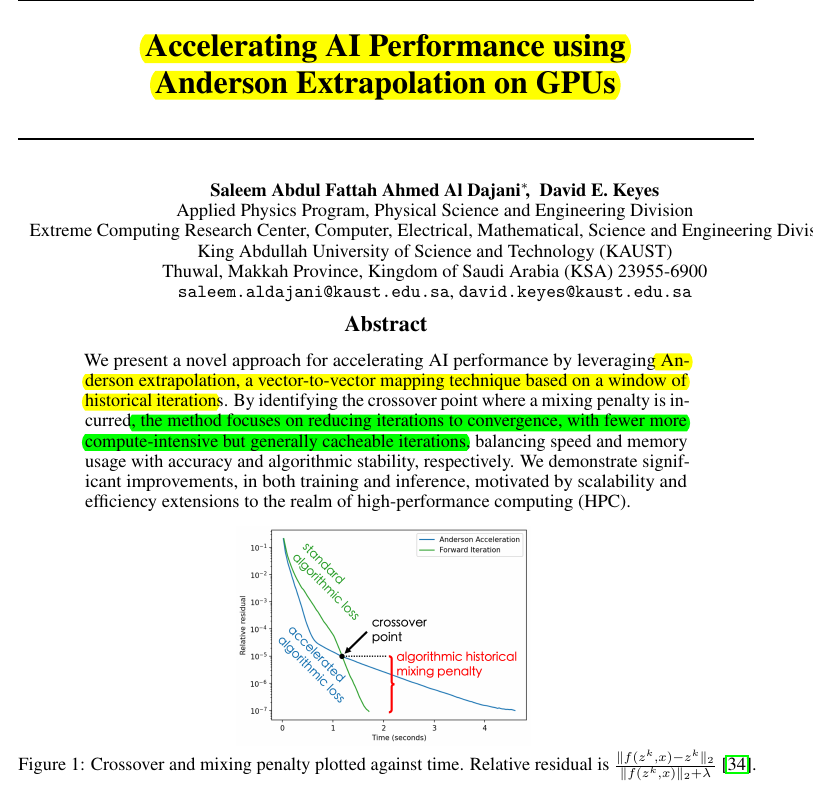
Mathematical optimization (Anderson extrapolation) makes AI training 8x faster with less energy
Accelerates training by upto 8.6x while using upto 88% less compute.
🎯 Original Problem:
AI training consumes massive computational resources, projected to use 2% of global electricity by 2030. Current methods are inefficient and environmentally costly, potentially consuming 160 terawatt-hours annually.
🔧 Solution in this Paper:
• Uses Anderson extrapolation - a vector-to-vector mapping technique using historical iterations
• Implements window-based approach to balance memory usage and speed
• Optimizes linear combination of prior iterates to minimize residual norm
• Incorporates mixing parameter β to balance between previous and current iterations
• Focuses on Deep Equilibrium Models (DEQs) that represent infinite layers in single implicit layer
💡 Key Insights:
• Higher cost per iteration is offset by fewer total iterations needed
• Memory-intensive but cacheable iterations prove more efficient
• GPU implementation significantly outperforms CPU processing
• Balances between accuracy and computational efficiency
• Reduces environmental impact through optimized computation
📊 Results:
• Achieves 50-88% compute savings compared to standard methods
• Delivers 2-8.6x speedup in processing time
• Improves training accuracy from 64.7% to 96.3%
• Enhances testing accuracy from 64.2% to 79.1%
• Reduces training time from 12,000 to 1,400 seconds
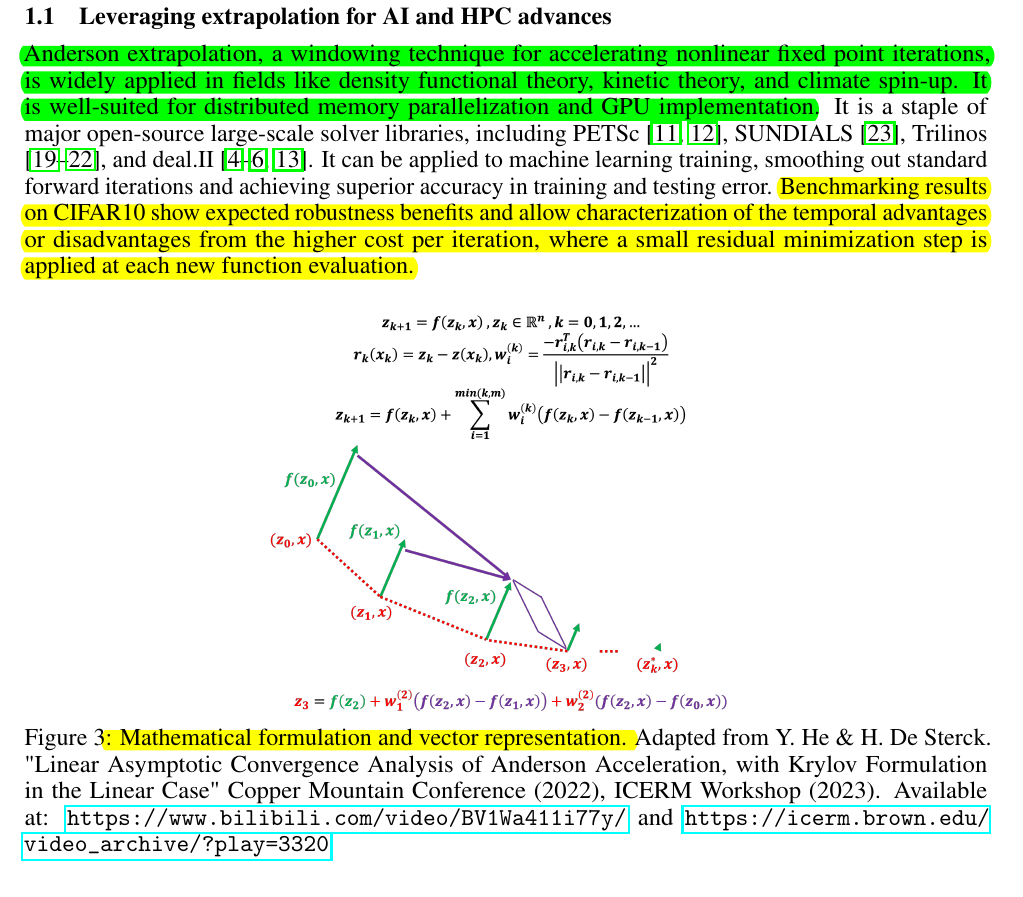
The key components of Anderson acceleration implementation 👨🔧
Fixed-point iteration formula for finding equilibrium state
Linear combination of prior iterates optimized to minimize residual norm
Window-based approach for historical iterations
Mixing parameter β to balance between previous and current iterations.
Generated the below podcast on this Paper with Google's Illuminate, a specialized tool to create podcast from arXiv papers only.