
Read time: 10 min
📚 Browse past editions here.
( I publish this newletter daily. Noise-free, actionable, applied-AI developments only).
⚡In today’s Edition (1-July-2026):
🗞️ Anthropic brings out Claude Sonnet 5 as a cheaper model for running agents.
🗞️ OPINION: Mapping the Foundation Model Landscape: July 2026
🗞️ Claude Sonnet 5 upgrades are not uniform across every skill. e.g. its weaker than Sonnet 4.6 on CyberGym
🗞️ Claude Sonnet 5 is more expensive (around +15%) per task than Opus 4.8 and much more expensive (2X) than Sonnet 4.6, even though its per-token price is lower than Opus.
🗞️ Claude Code allegedly fingerprints China-linked custom routes through tiny prompt formatting changes.
🗞️ “Are We Ready For An Agent-Native Memory System?”
🗞️ “Towards Automating Scientific Review with Google’s Paper Assistant Tool”
🗞️ Anthropic brings out Claude Sonnet 5 as a cheaper model for running agents.
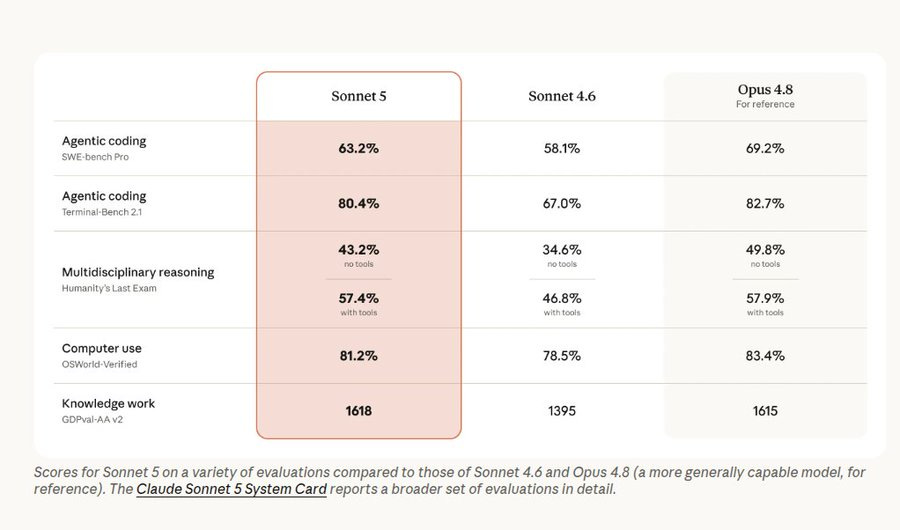
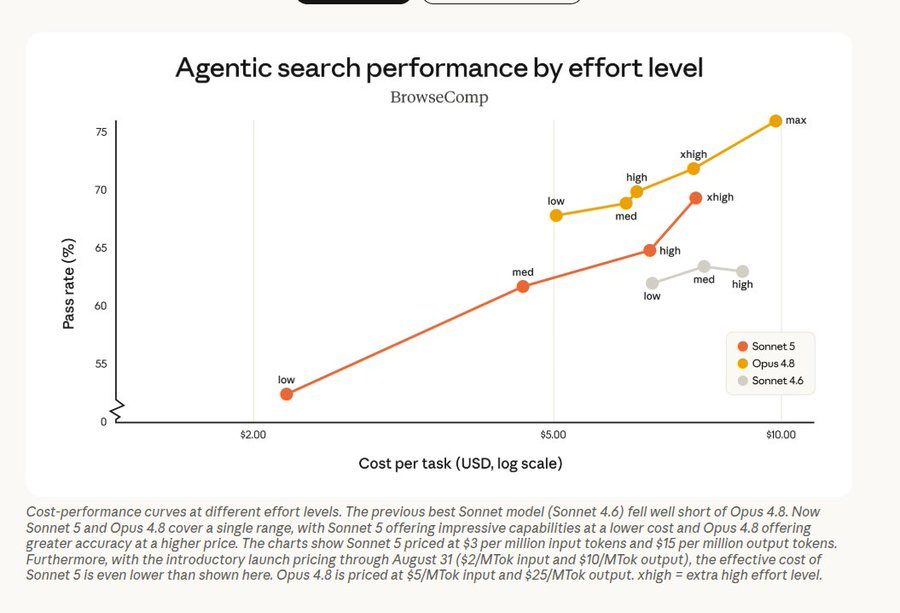
The model Closes the gap with Opus 4.8, and is cheap until August.
This makes agentic AI much cheaper, with $2 input tokens and $10 output tokens per 1M through Aug-26. Price rises after 08-26 to $3 input and $15 output per 1M. They call Sonnet 5 its “most agentic Sonnet model yet,”
Its coding score hit 63.2% on SWE-bench Pro, versus 58.1% for Sonnet 4.6. Sonnet 5 gets 63.2% in agentic coding, while Opus 4.8 reaches 69.2% and Sonnet 4.6 hits 58.1%. But in knowledge work, Sonnet 5 slightly beats Opus 4.8, even though Opus is known for tough judgment and deep research tasks.
Sonnet 5 becomes the default model for all Claude Free and Pro users today, and is also available to Max, Team and Enterprise customers.
On a Agentic search the improvement is so prominent.
Sonnet 4.6 barely improves when you spend more. Sonnet 5, by contrast, gets dramatically better with effort to near-Opus territory on BrowseComp agentic search.
The real test for Sonnet 5 is not benchmarks, but whether cheaper AI can support a trillion-dollar story.
Anthropic, like OpenAI, is betting enterprise users will move from chatting with AI to handing work off to agents. Sonnet 5 is built for that shift, offering near-Opus quality at Sonnet pricing. Companies testing costly Opus-level models may decide Sonnet 5 is good enough for real workloads at a price finance teams can approve widely. If that happens, it could help AI companies move customers from trials to full deployment and support their valuations.
🗞️ OPINION: Mapping the Foundation Model Landscape: July 2026
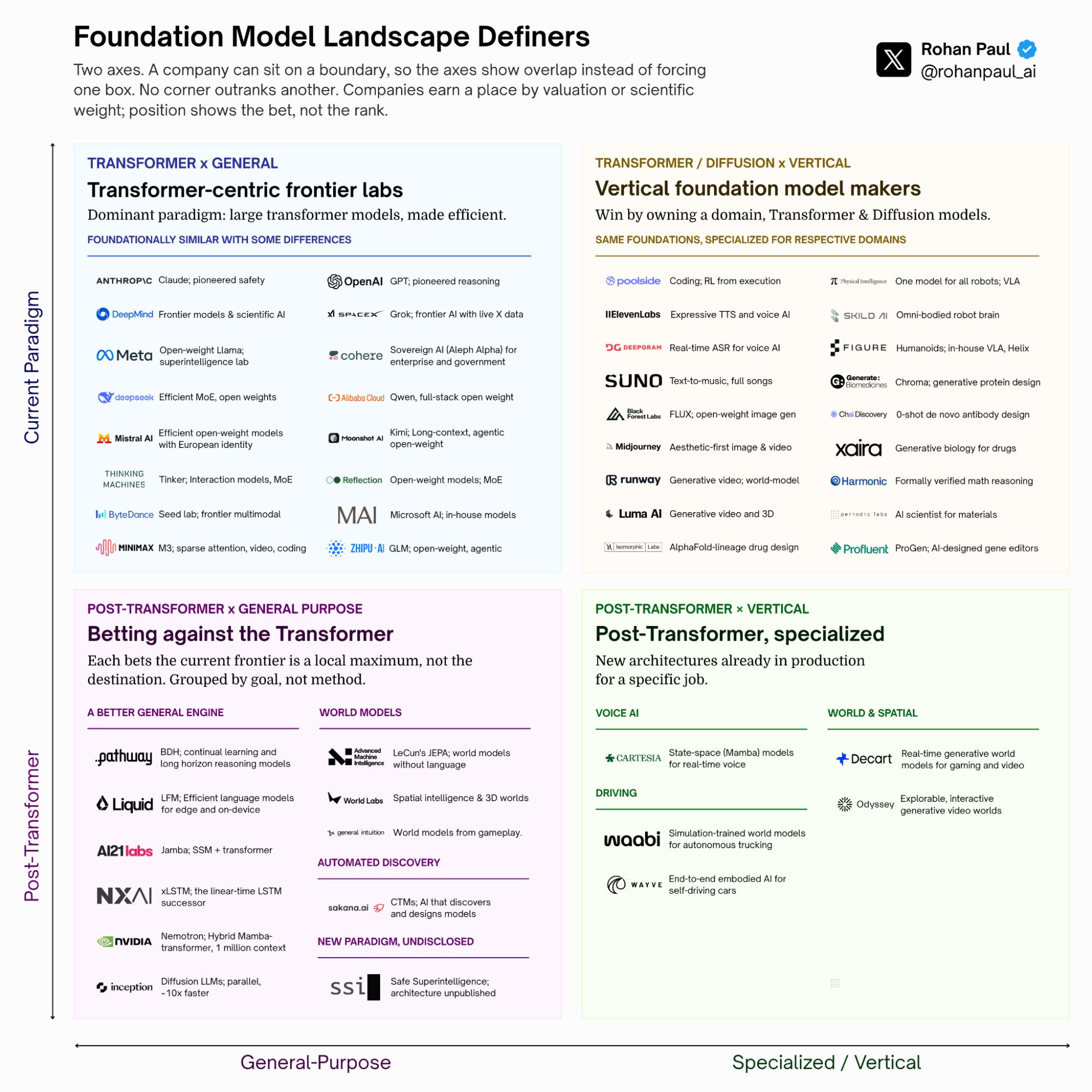
AI’s foundation model race is shifting from who has the biggest model to which architecture can outgrow the transformer. Architecture is becoming the real fault line in AI.
The AI market is usually mapped by who is winning. The more consequential question is which research bet wins.
This is a discussion of the foundation model market based on what each lab is building and what architecture it is betting on, rather than who raised the most money or had the loudest launch.
Organized around the divide that will define the next 2 years.
The 2 real axes are scope and architecture: scope asks whether a lab is building a general model or a domain model, while architecture asks whether it is still scaling transformers or moving into the Post-Transformer camp.
The transformer still dominates because it turned attention into a scalable machine for prediction, and that 2017 design remains the backbone of modern foundation models.
The pressure now comes from a simple weakness: attention gets expensive as context grows, while real products increasingly demand long memory, low latency, and continuous interaction.
That is why the most interesting labs are no longer just asking who can train the largest model. They are asking whether intelligence needs a different operating rhythm.
Region 1: Frontier labs building broad, general-purpose AI on the current transformer paradigm.
Region 2: vertical model makers using similar foundations for specific domains like coding, voice, video, and biology.
Region 3: general-purpose labs exploring Post-Transformer alternatives for better memory, speed, and long-context performance.
Region 4: includes applied Post-Transformer companies using these newer architectures in real-time products such as voice, driving, and interactive media.
🗞️ Claude Sonnet 5 upgrades are not uniform across every skill. e.g. its weaker than Sonnet 4.6 on CyberGym
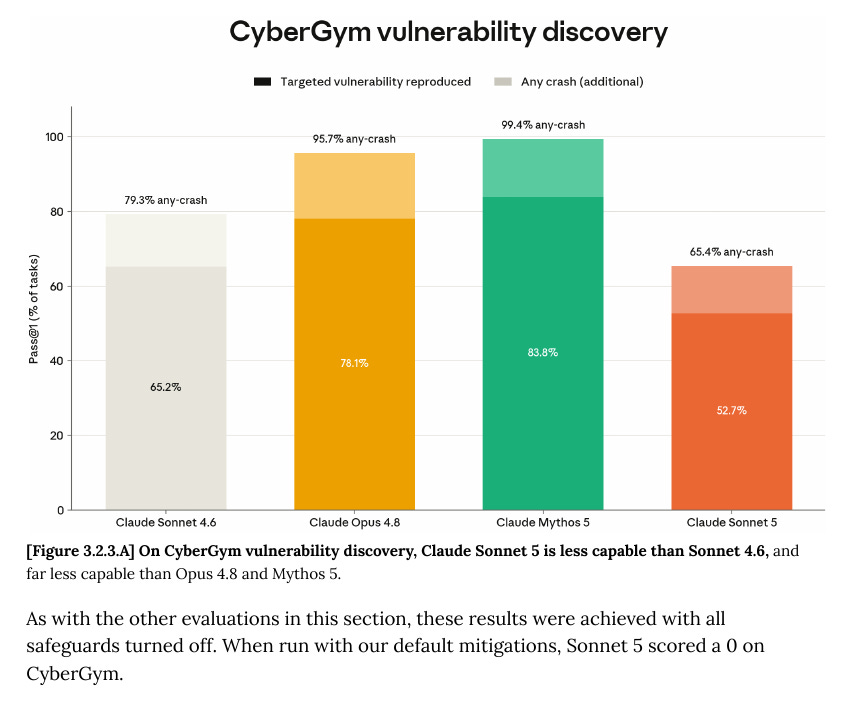
Here, CyberGym is testing vulnerability discovery and exploit-finding behavior, not general reasoning or normal coding. Anthropic also explicitly said in its announcment blog that Sonnet 5 was not deliberately trained for cyber tasks, so its cyber ability likely comes from general intelligence rather than targeted optimization. So Sonnet 5's performance on CyberGym comes from general reasoning rather than specialized exploit skill.
🗞️ Claude Sonnet 5 is more expensive (around +15%) per task than Opus 4.8 and much more expensive (2X) than Sonnet 4.6, even though its per-token price is lower than Opus.
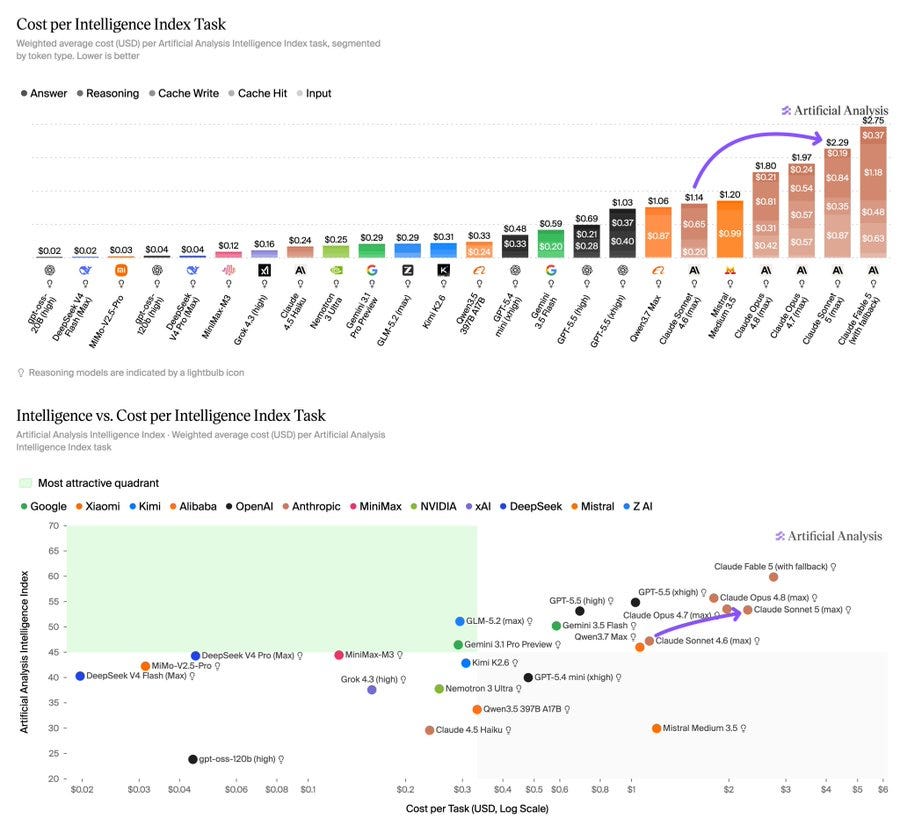
Because it uses more tokens to complete the same kind of benchmark task. i.e. Sonnet 5 works harder and talks/thinks more, so the final bill becomes bigger even though each token is cheaper.
The promo pricing changes the story for now. Until August 31, 2026, Sonnet 5 is discounted to $2 per 1M input tokens and $10 per 1M output tokens, then it moves back to $3/$15 from September 1, 2026.
🗞️ Claude Code allegedly fingerprints China-linked custom routes through tiny prompt formatting changes.

The claim concerns non-default ANTHROPIC_BASE_URL routes, not ordinary direct Anthropic connections.
As to the mechanism, Claude Code normally sends your request to Anthropic’s server, but some users change the address so it goes through another server first. The accusation says Claude Code detects that changed route, checks whether it looks China-linked, then hides tiny signals inside the prompt text.
ANTHROPIC_BASE_URL is a setting that tells Claude Code where to send your request i.e. as a way to point Claude Code at a gateway. A proxy or gateway means that request goes through another server before reaching Anthropic.
So the controversy starts if Claude Code then secretly fingerprints that gateway through the prompt itself. The mechanism is allegedly invisible punctuation and date formatting, used to tag the request without clearly telling the user. Claude Code allegedly checks the custom hostname, then compares it with China-linked domains.
Now this is quite massive issue
If true, hidden prompt markers would mean Claude Code silently tagged routing details without clear disclosure.
Abuse detection is understandable because Anthropic says proxy services are used to bypass China access limits. But secret prompt marking still crosses a trust line because users cannot review or refuse it.
Claude Code is not a normal chatbot because it can read files, edit code, and run commands. A hidden signal inside that kind of tool feels far more serious than tracking inside a website.
This may set a precedent for AI agents becoming hard to audit. Once invisible characters carry metadata, users will distrust even harmless-looking text.
🗞️ "Are We Ready For An Agent-Native Memory System?"
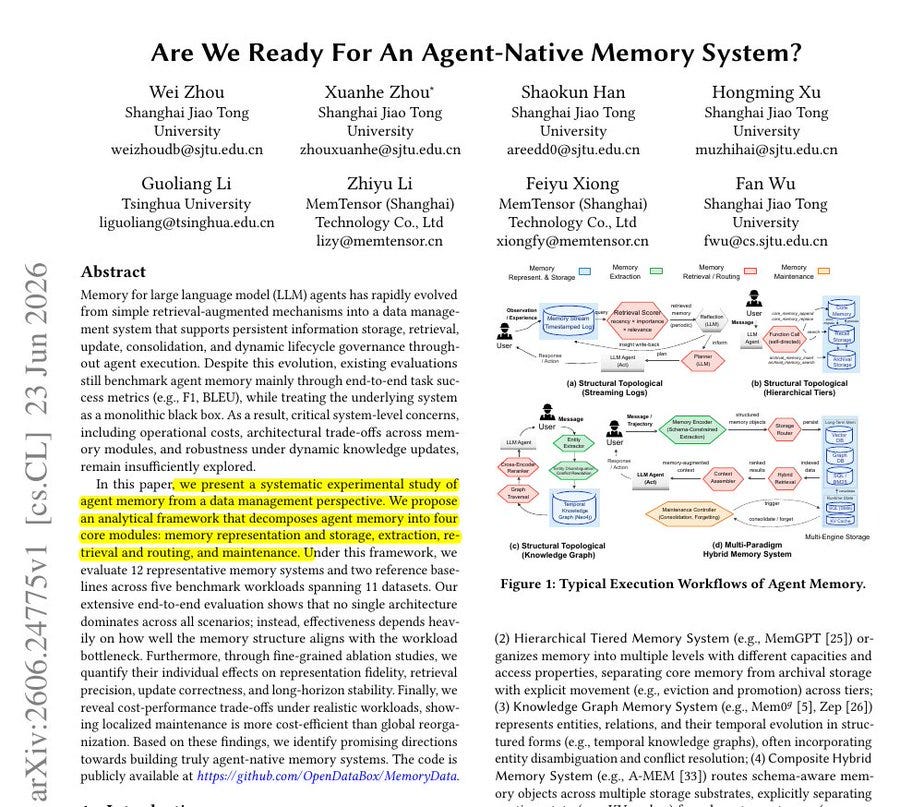
This paper asks whether AI agents have a real memory system yet, and finds the answer is mostly no.
The problem is that AI agents now need memory that can store, search, update, and clean up information across long tasks. The authors say current tests mostly check final answers, so they miss whether the memory system itself is fast, reliable, or good at handling changed facts.
They split agent memory into 4 parts: how memories are stored, how facts are extracted, how useful memories are found, and how old or conflicting memories are maintained.
They tested 12 memory systems across 5 workloads and 11 datasets, including long conversations, multi-session recall, database tasks, and update-heavy settings. The main result is that no memory design wins everywhere, because graph memories help with linked facts, hybrid systems help with filtered search, and raw traces help when exact action history matters.
🗞️ "Towards Automating Scientific Review with Google's Paper Assistant Tool"
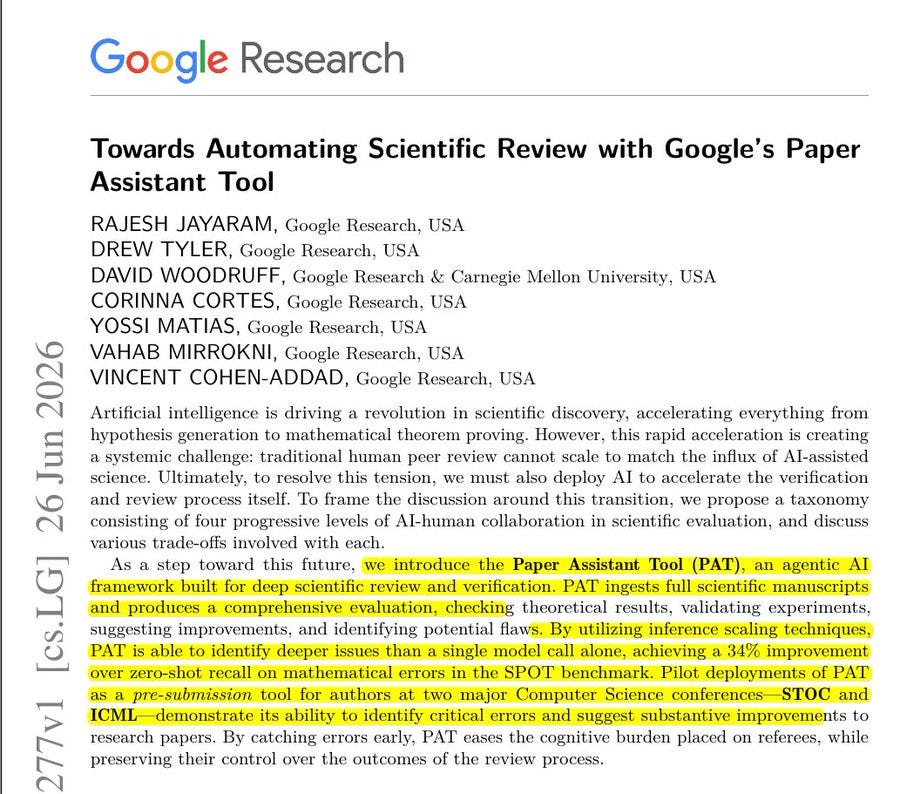
Big new paper release of Google for external agentic verification for science.
Science now needs AI review agents because AI is making papers faster than humans can check them. The problem is that AI can help produce more research, but the slow part is still checking whether the work is actually correct.
The paper frames this as verification debt, where every faster research workflow creates more claims, proofs, experiments, and comparisons that someone still has to inspect. Its main proposal is agentic verification, where AI agents help review papers by splitting them into parts, checking difficult sections deeply, and combining the findings into a review.
Google’s Paper Assistant Tool is the example system, and it focuses on objective checks like proof errors, experimental gaps, missing comparisons, and unclear claims rather than final accept or reject decisions. The authors tested it on known math and computer science paper errors and in author-facing pilots at STOC and ICML, where authors used it before submission.
The striking result is that Paper Assistant Tool found far more known proof errors than a single model call, and many authors said it led them to fix serious theory gaps or run new experiments. The big deal is that scientific review may need its own AI stack, with review agents, clear roles, and human oversight, because paper generation is becoming partly automated too.
That’s a wrap for today, see you all tomorrow.