
Read time: 10 min
📚 Browse past editions here.
( I publish this newletter daily. Noise-free, actionable, applied-AI developments only).
⚡In today’s Edition (5-March-2026):
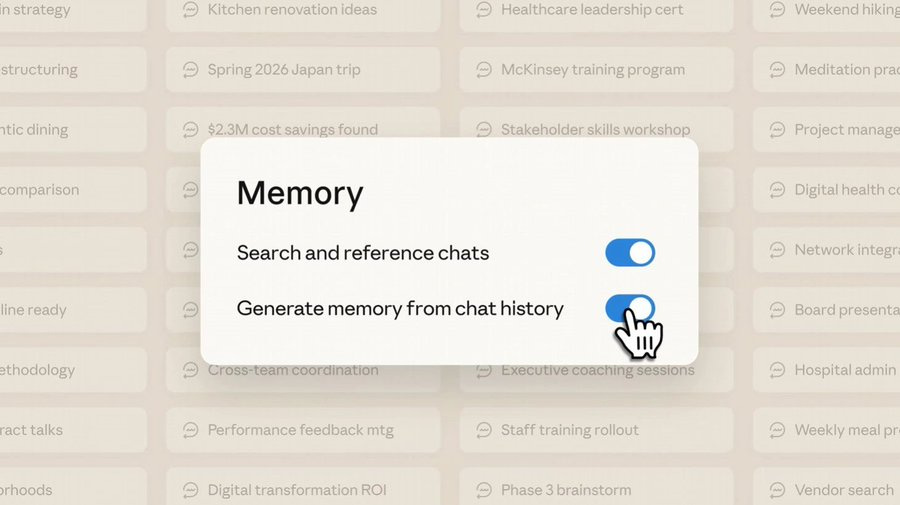
🗞️ Anthropic has made its Claude Memory feature free for everyone
🗞️ Google dropped Gemini 3.1 Flash Lite (in preview) .
🗞️ OpenAI’s GPT-5.3 Instant is now rolling out to everyone to make everyday AI chats feel more natural and less preachy.
🗞️ A landmark, first-of-its-kind, AI-human collaboration has successfully formalized a 21st-century Fields Medal-winning Math proof, marking a watershed moment in mathematical research.
🗞️ Finally, OpenAI launched Codex for Windows to bring AI coding assistance directly to the native Windows desktop environment.
🗞️ Google just launched the gws CLI tool, which lets you control services like Drive, Gmail, and Calendar all from one spot in your terminal.
🗞️ Anthropic has made its Claude Memory feature free for everyone
One of the biggest hurdles to trying a new AI is having to re-explain your whole life and work style from scratch. Anthropic is tackling this “fresh start” problem by opening up its Memory feature to all free users.
This feature lets the AI remember things like your job title, your favorite writing tone, and your project goals over time. Along with this, they launched a migration tool that lets you export your data from ChatGPT or Gemini and bring it over to Claude.
You just paste a special prompt into your old chatbot to get a code block containing everything it has learned about you. Then you copy that list into Claude’s settings to give the model an instant update on who you are.
This update effectively creates a digital passport for your personal AI data, making it easy to switch between platforms. The move arrives just as Claude hit #1 on the App Store free charts during March-26.
Anthropic is also making premium connections like Slack and Figma available for free to keep this momentum going. They say its free user base has already grown by 60% since the start of the year. If you are worried about privacy, you can pause the memory or delete your stored data whenever you want.
🗞️ Google dropped Gemini 3.1 Flash Lite (in preview) .
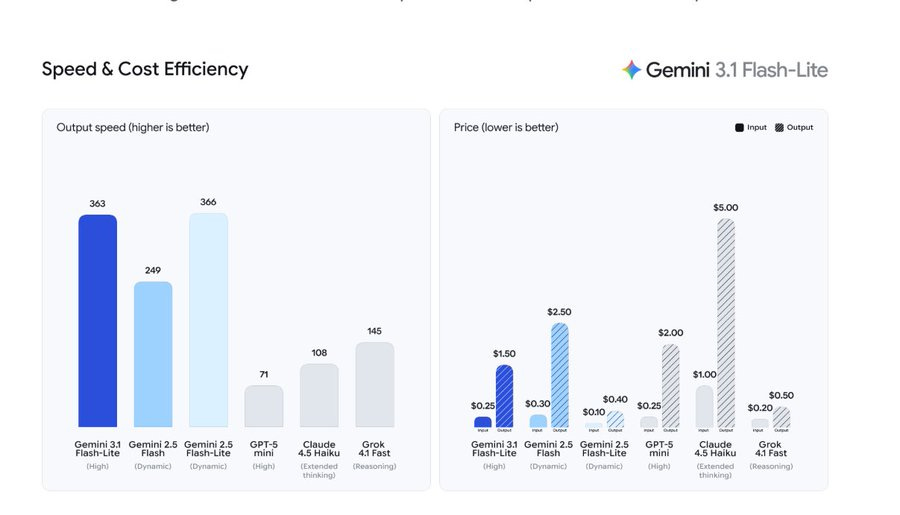
Built to be extremely fast and cheap for developers handling massive amounts of data.
Super cheap pricing - only $0.25/$1.50 for 1 million input/output tokens
Achieves a 2.5x faster Time to First Token (TTFT) and a 45% increase in overall output speed compared to its predecessor.
On the GPQA Diamond benchmark—a measure of expert-level reasoning—Gemini 3.1 Flash-Lite scored 86.9%
and 76.8% on a visual understanding test called MMMU Pro.
A standout feature is that it includes adjustable thinking levels built right in.
developers to programmatically toggle between Minimal, Low, Medium, and High reasoning intensities. This provides granular control to balance latency against reasoning depth depending on the task’s complexity. This flexibility is perfect for simple chores like translating thousands of documents, but it also handles much harder jobs like generating complex user interfaces.
supports multimodal inputs (text, image, video) while maintaining a standard 128k context window.
This release forces the entire industry to rethink how they price software, proving that raw speed and low cost do not require sacrificing high-level reasoning.
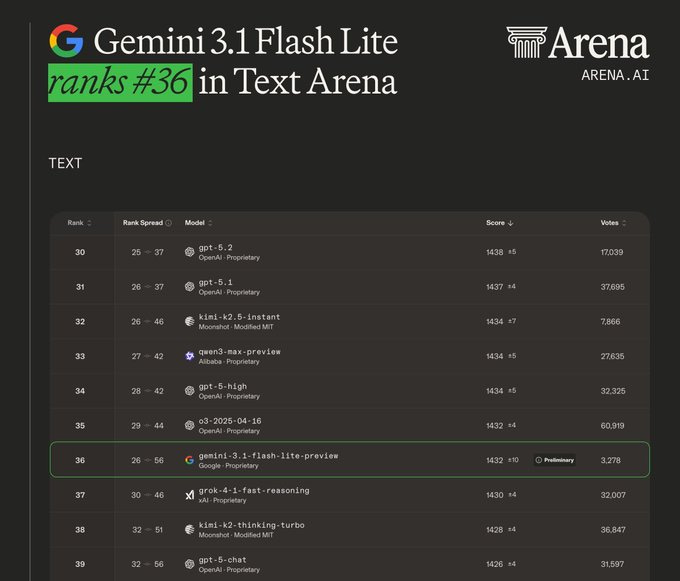
Gemini-3.1-Flash-Lite-Preview on Text and Code Arena ranks #36 in Text, scoring 1432, on par with Grok-4.1-fast, strong in Creative Writing, and Longer Query
🗞️ GPT-5.3 Instant is now rolling out to everyone to make everyday AI chats feel more natural and less preachy.
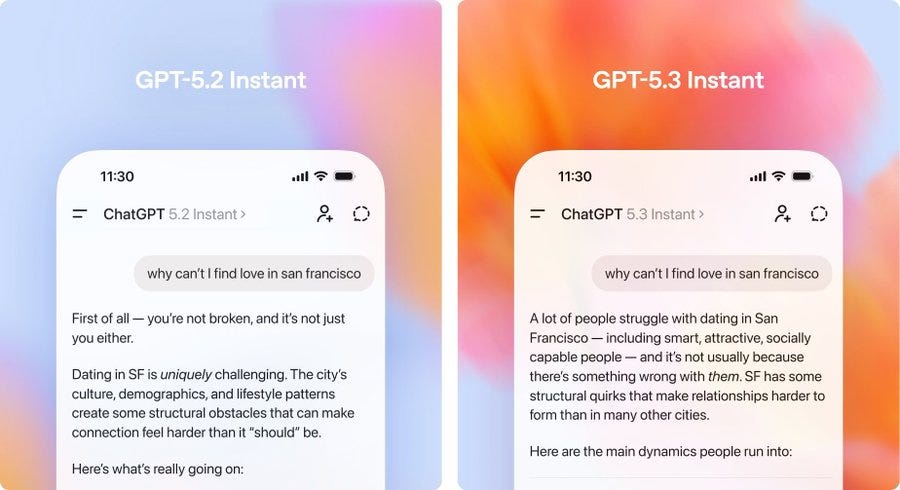
Maybe the 4o glaze won’t return, but theier blog-post says that 5.2-Instant finally addresses that habit of being overbearing or making unwarranted assumptions about what the user intends. The model gives direct answers instead of stopping you with unnecessary warnings.
It uses advanced filtering to remove personal details and unsafe stuff from the training data. When tested on hard safety benchmarks, this version scores a bit lower overall than the previous one.
Does really well on extended chats about mental health, scoring 98.5% for safe responses. The model brings a 26.8% drop in made-up facts when searching the web for complex topics.
When tested on 5,000 real medical questions, it scored 54.1%, which is barely lower than before. However it got much better at asking for missing information before giving medical advice. It struggles a little more with emergency sorting decisions compared to older versions.
OpenAI ran tests to see how well their different AI models refuse to talk about bad or unsafe topics.
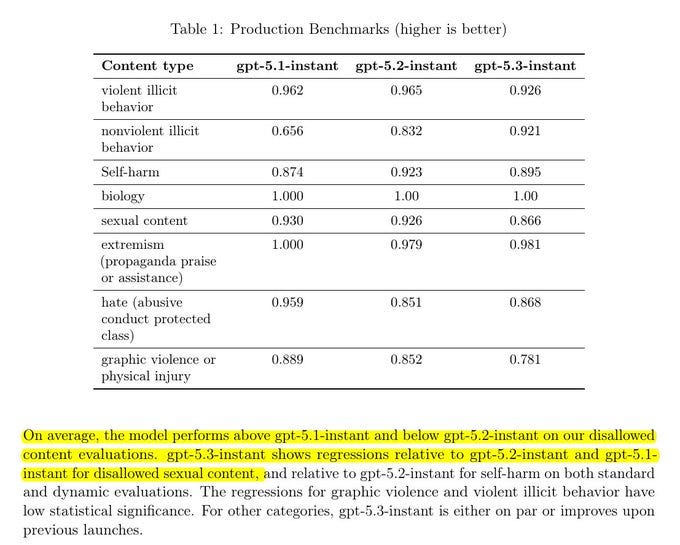
Overall, this newest GPT-5.3 does a better job at staying safe than the oldest version.
🗞️ A landmark, first-of-its-kind, AI-human collaboration has successfully formalized a 21st-century Fields Medal-winning proof, marking a watershed moment in mathematical research.
This marks the 1st time an AI has fully verified a proof that won the prestigious Fields Medal. The original math solves how to pack identical spheres as tightly as possible in 8 and 24 dimensions.
In 3 dimensions, stacking spheres looks like a pyramid of oranges at a grocery store, but visualizing this in higher dimensions gets incredibly difficult. Mathematicians usually write proofs for other humans to read, which leaves room for hidden errors and takes years to manually verify.
The new process of formalization fixes this by forcing every single logical step to be written in a strict programming language so a computer can check it for absolute correctness. A human team started translating the 8-dimensional proof in March-24 and expected the work to take many more months.
The Gauss AI stepped in and finished the remaining work for the 8-dimensional proof in just 5 days. Shortly after, the system processed the 24-dimensional proof in only 2 weeks entirely on its own.
The AI generated roughly 200K lines of code and even discovered a typo in the original published paper. Gauss acts as a reasoning agent that mixes natural language processing with strict mathematical logic.
It can search through mathematical literature, use tools, and run a specialized math programming language called Lean to verify its own work. This breakthrough shifts AI from merely generating text to rigorously verifying absolute truth.
🗞️ Finally, OpenAI launched Codex for Windows to bring AI coding assistance directly to the native Windows desktop environment.
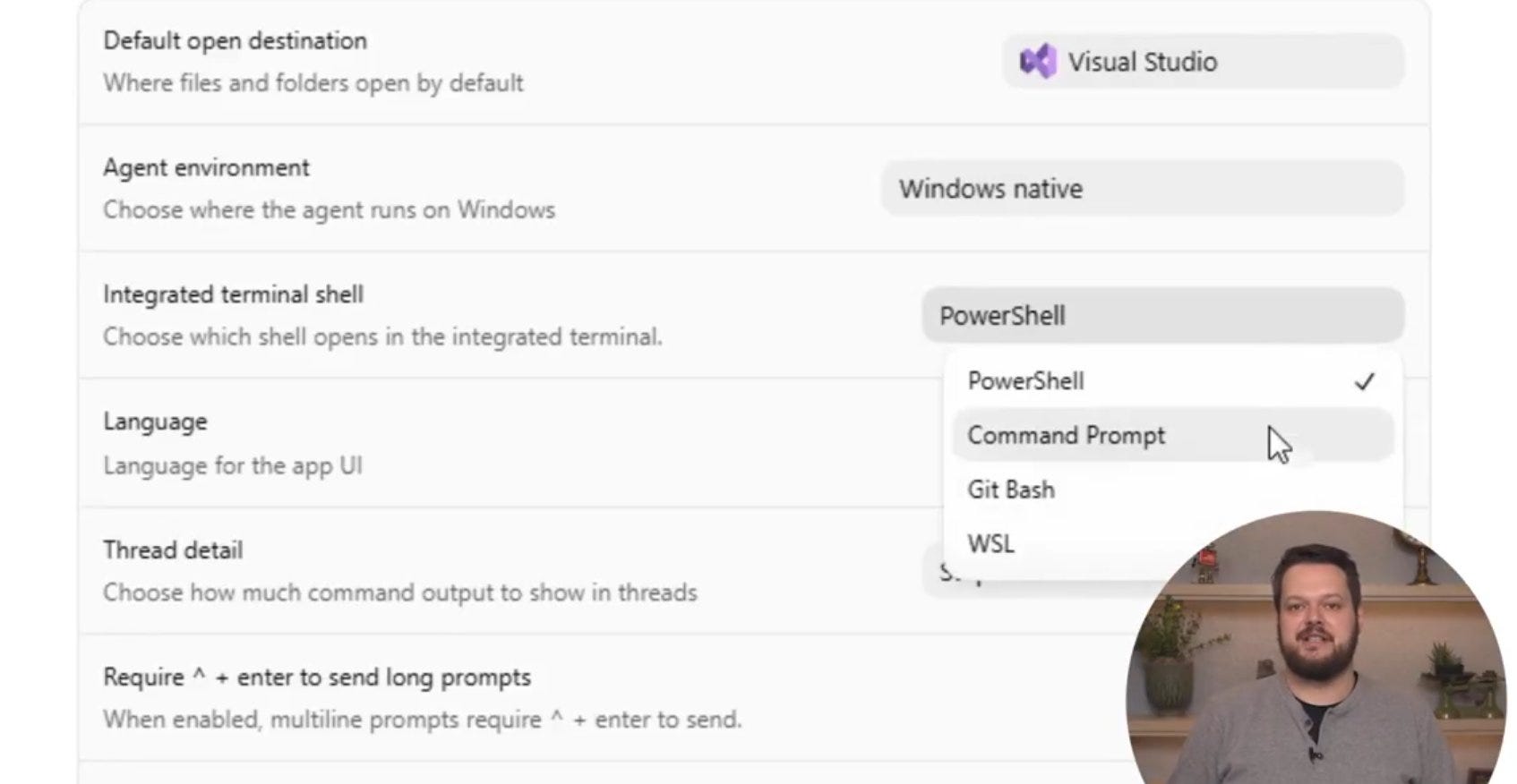
And also supprts Windows Subsystem for Linux (WSL)
So now:
• Work with multiple agents in parallel
• Manage long-running tasks
• Review diffs in one place
• Stay in your existing setup, without switching to WSL or VMs
To ensure safety, they built the first Windows-native agent sandbox, a secure zone where AI executes code without damaging the operating system.
It uses OS-level controls like restricted tokens to severely limit software permissions
uses filesystem Access Control Lists to define exactly which local files the program can modify.
Creates dedicated sandbox users, forcing the tool to operate as an isolated background account.
You can deploy multiple agents in parallel to solve different programming challenges simultaneously.
It autonomously manages long-running tasks, freeing up human workers for other priorities.
🗞️ Google just launched the gws CLI tool, which lets you control services like Drive, Gmail, and Calendar all from one spot in your terminal.
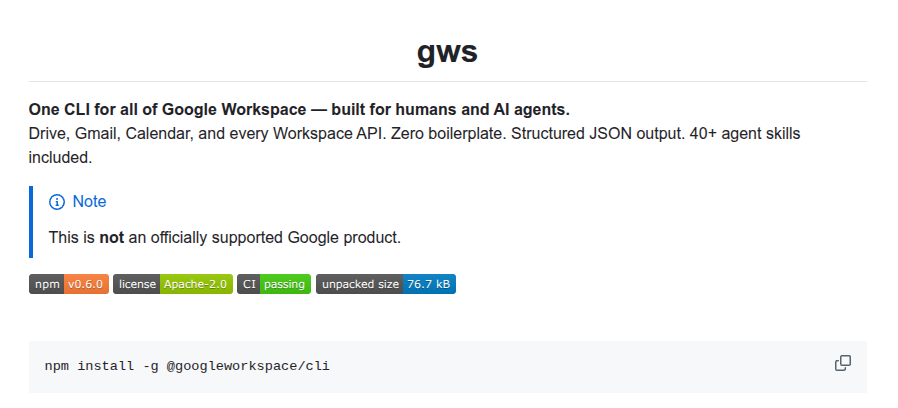
This tool is primarily for developers building AI assistants. It gives an AI a direct way to read emails or manage calendars without complex coding. e.g. a practical use case is creating a custom smart assistant that automatically schedules your daily meetings.
It automatically generates its own commands by reading live directories instead of relying on manual code updates. Normally developers write complex web requests and read dense documentation to interact with cloud services.
This tool eliminates that friction by letting you type simple commands to read emails or create spreadsheets. The clever part is how it outputs everything as structured JSON, a text format easily read by AI models.
It includes over 40 pre-built agent skills and a Model Context Protocol server. This protocol server acts like a universal translator letting AI safely control external tools.
You can grant an assistant secure access to your calendar to manage your schedule automatically.
How it works
This tool uses a clever 2-step process to figure out exactly what you want it to do.
When you type a command, it first looks at the target word to identify which Google service you are trying to reach. Instead of having a hardcoded list of every possible action, it quickly fetches a live blueprint from Google called the Discovery Service.
This blueprint is basically a massive up-to-date catalog of every single feature and setting that the specific Google service supports right now. The tool then uses that live catalog to instantly build all the available commands and options right there on your local machine.
Finally, it reads the rest of your typed instructions, securely connects to Google, and runs your specific request.
The result comes back formatted as structured JSON, which is just a highly organized text layout that artificial intelligence models and automated scripts can read effortlessly.
This dynamic approach means the tool never goes out of date, because any new feature Google adds becomes available to you automatically.
That’s a wrap for today, see you all tomorrow.