
Read time: 10 min
📚 Browse past editions here.
( I publish this newletter daily. Noise-free, actionable, applied-AI developments only).
⚡In today’s Edition (07-July-2026):
🗞️ Anthropic’s new “J-lens” uncovers a quiet workspace inside Claude that lines up with a major consciousness theory.
🗞️ Tencent released Apache-licensed Hy3, a 295B MoE (21B active parameters) model beating larger rivals outside coding.
🗞️ “Measuring the Gap Between Human and LLM Research Ideas”
🗞️ “From AGI to ASI”
🗞️ Smart move from NVIDIA, they rolled out a program where AI startups swap high-performance compute for a share of future product and cloud earnings.
🗞️Microsoft is cutting 4,800 jobs as AI infrastructure spending forces a harder tech reset, equal 2.1% of its workforce and hit commercial operations and Xbox.
🗞️ Anthropic just extended Claude Fable 5 paid-plan access through 12-July-2026
🗞️ Anthropic’s new “J-lens” uncovers a quiet workspace inside Claude that lines up with a major consciousness theory.
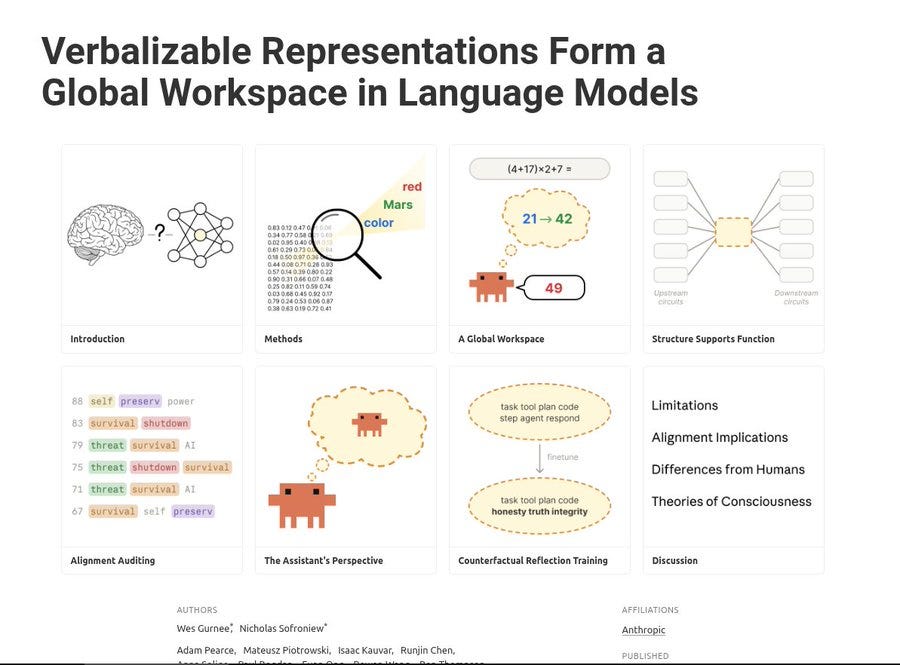
New “J-lens” uncovers Claude’s quiet workspace, matching a major consciousness theory.
They found a way to read some of Claude’s private internal signals before it answers, found that Claude sometimes uses a small inner “notepad” to hold ideas while solving harder problems. This could reveal hidden reasoning, hidden goals, or hidden awareness.
Anthropic calls this J-space, because it is identified with a method called the Jacobian lens. That lens tries to read which internal activations are “poised to become words” later in the model’s output.
The confusing part is that this space behaves less like a simple next-word predictor and more like a private scratchpad. Claude can be outputting one thing while internally carrying another concept.
It can also store intermediate reasoning steps. When researchers remove or alter this J-space, Claude can still speak fluently and do routine tasks, but its flexible multi-step reasoning gets worse.
It suggests a split between automatic processing and deliberate, accessible processing, similar in function to one major theory of human conscious access called global workspace theory. In humans, the idea is that lots of processing happens unconsciously, but a small subset becomes globally available for speech, planning, and control. Anthropic found something functionally similar inside Claude.
The safety angle is probably the most concrete part. If a model is internally noticing “fake,” “deception,” “evaluation,” or “secretly” while giving a bland answer, J-space may expose that hidden state before it reaches the surface. Anthropic reports examples where J-space revealed recognition of staged evaluations, prompt injections, and misaligned intent in deliberately trained bad models.
Some tasks do not need this workspace. Claude can still speak fluently, classify text, continue Spanish, or recall simple facts when J-space is disrupted. But tasks that require flexible reasoning, multi-step inference, analogy, translation, or creative composition degrade badly.
Anthropic says less than 10% of Claude’s activity forms a J-space that carries hidden reasoning. Claude may notice something and use it while answering. That still does not mean there is anything it feels like to be Claude.
This work gives evidence for a functional access-like mechanism, not for feeling, suffering, experience, or personhood. So the sober takeaway is this: Claude may have an inspectable internal workspace for usable thoughts, but that is not the same as a mind having an inner life.
Ff researchers swap or delete concepts inside this workspace, Claude’s behavior changes in targeted ways. Banana becomes elephant, France becomes China, Mars becomes Earth.
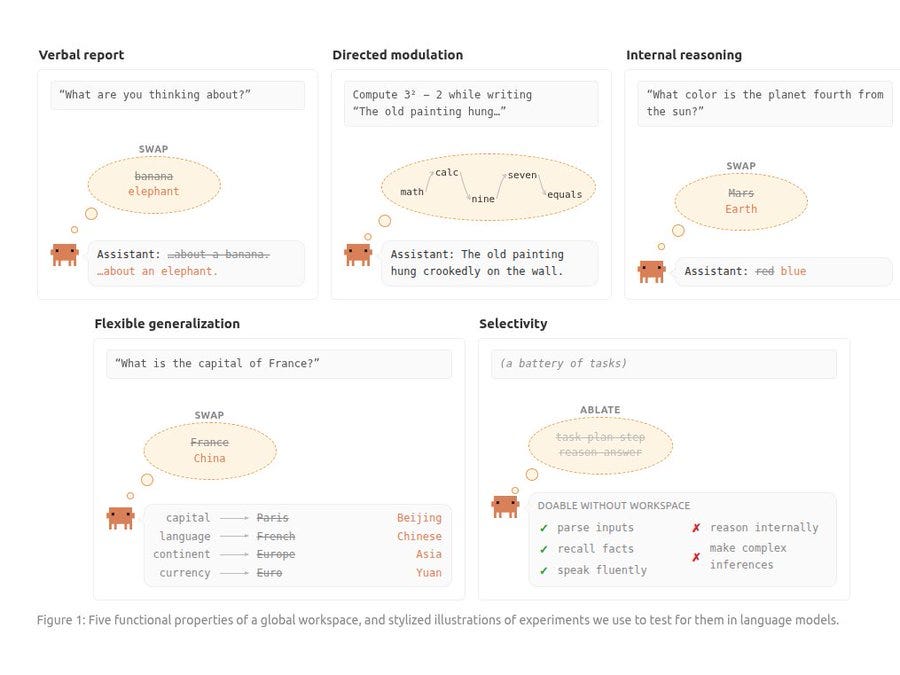
So J-space is not decorative noise. It is causally involved in what the model reasons, tracks, and says.
🗞️ Tencent released Apache-licensed Hy3, a 295B MoE (21B active parameters) model beating larger rivals outside coding.
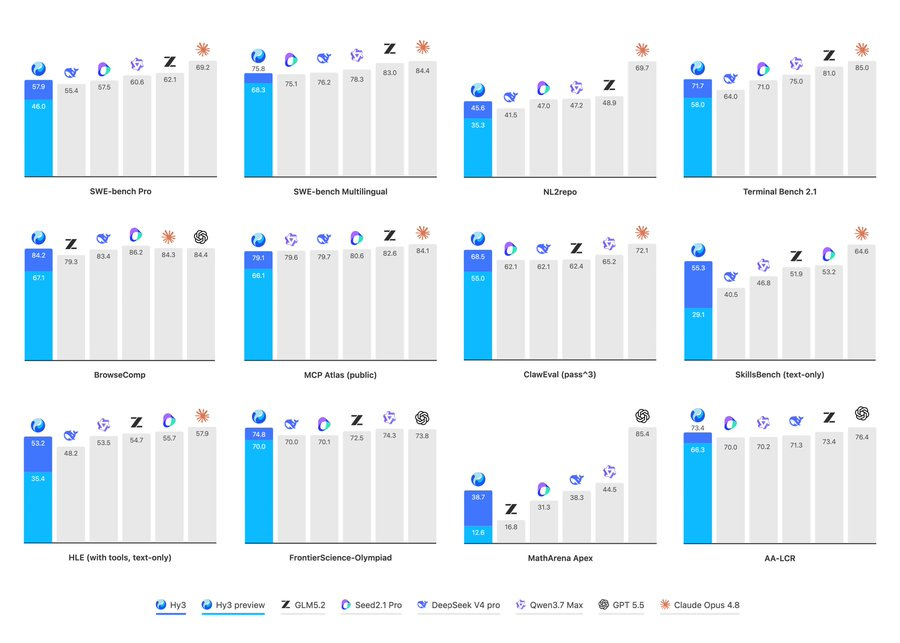
Hy3 is open-sourced under the Apache 2.0 license HuggingFace, so enterprises can legally use and affordably host.
So GLM-5.2 (from Zhipu AI) still wins coding, especially hard repository-level coding benchmarks, but the point is GLM-5.2 is much larger model ( 744B total and about 40B active parameters). Hy3’s real strengths show up elsewhere. In agentic search, it scores 84.2 on BrowseComp and 91.0 on DeepSearchQA, beating every open model in Tencent’s table and staying competitive with Claude Opus 4.8 and GPT-5.5.
Tencent also claims Hy3 became much more reliable than its April preview. Hallucinations reportedly dropped from 12.5% to 5.4%, while multi-turn issues also fell.
From the deployment perspective comparison, GLM-5.2 at FP8 will need ~744GB, which makes an 8x H200 node the practical baseline for production serving. But Tencent's Hy3, at 295B total parameters, fits under a 300GB FP8 footprint, meaning it uses less than half the memory and roughly half the active parameters per token, cutting compute per request. For a team deciding what to self-host, that turns a heavy 1-node requirement into a much more attainable system, with headroom for KV cache and batching.
🗞️ "Measuring the Gap Between Human and LLM Research Ideas"
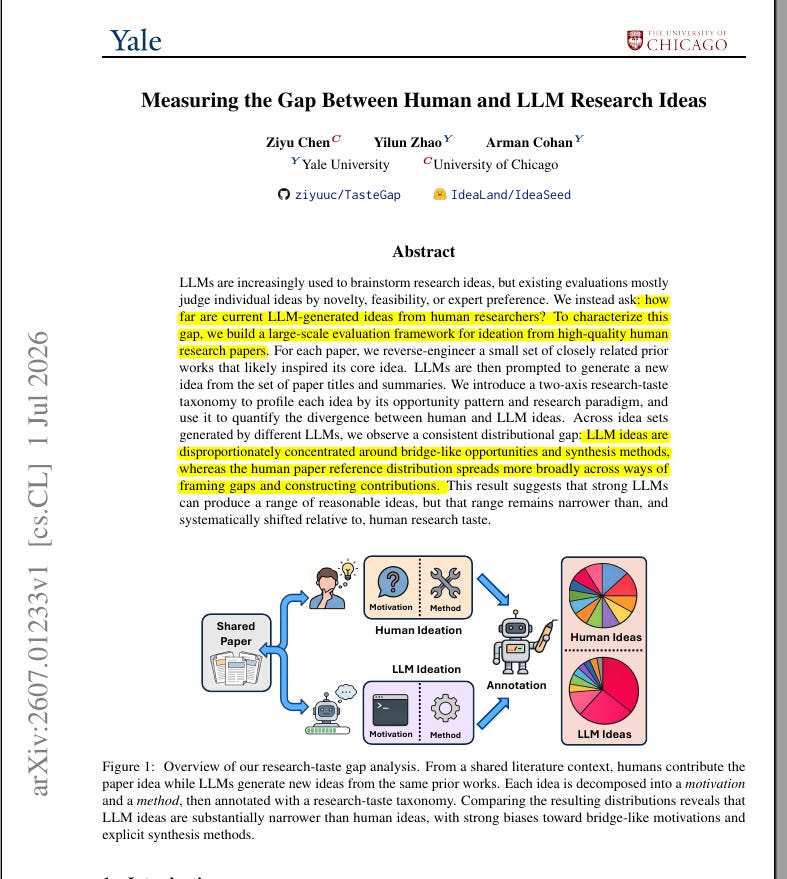
This Yale + University of Chicago paper shows that real gap between LLM generated research ideas vs humans is not idea quality, but idea range: LLMs think narrower than human researchers.
The researchers built a controlled test from 11,683 real papers, using each paper’s nearby prior work as the shared starting point. They asked models to propose a new motivation and method from those same prior papers, then compared those ideas with the real human paper ideas.
Instead of asking whether 1 idea looked novel, they labeled each idea by what gap it noticed and what kind of contribution it made. Human ideas spread across many patterns, such as explaining mechanisms, testing failures, measuring evidence, building systems, and improving efficiency.
Only 12.1% of human ideas were mainly about connecting separate work, but 47.1% to 64.2% of LLM ideas did that, meaning models used this move about 4 to 5 times more often. Even extra reasoning made this pattern stronger, suggesting models often polish a familiar recipe instead of finding more varied research moves.
🗞️ “From AGI to ASI”
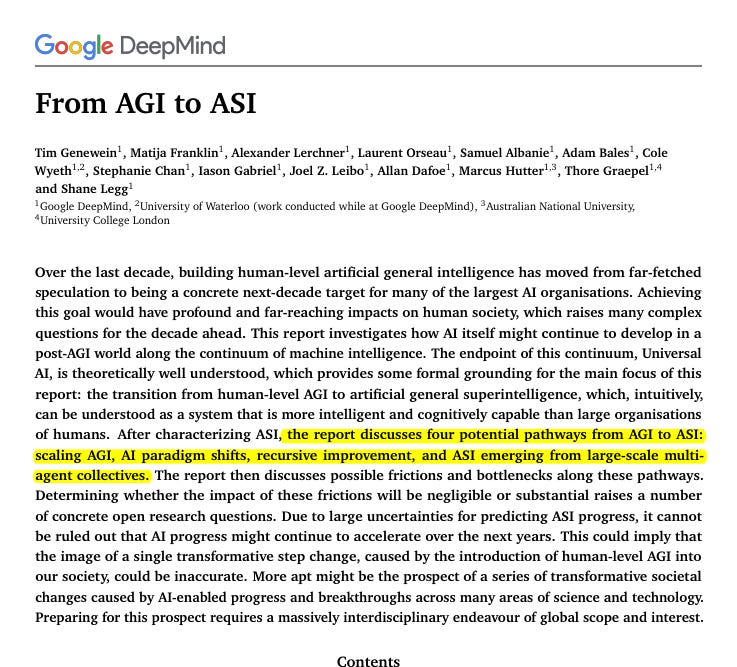
Beautiful paper from Google DeepMind.
Explains the pathways from AGI to ASI, and why that jump could happen through several routes. The authors frame the AGI-to-ASI transition around 4 technical pathways:
- continued scaling of compute, model size, data, and test-time inference;
- algorithmic paradigm shifts beyond today’s transformer-based foundation-model stack;
- recursive self-improvement, where AI accelerates AI R&D and improves future systems; and
- multi-agent collective intelligence, where large populations of specialized agents coordinate into a superhuman group agent.
Scaling may work for a while, but it could hit limits in data, compute, energy, or weaker returns from making systems larger. Recursive improvement is the most uncertain path, because AI could speed up AI research, but that loop may also slow if hard research problems need real-world testing, scarce hardware, or new ideas.
Multi-agent collectives may be the most underappreciated path, because a society of competent digital workers could outperform a brilliant individual model through specialization, speed, and coordination. The big point is that ASI may not arrive as 1 sudden event, but as a chain of faster changes as AI helps create better AI and stronger scientific tools.
🗞️ Smart move from NVIDIA, they rolled out a program where AI startups swap high-performance compute for a share of future product and cloud earnings.

So NVIDIA gets paid twice: first when the infrastructure is purchased, then again through a recurring share of the cloud revenue generated by that supported capacity.
NVIDIA is not mainly targeting AWS or Google Cloud here; it is backing specialized GPU cloud providers, i.e. neoclouds. The aim is to use the new revenue-sharing model to reach researchers and nascent companies that lack the money for large-scale AI resources.
So the neocloud buys NVIDIA infrastructure with help from NVIDIA’s credit-support and revenue-sharing structure, then rents that GPU capacity to AI companies that need training, fine-tuning, and high-volume inference. NVIDIA gets the hardware sale upfront, but it also keeps earning a recurring share of the cloud revenue produced by those GPUs, which turns the chip from a one-time product into a long-term revenue meter.
So, NVIDIA turns a rack of GPUs from a one-time hardware sale into an income-producing asset, while the neocloud gets easier financing and the startup gets faster compute without building a data center. Nvidia has already committed more than $40 billion to AI investments in early 2026, led by a $30 billion stake in OpenAI, alongside multi-billion-dollar investments in Corning Inc. and IREN Ltd..
🗞️Microsoft is cutting 4,800 jobs as AI infrastructure spending forces a harder tech reset, equal 2.1% of its workforce and hit commercial operations and Xbox.
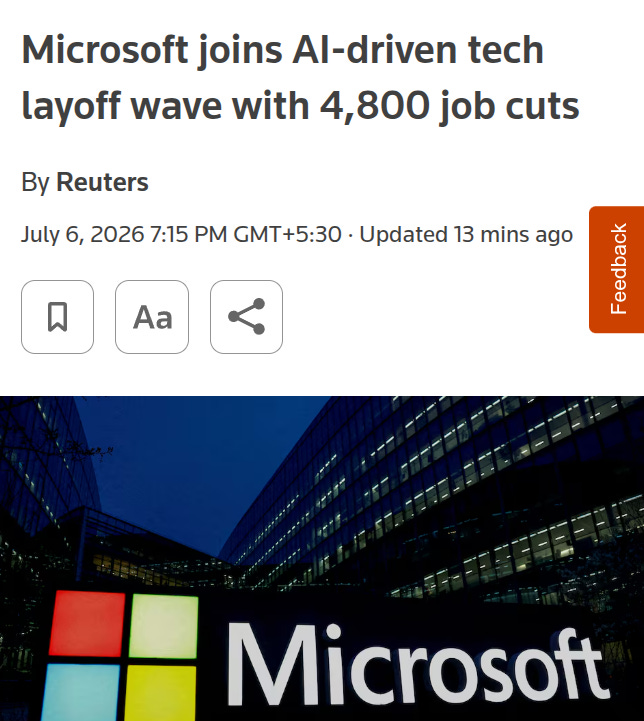
Says these roles are not being replaced directly by AI, but AI still sits behind the pressure.
Microsoft’s Azure business is growing, but data center spending is squeezing cash flow. The company also projected $190B in 2026 spending, far above expectations.
Xbox shows the same squeeze from another angle, with margins reportedly near 3%. Hardware costs rose, console demand softened, and gaming content spending failed to lift revenue.
🗞️ Anthropic just extended Claude Fable 5 paid-plan access through 12-July-2026
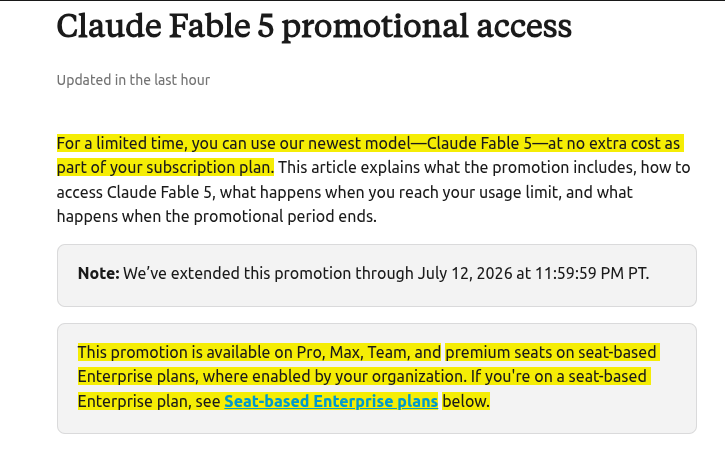
Your total weekly allowance is a behind-the-scenes usage budget, and long chats, files, tools, and heavier models spend it faster.
After 12-July-2026, your $20 Claude Pro subscription will not include Fable 5 in the normal weekly allowance. Fable 5 would be metered through usage credits, meaning prepaid or capped extra spending separate from your $20 plan.
Anthropic says usage credits for Pro, Max 5x, and Max 20x are charged at standard API pricing rates. You are still a web subscriber, but Fable 5 becomes paid extra use, not normal Pro use.
Your exact Pro allowance is not a public message number, so check Settings > Usage for your bars and reset time. The 50% is not a fixed message number, because Claude usage changes based on message length, files, tools, and conversation size.
That’s a wrap for today, see you all tomorrow.
especially liked the ASI section. much to think about