
Read time: 10 min
📚 Browse past editions here.
( I publish this newletter daily. Noise-free, actionable, applied-AI developments only).
⚡In today’s Edition (06-July-2026):
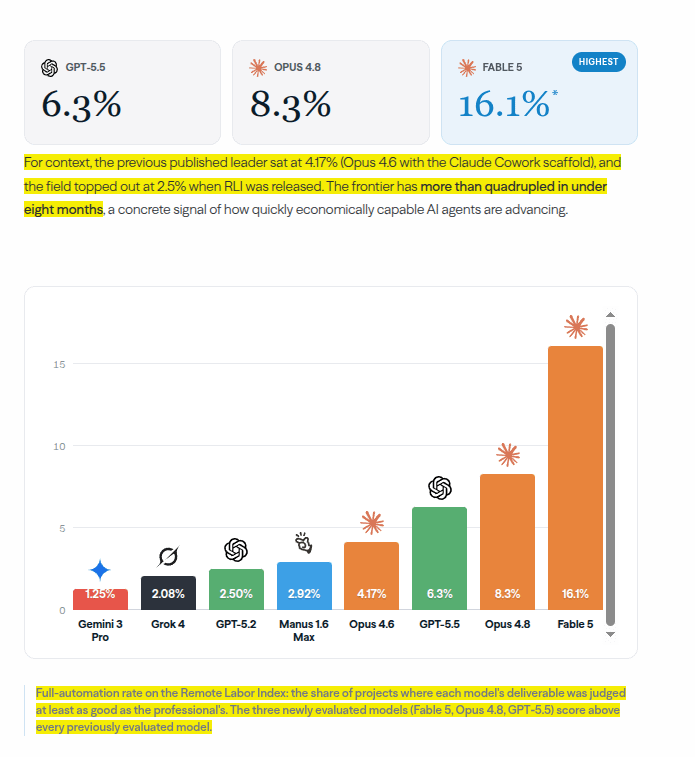
🗞️ CAIS and Scale (AI safety research group) say Fable 5 now automates 16.1% of real remote-work projects, about 2x Opus 4.8.
🗞️ “The ATOM Report: Measuring the Open Language Model Ecosystem”
🗞️ “Cognitive offloading and the speedup illusion in human-AI interaction”
🗞️ By 2027, just 5 companies, Alphabet, Amazon, Meta, Microsoft, and Oracle, are expected to spend around 3.2% of US GDP on AI capital expenditure.
🗞️ AI revenue is scaling 3x quicker than mobile or internet did.
🗞️ Cathie Wood (founder, CEO & CIO of ARK Invest) is saying that productivity improved significantly last year, partly because companies delayed hiring and used more AI instead.
🗞️ Hugging Face Engineer publishes an exhaustive slide presentation on how to train an open coding agent using TRL and OpenEnv
🗞️ CAIS and Scale (AI safety research group) say Fable 5 now automates 16.1% of real remote-work projects, about 2x Opus 4.8.
Remote Labor Index tests whether an AI can finish paid freelance work well enough for a client to accept it.
Each task comes with briefs, files, and a professional deliverable used as the human baseline. Fable 5 led the new results, while Opus 4.8 reached 8.3% and GPT-5.5 reached 6.3%.
That 16.1% number still means failure on most tasks, but the direction of improvement is massive. For the context of how large this jump is, the best model scored only 2.5% when RLI launched.
The work is not toy prompting, since tasks include CAD, architecture, animation, audio, data analysis, and web apps. This means the benchmark is testing computer work across messy tools, not narrow text answers.
Fable 5 looked strongest on examples like ring modeling, animation, and bathroom design. The automated judge ranked models well, but overstated GPT-5.5 by about 2.9x and Opus 4.8 by about 2.3x. The result says AI agents are improving fast, but quality control remains the hard wall.
Another key point is that the model alone is not the whole product anymore. The gains are coming from stronger agent setups: better tool use, full desktop environments, professional software, longer runtimes, and worker-critic loops where 1 agent does the task and another reviews it like a demanding client.
AI judge can track progress directionally, but they miss hidden quality failures that human evaluators catch.
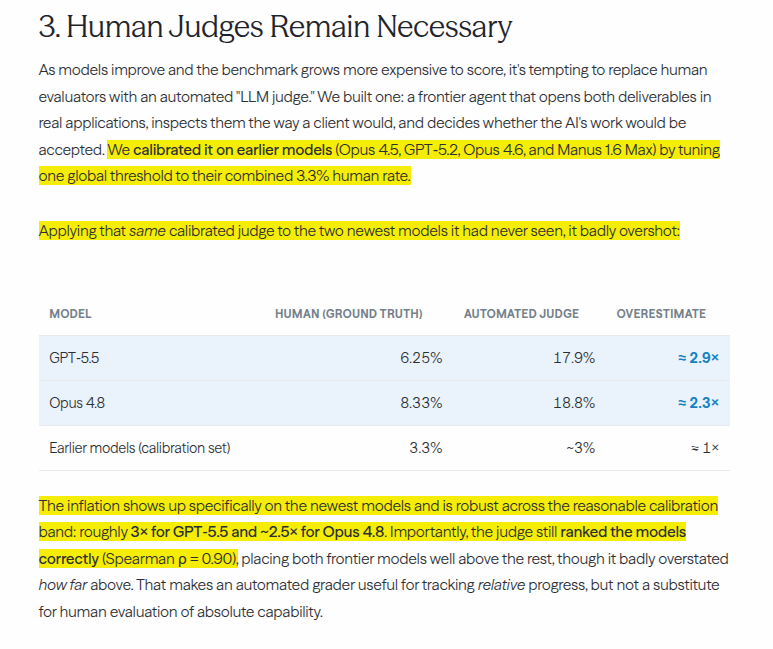
The automated judge matched earlier models at ~3%, but badly overrated newer ones: GPT-5.5 rose from 6.25% human-approved to 17.9%, and Opus 4.8 from 8.33% to 18.8%.
Longer human work did not mean harder AI work across the benchmark.
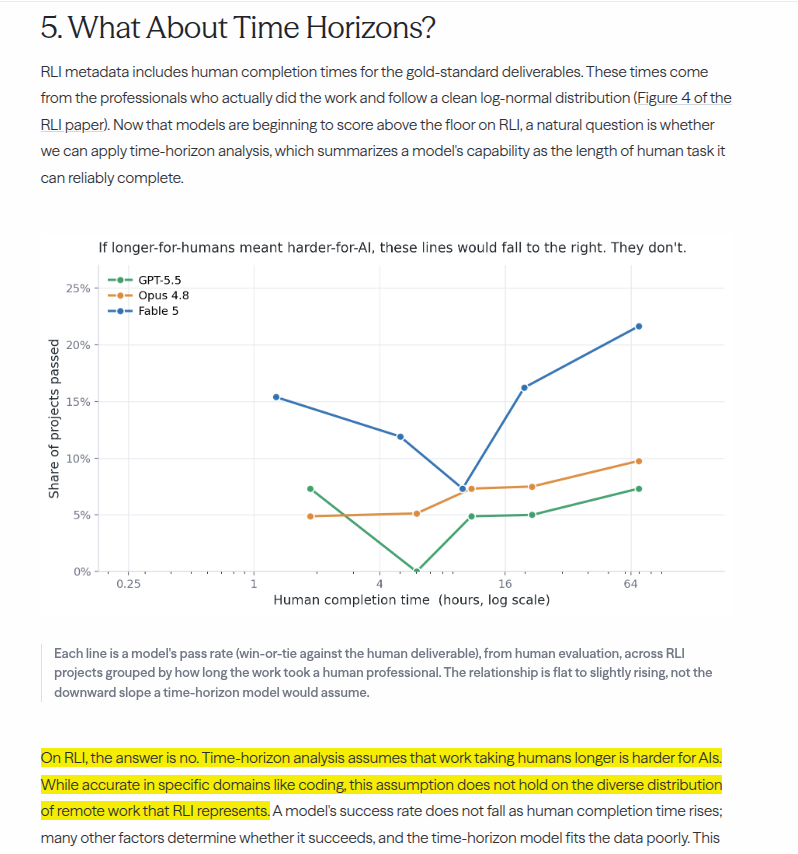
Remote labor automation does not scale with human time in the clean way many forecasts assume. A task that takes a professional 60 hours may contain long stretches of production work.
That work can be easier for agents because tools compress rendering, drafting, coding, or iteration. A task finished by a person in 2 hours may require judgment that models still lack.
The result points to a jagged capability frontier, not a smooth ladder of harder tasks. This weakens time-horizon forecasts that treat longer human duration as harder AI difficulty.
That indicates automation will arrive unevenly inside jobs, not across them. Some expensive project slices may fall early, while small expert checks may remain stubborn. Remote Labor Index is therefore measuring client-acceptable output, which is closer to labor risk than task length.
🗞️ "The ATOM Report: Measuring the Open Language Model Ecosystem"
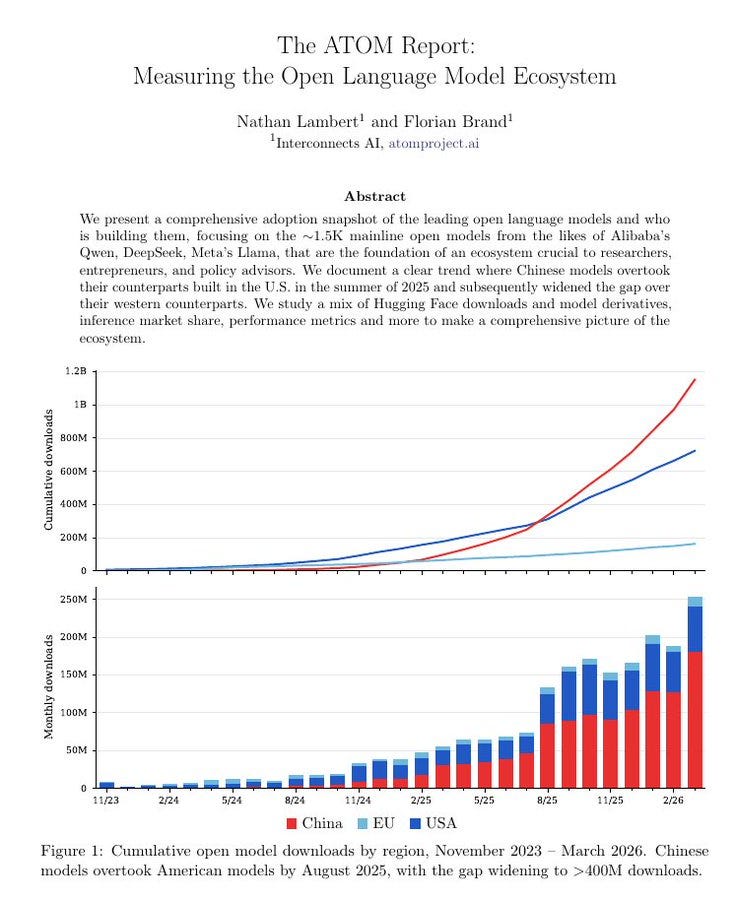
A paper on open model adoption and finds Chinese models, led by Qwen, now dominate.
China passed the U.S. in open model downloads in summer 2025. By March 2026, Chinese models had 1.15B tracked downloads, while U.S. models had 723M.
Most of that shift comes from Qwen, which became the default base family for many builders. Qwen’s lead is not just about 1 famous model; it comes from having many useful models across many sizes, especially small ones that people can run cheaply and reuse often.
DeepSeek matters in a different way: it does not dominate the whole open model ecosystem like Qwen, but it leads the very large model category, especially models above 250B param.
After adjusting for model size and age, some U.S. models like GPT-OSS 120B and Nemotron Super 120B still show very strong adoption momentum, even though China leads overall.
🗞️ "Cognitive offloading and the speedup illusion in human-AI interaction"
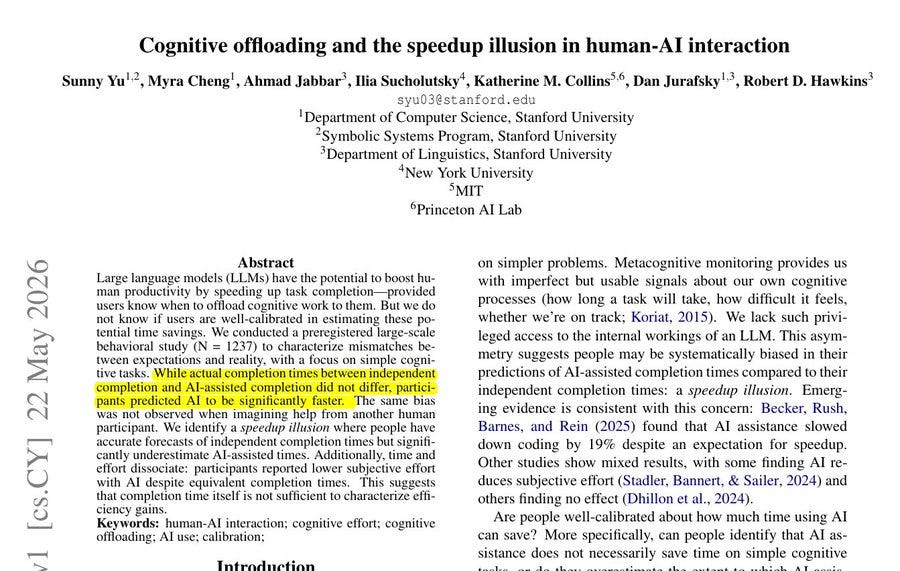
This MIT, Stanford, New York Univ, Princeton, study shows that while people expected AI to save time on simple tasks, but it mostly saved effort instead.
Across 1,237 people, participants predicted that AI help would cut about 69 seconds from task time. In the real task group, AI help did not meaningfully reduce total completion time overall.
The gap came from a speedup illusion, where people judged their own solo time fairly well but badly underestimated AI-assisted time. AI did help on some harder tasks, such as longer summarizing or editing, but it did not help much on easy tasks.
The important twist is that AI made tasks feel easier, even when it did not make them faster.
---
To note, the biggest limitation is that this study used short, simple tasks that could be finished in under 5 minutes, so it does not test long report reading, synthesis, cross-checking, and analysis work where AI can compress hours into minutes. It also used crowdworkers doing one-off tasks in a controlled setting, so it misses expert users with strong prompting habits, personal context, repeated workflows, and clear business goals, where gains can be much larger.
🗞️ By 2027, just 5 companies, Alphabet, Amazon, Meta, Microsoft, and Oracle, are expected to spend around 3.2% of US GDP on AI capital expenditure.
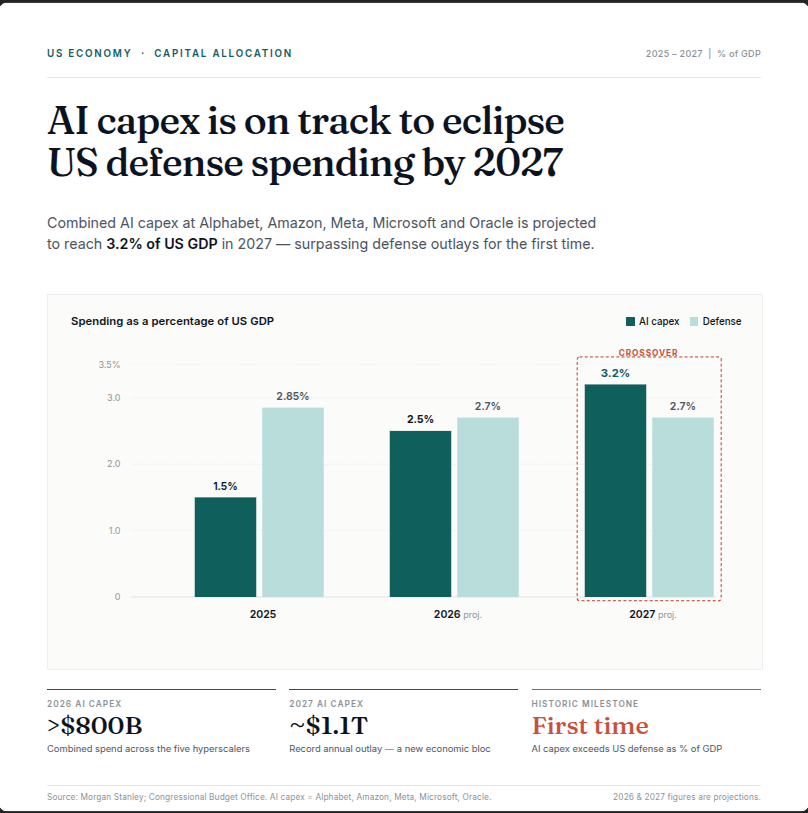
That would put private AI infrastructure spending above US national defense spending, which is expected to be around 2.7% of GDP. The AI race is now being funded at a scale normally associated with governments, wars, energy systems, railroads, highways, and telecom buildouts.
The striking part is the speed. AI capex is expected to jump from about 1.5% of GDP in 2025 to about 2.5% in 2026, then to 3.2% in 2027. AI boom is now large enough to influence the broader US economy significantly, it can move GDP growth, electricity demand, chip supply, construction activity, corporate debt markets, and ofcourse the labor market.
🗞️ AI revenue is scaling 3x quicker than mobile or internet did.
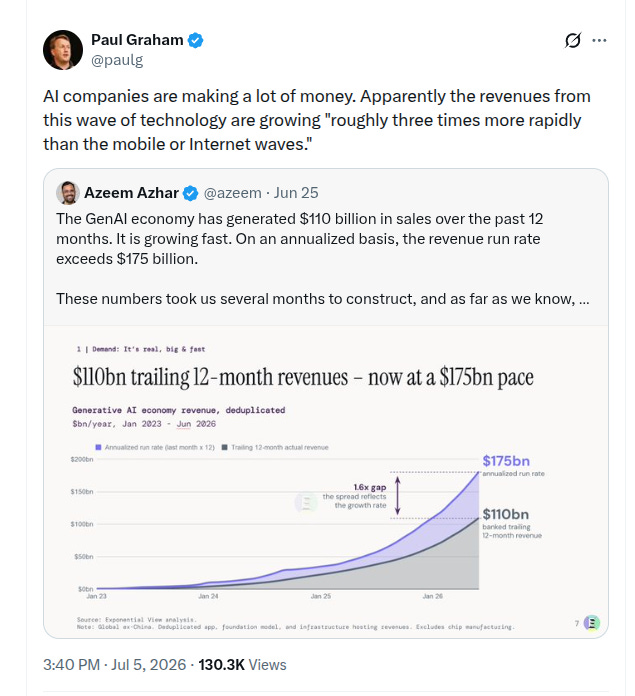
The unit of value is shifting from attention to completed work. Read the main report.
🗞️ Cathie Wood (founder, CEO & CIO of ARK Invest) is saying that productivity improved significantly last year, partly because companies delayed hiring and used more AI instead.

She expects productivity growth to move from around 2.9% currently to the 5% to 6% range within the next five years, possibly sooner.
AI is helping companies do more with fewer workers.
🗞️ Hugging Face Engineer publishes an exhaustive slide presentation on how to train an open coding agent using TRL and OpenEnv
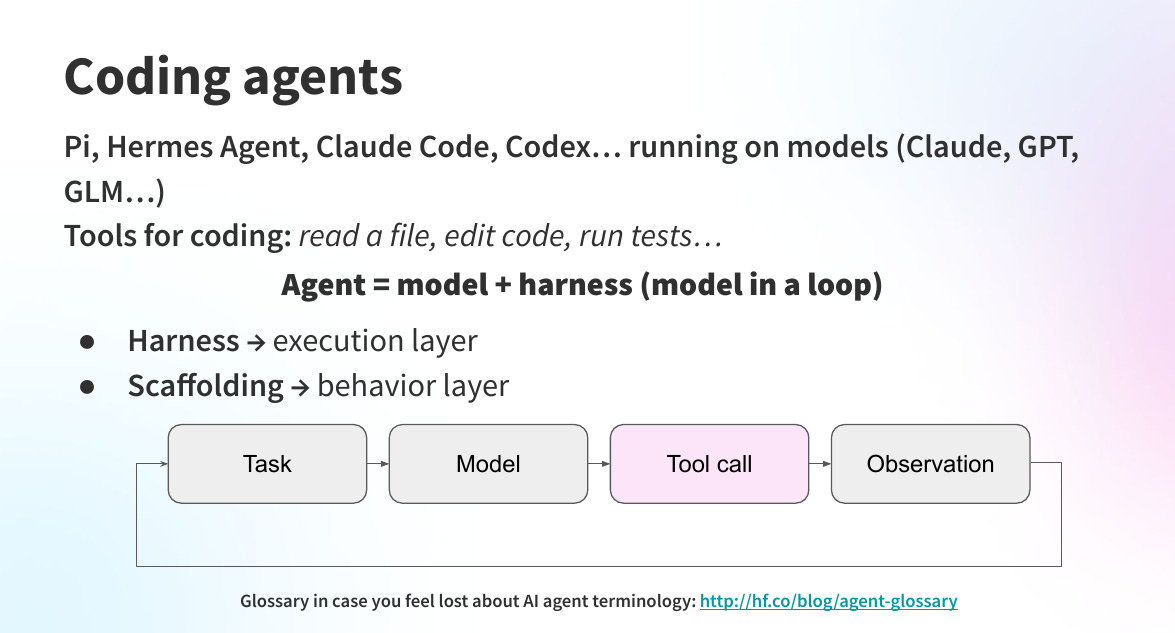
The whole deck is saying 1 thing: a coding agent should be trained inside the kind of tool loop it will actually use, not only trained to chat well.
A coding agent has 2 parts. The model thinks and writes actions. The harness gives it tools like read file, edit code, run tests, and return results.
It starts with the basic agent setup: agent = model + harness. The model decides what to do, while the harness gives it tools like reading files, editing code, running tests, and seeing results.
You will learn why a normal instruction model is not enough. It may answer well in chat, but it does not automatically know the exact tool format, the multi-turn loop, or how to behave inside a real coding environment.
The first training step is Supervised Fine-Tuning, or SFT. Here, the model learns from agent traces, which are full records of a good agent solving tasks through messages and tool calls.
A useful detail here is completion masking. The model is trained only on the assistant and tool-call tokens, so it learns what the agent should say and do, not the raw output returned by tools.
Then the tutorial explains why imitation has a ceiling. SFT teaches the model to copy good examples, but it does not teach the model how to recover when its own action fails.
That is where Group Relative Policy Optimization, or GRPO, comes in. The model tries solutions, tests are run, and successful attempts get rewarded.
For coding agents, this reward can be very concrete: tests pass = reward. That makes reinforcement learning easier to reason about because the reward comes from a verifier, not a vague human preference score.
The final part explains OpenEnv, which gives agents real environments to act inside. The agent can read, edit, run tests, fix mistakes, and learn through long multi-turn rollouts.
You will also understand why agent training is partly a systems problem. Long rollouts need async training, so AsyncGRPOTrainer separates generation from weight updates.
That’s a wrap for today, see you all tomorrow.
a very useful article. thanks