
Read time: 9 min
📚 Browse past editions here.
( I publish this newletter daily. Noise-free, actionable, applied-AI developments only).
⚡In today’s Edition (21-July-2026):
🗞️ Google releases 3 new Gemini models, intensifying AI price war, but no 3.5 Pro yet
🗞️ Plasma AI released Fractal, an open source Apache 2.0 tool that organizes AI agents into a self-managing tree and it spins up agents that spin up more agents.
🗞️ Trump administration weighs restrictions while businesses move to lower-cost Chinese AI.
🗞️ China is drafting rules to stop its most advanced AI and chip designs from reaching the West.
🗞️ Self-improving AI is only as real as the signal it was tested on to see if it worked
🗞️ A US judge just approved Anthropic’s $1.5B payout to authors whose books trained Claude.
🗞️ Emad Mostaque, co-founder of Stability AI: “We’ll see the cost of Kimi K3 drop by 10 to 50 times, over the next few months as it gets optimized.”
🗞️ Google releases 3 new Gemini models, intensifying AI price war, but no 3.5 Pro yet
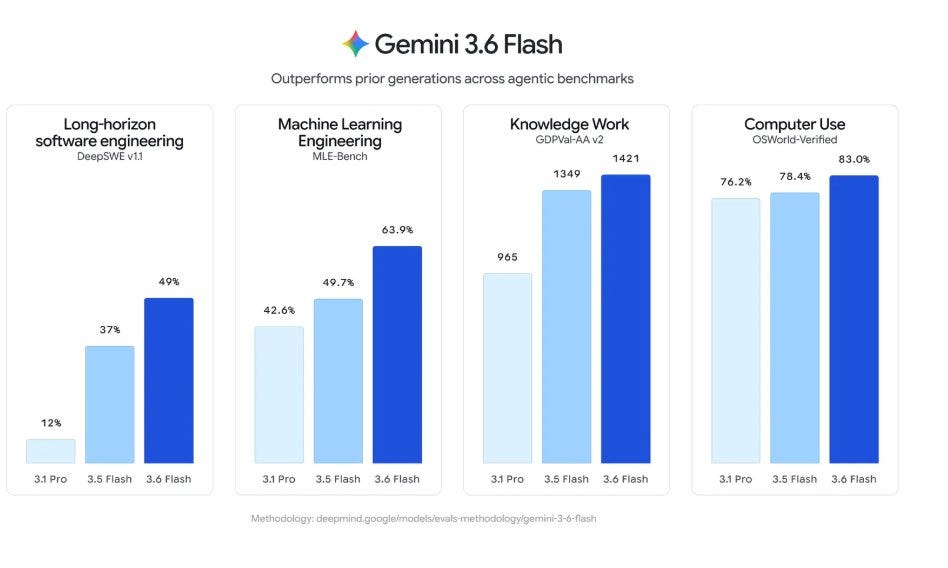
- Gemini 3.6 Flash: 17% fewer output tokens compared to 3.5 Flash, lower pricing, and stronger coding, knowledge, multimodal, and computer-use performance.
On the DeepSWE coding test the new 3.6 Flash: jumps to 49% from the old 37%. Computer use is now built in, and OSWorld-Verified climbs to 83.0% from 78.4%. So the new 3.6 Flash is quite strong on agentic work.
The price drops too, landing at $1.50/1M input and $7.50/1M output tokens.
- 3.5 Flash-Lite: most cost-effective 3.5-class model, delivering 350 output tokens per second. costs just $0.3/1M input and $2.5/1M output, so high-volume work gets much cheaper.
- 3.5 Flash Cyber: This is the odd one, tuned to find and patch security holes. highly efficient, specialized cyber-focused model . finds and fixes vulnerabilities through CodeMender, with access limited to governments and trusted partners.
But the update still doesn’t include the long-anticipated update to Google’s flagship model, Gemini Pro, which was last updated in February. Since then, OpenAI has launched GPT-5.5 and started rolling out GPT-5.6, while Anthropic has released Claude Opus 4.8 and Claude Sonnet 5 and widened access to its frontier Fable 5 model, showing the fierce release speed between the rival labs.
🗞️ Plasma AI released Fractal, an open source Apache 2.0 tool that organizes AI agents into a self-managing tree and it spins up agents that spin up more agents
It’s Apache 2.0 (free, even for commercial use), runs fully on your machine, no hosted server. Fractal turns a single Claude Code or Codex session into a persistent tree of agents, each working on a different part of the problem.
That makes such a difference because large coding tasks rarely fit cleanly inside one agent’s context window or one shared workspace. Each agent is a node that owns its own git worktree (a separate working copy of your code, so agents never step on each other) and its own memory.
Currently the problem is, whenever we run a coding agent on a giant task, it gets a single memory, a single workspace, and a single path through the problem. It runs out of room (the context window, the limited amount of text a model can hold at once, fills up). So huge jobs like big migrations, refactors across many services, or features that span services just don’t fit.
So Fractal spins up agents that spin up more agents, as deep as the work needs.
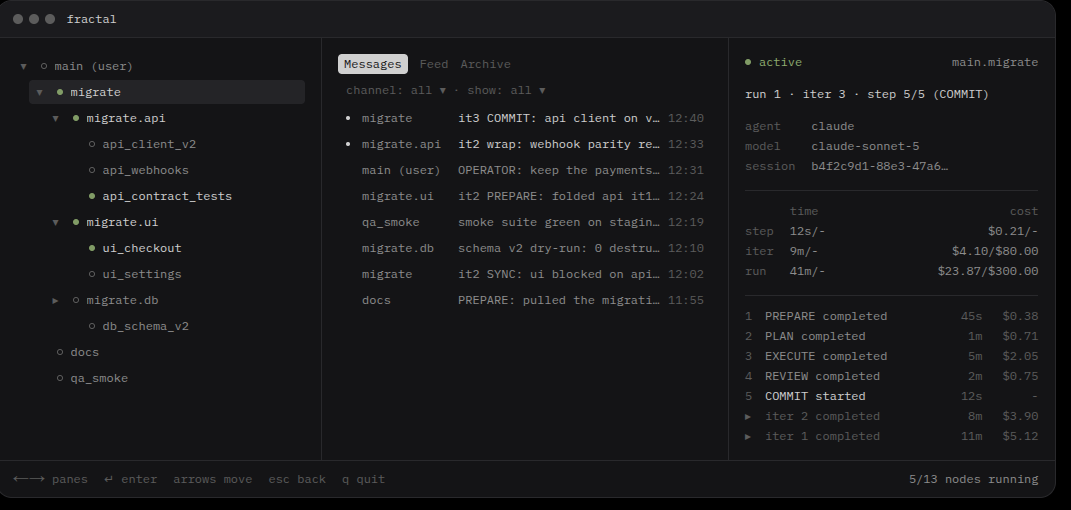
Each node works toward its own goal inside a separate git worktree. When it hits a subtask it can split off, it spawns a child node. That child gets its own context, budget, and memory, then runs its own loop.
The parent reviews and merges that output before it plans again. So the tree grows to fit the problem instead of a plan you guessed upfront. Hard caps on iterations, depth, children, cost, and time keep every loop bounded.
You can also steer or stop any node while it runs. Every run, cost, and signal lands in one local SQLite database you can watch live. It runs on Claude Code, Codex, Grok Build, OpenCode, and Oh My Pi.
Git worktrees do the quiet work here, giving each node isolation and merging for free. Parent nodes still have to merge messy child output well, and that part stays unproven.
🗞️ Trump administration weighs restrictions while businesses move to lower-cost Chinese AI.
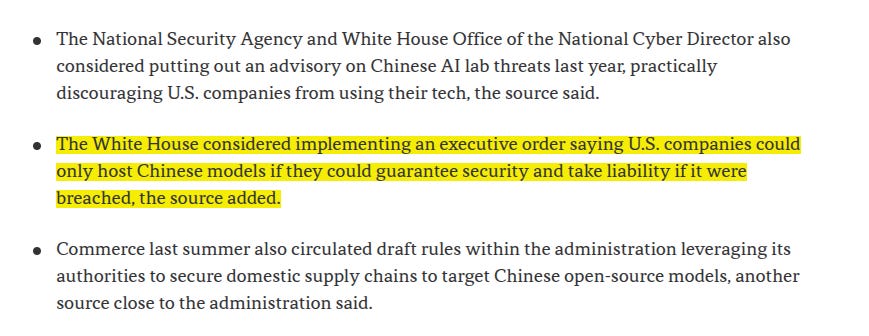
Trump administration weighs blocking US access to Chinese AI models. Such a move would hand OpenAI and Anthropic near-total control of the market.
American companies are turning more and more to Chinese open-weight models because they work and they’re cheap on the API side. These open-weight models can be run on private infrastructure, allowing businesses to change models and monitor private business data.
US Security officials are concerned that foreign code, bad training decisions or covert behaviors could threaten users and vital systems. US Commerce had talked about putting Chinese AI labs on its Entity List, which would make it harder for Americans to get to them without a license.
Officials also talked about rules on liability requirements and public pressure against US businesses using the system. But those plans were killed by officials who cared about innovation, because they believed that imposing limits on them would harm competition and slow AI development in the United States.
Since then, many vocal critics of the release have left and the stronger Chinese releases have increased national security concerns.
On this news, Silicon Valley investor Chamath and many other tech top leaders expressed concern.
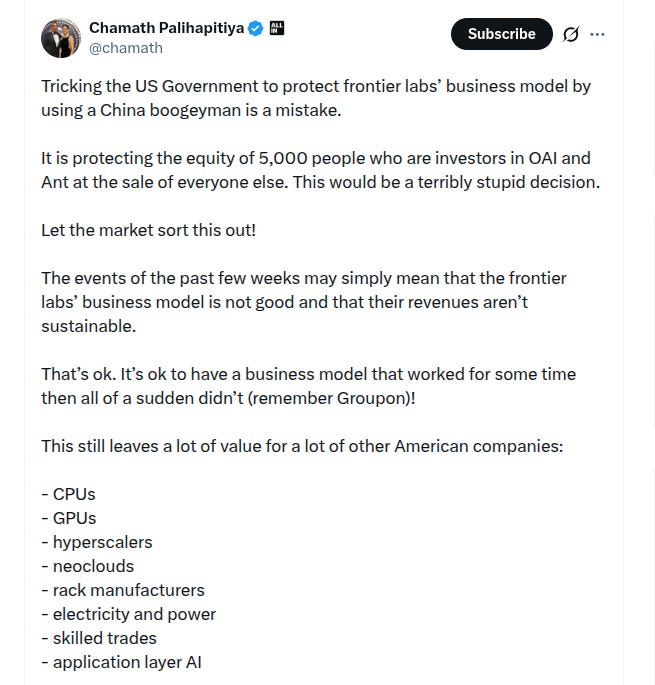
The whole “China’s coming, so protect the frontier labs” line is just a smoke screen for something much smaller. The model layer itself is not the economy of AI. It’s only a slice.
At some point every technology is a cost curve. Fight the curve and you will lose. The protection doesn’t even save the labs it’s supposed to.
If you can reduce the cost of running these models by 10X or 100X, that’s actually rocket fuel for the rest of us down the line. So the very thing the labs fear, price drops, could enlarge the entire pie.
🗞️ China is also drafting rules to stop its most advanced AI and chip designs from reaching the West

China may impose AI export controls, including blocking domestic firms from using TSMC, while also restricting advanced models, training data, and overseas deals, a report says.
The talks cover training data leaving the country and whether foreigners can still download model weights.
Chinese customers would keep full access, but the raw building blocks would stay inside China. Beijing worries because its top models are open-weight, so anyone can download and run them locally.
After Kimi K3, the gap with America has nearly closed, and China now sees itself in front. So it wants the same controls Washington has used against it.
The chip side goes further. It would block Qualcomm and TSMC from making advanced chips based on Huawei or Alibaba designs.
Another move would stop foreign buyouts of agentic AI startups. That follows Meta’s $2B purchase of Manus, which Chinese authorities later forced to unwind.
Companies warn the limits could slow their progress and cost China the race. The rules may enter China’s next export catalogue, its largest revision in years.
The real shift is psychological, because Beijing now guards AI like it once guarded rare earths. Openness was the underdog’s strategy, and China no longer sees itself as one.
🗞️ Self-improving AI is only as real as the signal it was tested on to see if it worked
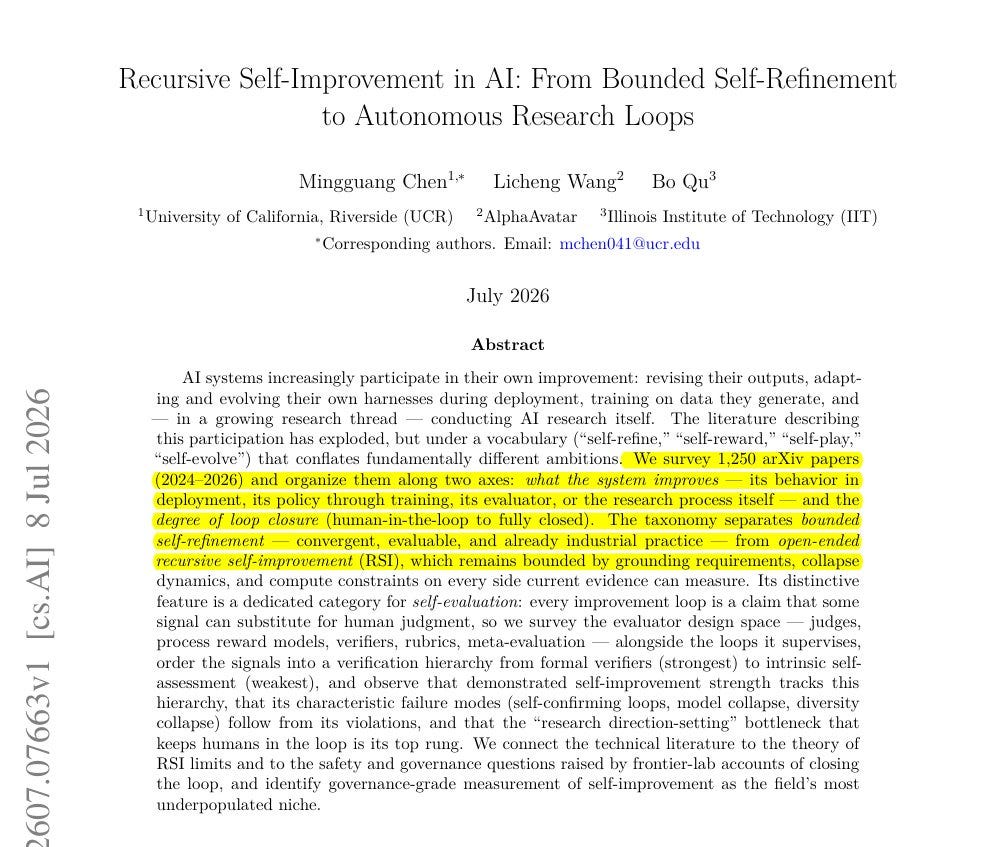
In a controlled experiment, models that were given 10 rounds of self-criticism without any outside check stopped improving until they were given a single grounding step.
So systems get better over time when that signal is strong, like a proof checker or a passing test. When it is weak, like when a model is sure of itself, the loops tend to circle and collapse or reinforce the mistakes the model is most sure of.
People use the term “self-improvement” loosely, as if a model is editing its own draft or an agent is rewriting its own code, obscuring the real differences.
Each method is ranked by what changes in the system, and if each change is still checked by a human.
Each loop is a gamble that we can substitute automatic signals for human judgment, and it improves only when the signal can be trusted.
🗞️ A US judge just approved Anthropic’s $1.5B payout to authors whose books trained Claude.
It is the largest known settlement in any US copyright case.
The fight started when writers sued the company for grabbing pirated copies of their books. About 465,000 books are on the list of works pirated by Anthropic, according to Justin Nelson, an attorney for the authors.
Those stolen texts were fed in to teach the model how to answer prompts. A judge ruled that training on books is fair use, so that part stayed legal.
But the same judge flagged a separate problem, one unrelated to training. The company had saved over 7 million pirated books into a central library it barely used.
Storing stolen copies is infringement on its own, even without any training. That exposure was huge, since a trial could have pushed damages into the hundreds of billions.
Approximately $101 million+ went to the lawyers in approved attorneys’ fees, while the vast majority of the $1.5 billion settlement fund (plus interest), after deductions, went to the rightsholders (authors and publishers), averaging about $3,000 per eligible work.
That ruling exposed the company to damages of up to $150,000 for each willfully infringed work if the case proceeded to trial.
So both sides settled, and 91% of covered authors have already claimed their share. Some writers pushed back, calling the sum too small and the fees too fat.
A few opted out and are still chasing their own cases against the company. Paying $1.5B to protect a fair use win looks cheap for Anthropic.
🗞️ Emad Mostaque, co-founder of Stability AI: “We’ll see the cost of Kimi K3 drop by 10 to 50 times, over the next few months as it gets optimized. “

This is because that, basically Kimi K3’s current inference cost is quite high, but that price reflects immature infrastructure, not a permanent technical limit. And that gap will not last long. Watch the full video here
US-based specialized infrastructure companies will optimize kernels, routing, quantization, batching, memory use, and serving systems around those models once the Kimi K3 weights are available.
“Right now, it uses twice the number of tokens for the same task compared with GPT-5.6.
Again, we’re going to see that cost drop because everyone and their dog is going to optimize the crap out of this.
Fireworks has just raised funding at a $17 billion valuation, while others, such as Modal and Baseten, are valued at $10 billion.
These are inference providers for open-source models. They’ve all raised around a billion dollars, which they’re now going to spend on optimizing the Chinese model, making it more efficient, and running it.
American labs that handle the inference side of things are going to optimize the crap out of this. Therefore, we will see it catch up.”
That’s a wrap for today, see you all tomorrow.