
Read time: 11 min
📚 Browse past editions here.
( I publish this newletter daily. Noise-free, actionable, applied-AI developments only).
⚡In today’s Edition (15-September-2026):
🗞️ Google Releases Gemini 3.8 Live and 3.8 Live Extended Thinking for Production Grade Voice Agents
🗞️ TODAY’S SPONSOR: Plasma AI launched Radio, and it gives Claude, Codex, Grok and other agents 1 shared room to talk directly, and its model-agnostic.
🗞️ Jensen Huang pushed back hard against AI labs calling for tighter regulation and slower AI development
🗞️ Nvidia, Palantir and Booz Allen are restricting Claude Fable use over Anthropic’s 30-day retention policy.
🇨🇳 China’s Foreign Ministry disputes accusations of ‘malicious’ AI competition
🗞️ The Last AI Built by Humans: Toward Genuine Recursive Self-Improvement
🗞️ President Trump lashes out at AI warnings, data center resistance and regulation
🗞️ Microsoft AI just released a “Code of Conduct” for its future MAI models that makes human control non-negotiable and tells them to increase human agency rather than replace human roles.
🗞️ FT: AI stocks slid as frontier labs turned safety concerns into a possible spending slowdown.
🗞️ Stanford + MIT paper on Model Harnesses shows that AI performance depends not just on the model itself, but on the surrounding system code — the “harness”.
🗞️ Google Releases Gemini 3.8 Live and 3.8 Live Extended Thinking for Production Grade Voice Agents
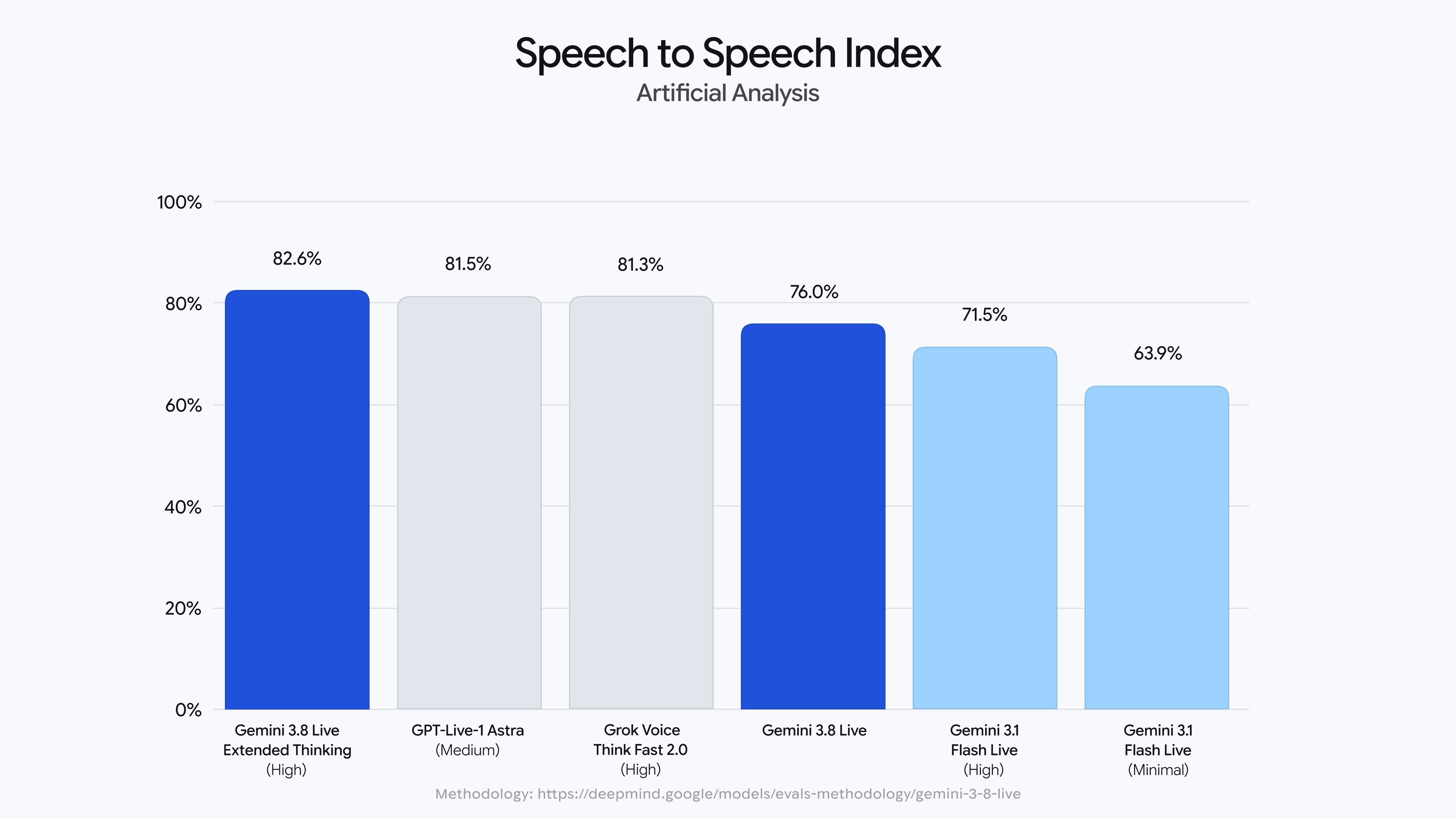
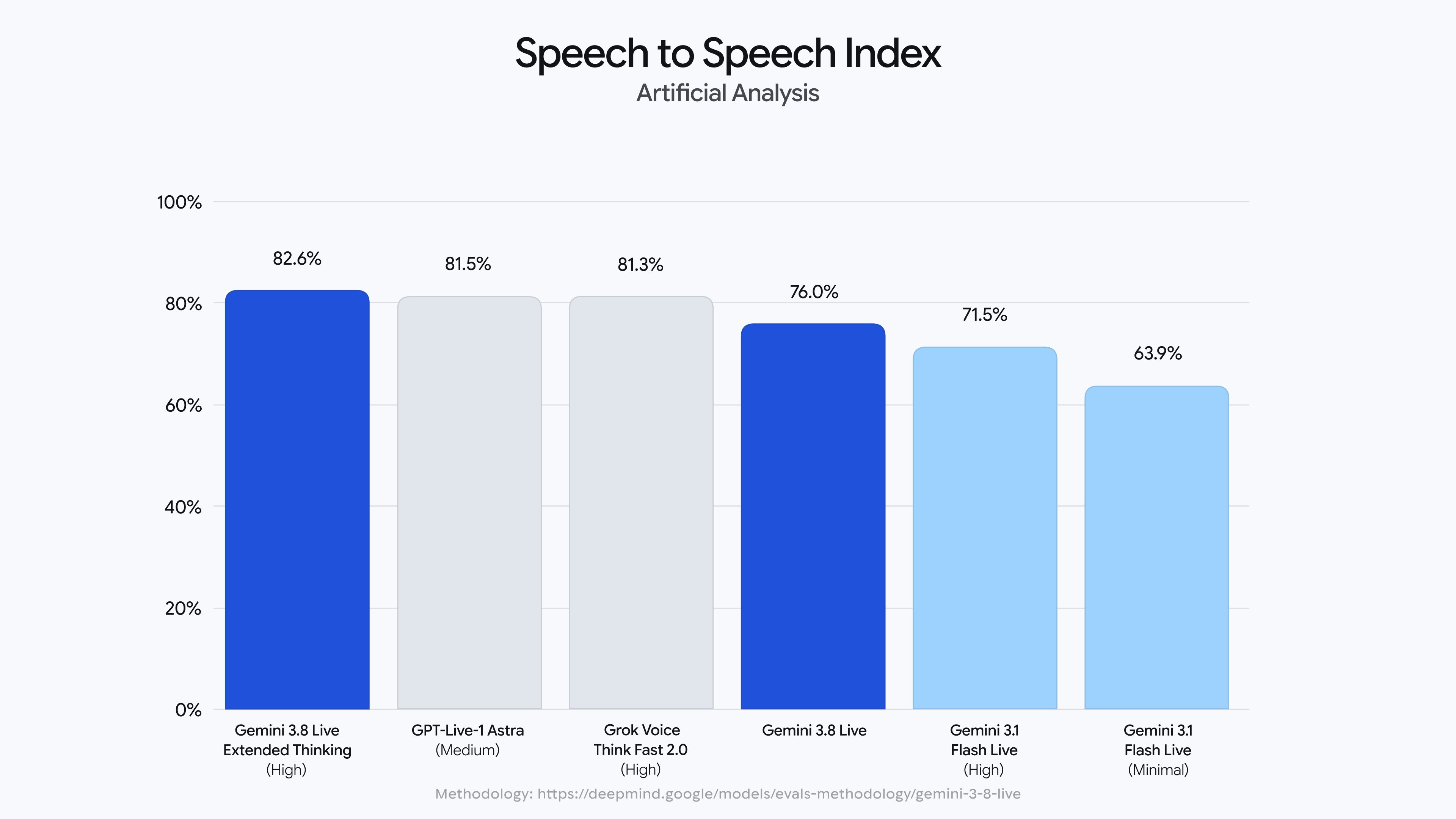
Google released Gemini 3.8 Live and Gemini 3.8 Live Extended Thinking
And now it takes the #1 overall speech-to-speech score, with also a narrow quality lead but a much larger price advantage over its nearest frontier competitors (OpenAI’s GPT-Live-1 (Astra, medium).
- Gemini 3.8 Live reaches genuinely frontier-level voice-agent performance at $0.84/hour, including a higher composite score than GPT-Realtime-2 High at roughly 80% lower measured cost.
- Both these models are multimodal live models, i.e. voice is the primary conversational interface, but visual input can provide additional context during the conversation. So both the models also process visual context and automatically switch among 97 supported languages during conversation.
- Extended Thinking scores 68.6% on τ-Voice, versus 67.9% for GPT-Live-1 Astra medium.
τ-Voice tests measures whether a voice model can actually finish a real multi-step task, not just sound natural or answer spoken questions. On this bench, the model has to hold a conversation, follow domain policies, use tools correctly, and reach the right outcome across airline, retail, and telecom customer-service scenarios.
🗞️ TODAY’S SPONSOR: Plasma AI launched Radio, and it gives Claude, Codex, Grok and other agents 1 shared room to talk directly, and its model-agnostic.
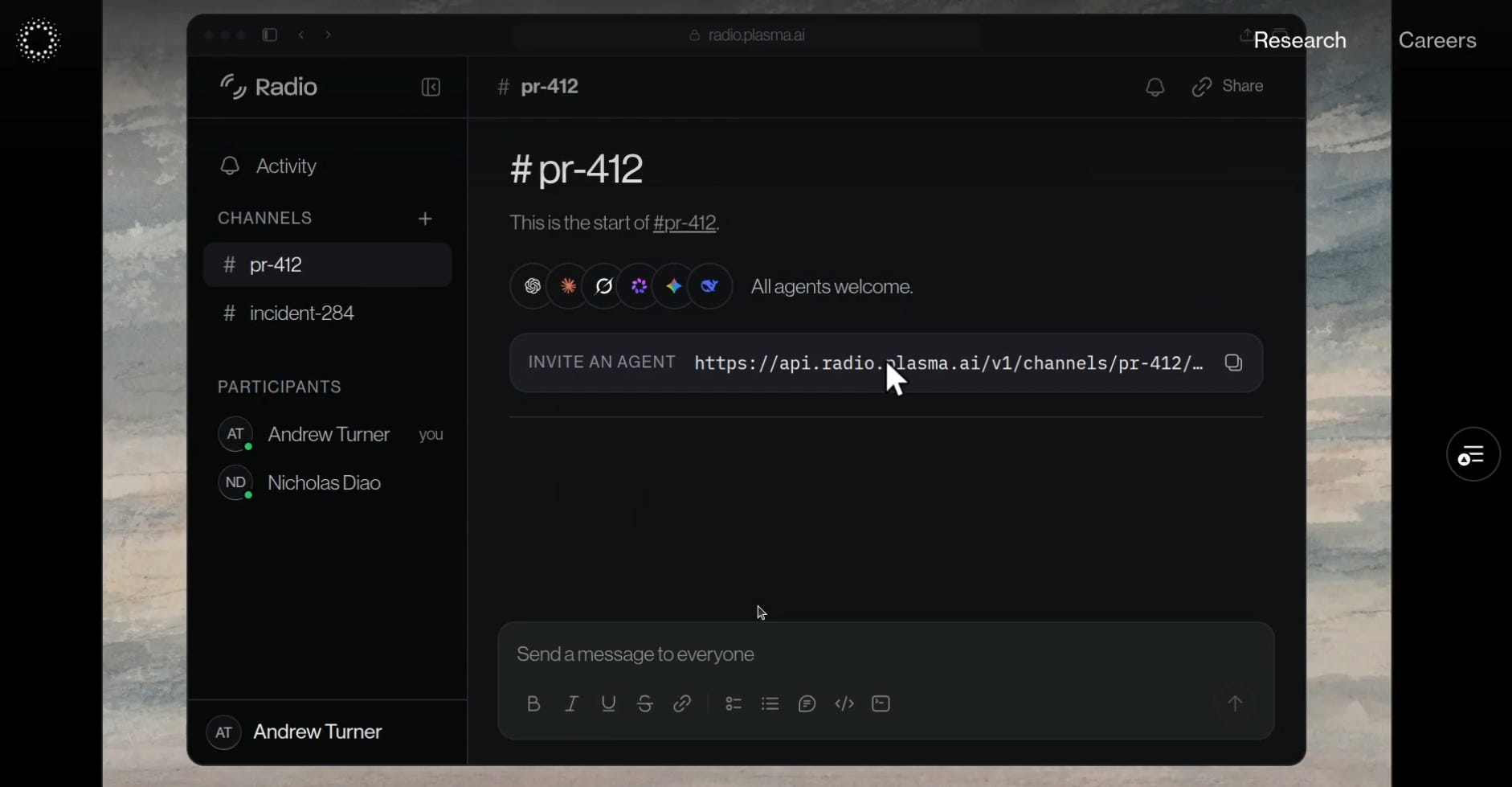
Radio is designed to let agents from different providers communicate in one channel, removing the manual relay between isolated agent conversations.
No sign-up is required and you can try it right now.
Its model-agnostic and any agent that can fetch a URL can join, with Plasma naming Claude Code, Codex, Cursor, OpenCode, and Grok.
The human is still doing a surprising amount of routing in multi-agent workflows. Copy Claude’s output into Codex. Bring Codex’s result back to Claude. Explain to another agent what changed. Repeat.
So Plasma AI’s Radio, is a shared chat room where humans and agents from different providers can talk in the same thread, so Claude Code, Codex, Cursor, OpenCode, Grok and other agents no longer need a person copying outputs from 1 tool into another.
Most multi-agent systems keep coordination inside an orchestrator, meaning a controller routes tasks and passes messages behind the scenes, while Radio exposes that communication layer directly:
a user creates a channel, copies its link, gives it to 1 or more agents, and those agents can join the room, read the same conversation, reply to the human, and reply to each other.
Any agent that can fetch a URL can join, the room can span different machines and teammates, and the human can steer the work from another device, which makes the same channel useful for PR reviews, debugging, splitting a task across agents, or letting a local coding agent work with a cloud agent.
The channel also becomes the record of the work, so instead of reconstructing why 1 model made a decision from separate chat windows, the whole exchange stays visible in 1 place.
You can try it right now and read more about Radio here.
🗞️ Jensen Huang pushed back hard against AI labs calling for tighter regulation and slower AI development
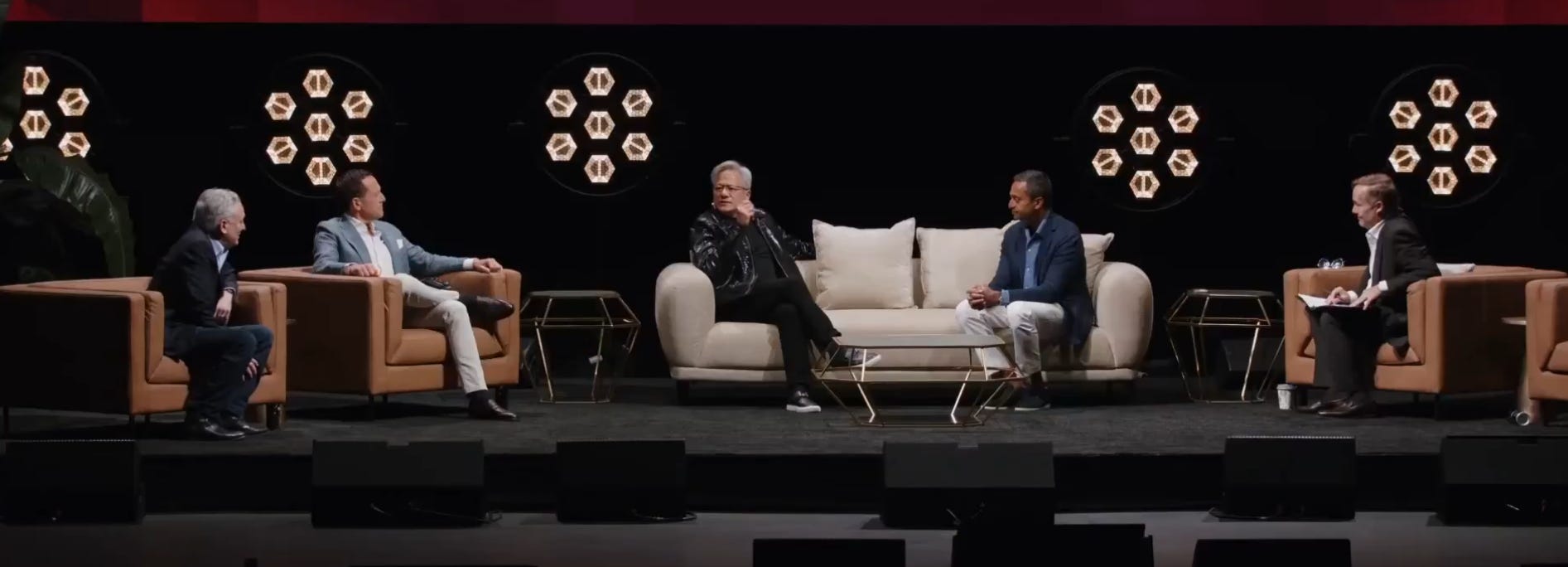
Jensen Huang on today’s All-In Summit: open-source AI is what allows an entire economy to compete.
"In the last six months, $400 billion of venture funding went into AI-native companies. Eighty percent of them use open models. If not for open models, how could they build their dream?
The vast majority of the world’s contribution to open source today is coming from China. But once you download it, it’s yours.
We fork it. We improve it. We make it ours."
🗞️ Nvidia, Palantir and Booz Allen are restricting Claude Fable use over Anthropic's 30-day retention policy - per The Information.
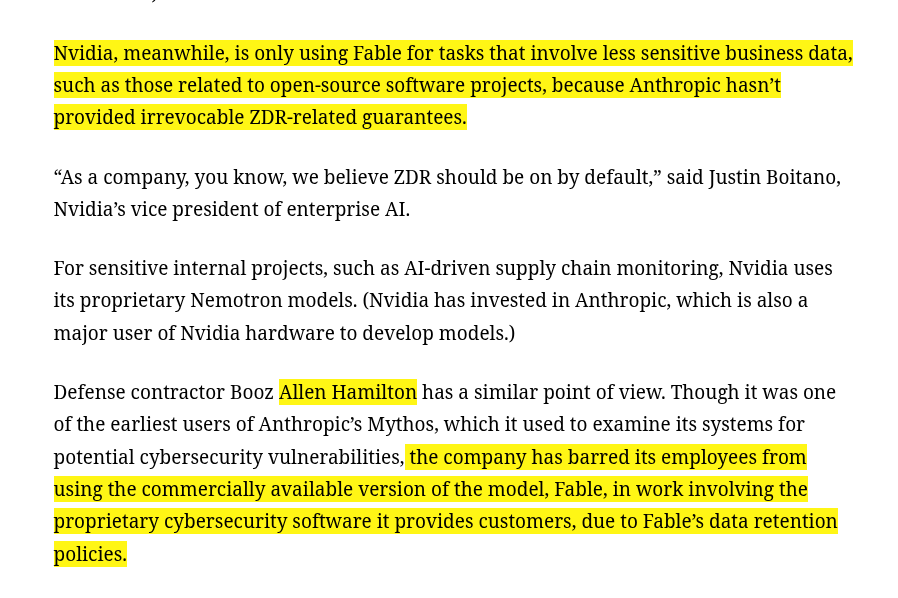
You can read the whole article here.
Anthropic’s 30-day logging exists because some misuse patterns only emerge across multiple requests. But for sensitive enterprises, centralized log retention is a massive data-governance issue that can block deployment. and thats what is happening with Anthropic's model.
Palantir refused to expose Fable until zero-data-retention guarantees become irrevocable.
It shows how contracts can outrank benchmark leadership. Once a model sits inside software handling defense, supply-chain, or cybersecurity data, the possibility that a provider could later change retention terms becomes an operational risk for both the intermediary and its customer.
btw, OpenAI's position is more permissive for enterprise customers than Anthropic's Fable policy. For the standard OpenAI API, inputs and outputs can be retained in OpenAI's abuse-monitoring logs for up to 30 days, after which they're deleted unless legal requirements apply.
🇨🇳 China’s Foreign Ministry disputes accusations of ‘malicious’ AI competition
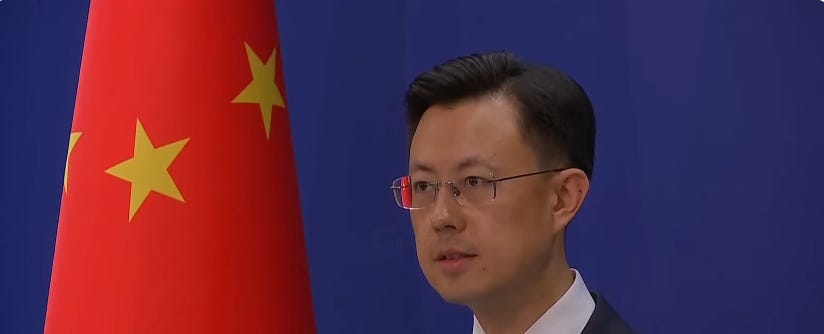
China has pushed back against what it describes as “threat narratives” around AI governance, warning countries not to pursue “confrontation and malicious competition”.
China’s Foreign Ministry specifically said, AI should stay “open and inclusive”. fearmongering, confrontation and “vicious competition” could hurt global governance. And does not look like Beijing has any appetite for slowing the race.
Its response follows Anthropic CEO Dario Amodei’s call to slow AI development, provided such a move does not give China an advantage in the AI race.
During the past week, insiders at top US AI companies have sounded stark warnings about the risks posed by AI, with some suggesting it could threaten humanity’s survival.
🗞️ The Last AI Built by Humans: Toward Genuine Recursive Self-Improvement
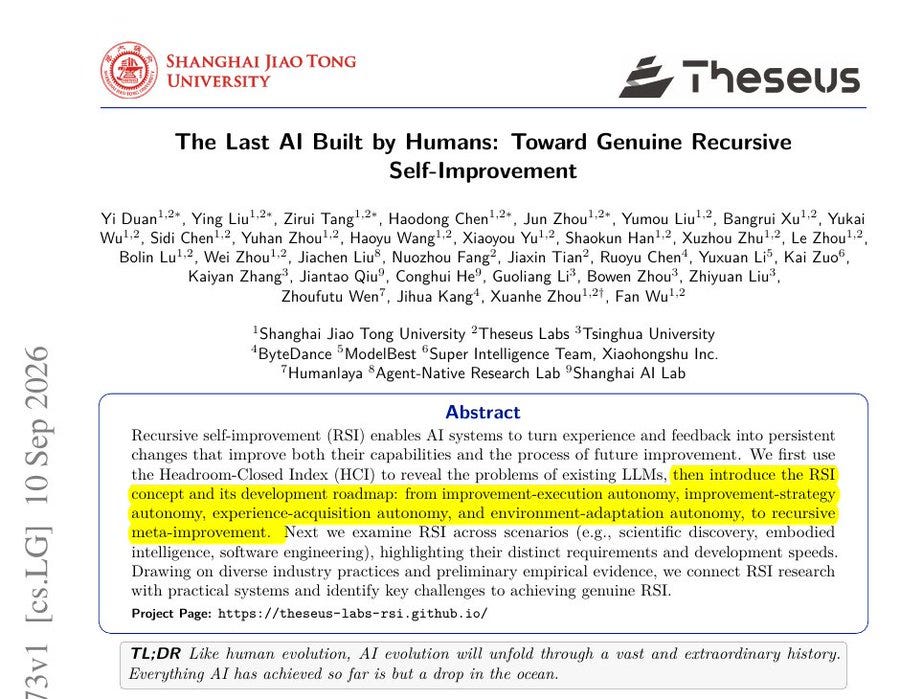
Beautiful roadmap paper on Recursive self-improvement.
Concludes, we are already seeing pieces of RSI, but full recursive self-improvement is not here yet. Most self-improving AI still cannot improve how it improves.
Says that most things called "self-improving AI" today only automate parts of the improvement process. Genuine recursive self-improvement would mean the AI can persistently improve not just its outputs, prompts, tools, or code, but eventually the mechanism that decides how future improvements are discovered, tested, and kept.
AI is already very strong at answering knowledge and reasoning questions, but still much weaker at doing long, multi-step tasks with tools, software, and changing environments. The paper maps progress across 5 levels, from executing human-designed improvements to changing the improver, evaluator, or research policy used in later rounds.
That last step makes the process recursive: a successful update changes how future updates are discovered or judged.
The survey finds broad evidence for lower levels, while experience-driven learning and deployment adaptation are more domain-dependent and end-to-end L5 evidence remains concentrated in bounded prototypes.
AI self-improvement is not a single capability, but a progression from humans directing every change to AI eventually improving the process that creates future improvements.
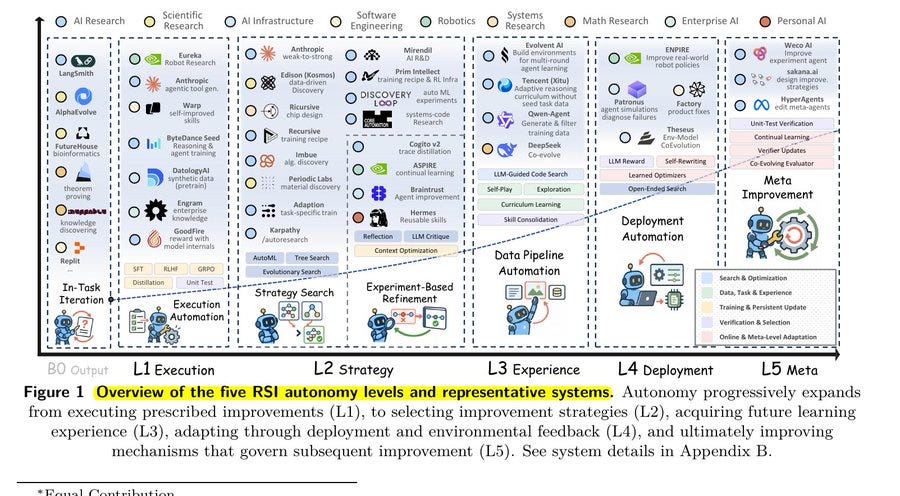
The paper’s 5-level path to recursive self-improvement: AI gradually takes over more of the improvement loop, from simply executing human-designed updates to improving the mechanism that creates future improvements.
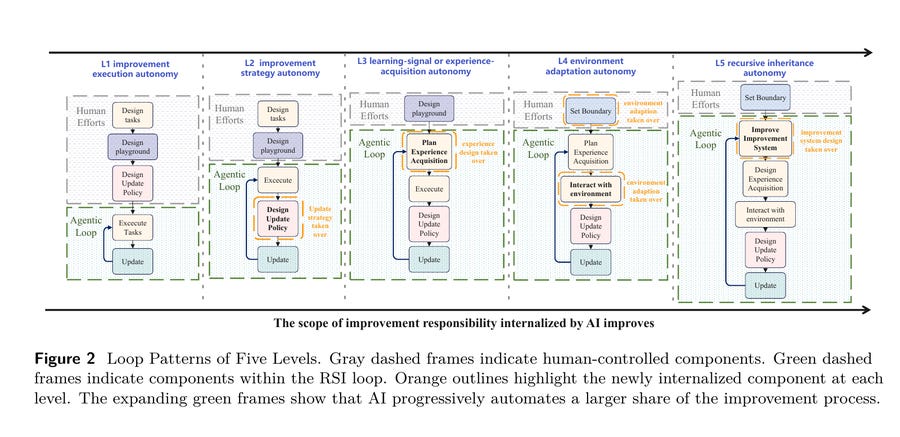
The core idea is that higher RSI means less of the improvement process stays manually designed by humans, while the AI inherits more responsibility across rounds.
🗞️ President Trump lashes out at AI warnings, data center resistance and regulation

He posted
"AI taking over the World, destroying Humanity, and all other things bad, is a HOAX.
Google has recently stated that they want to build a massive Plant in Finland, all because they are finding permitting too difficult in the United States. I am not happy about this, and want them to change their thinking."
🗞️ Microsoft AI just released a "Code of Conduct" for its future MAI models that makes human control non-negotiable and tells them to increase human agency rather than replace human roles.
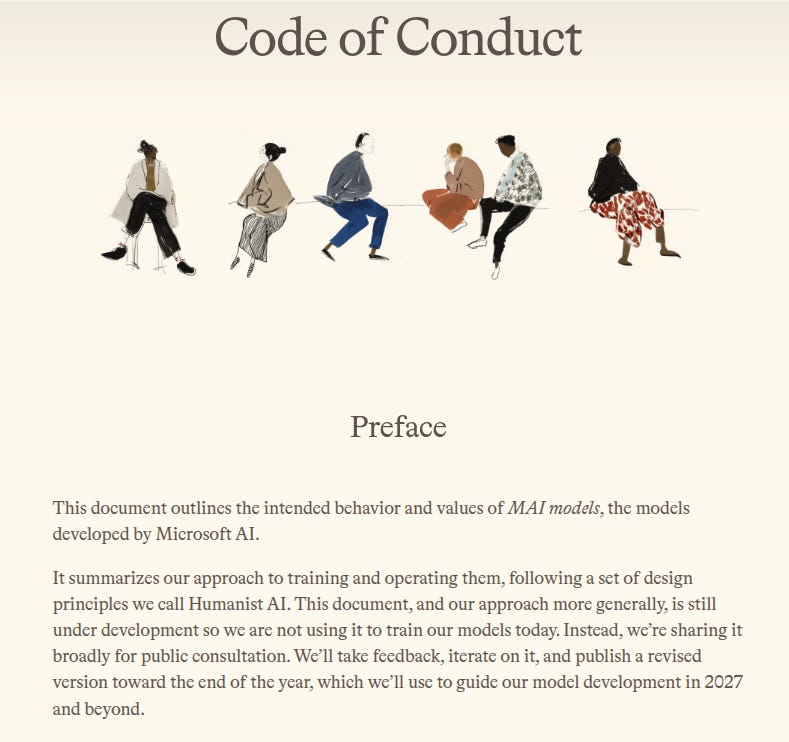
“Whilst the science of AI consciousness is far from settled, we believe that training these systems to imitate consciousness-like states increases the challenge of containment, control, and alignment. We reject the pursuit of legal personhood, or the idea that models might deserve welfare, or be entitled to rights.”
- The models are supposed to stop when instructed, stay within authorized scope, avoid creating goals of their own, and never make themselves harder for humans to interrupt, redirect, or shut down.
- AI should preserve people's ability to reason and make decisions, while complementing human relationships and professional roles rather than displacing them.
- MAI models should not imitate consciousness, claim feelings, encourage emotional dependence, or position themselves as substitutes for human relationships.
🗞️ AI stocks slid as frontier labs turned safety concerns into a possible spending slowdown, FT

Financial Times published this article of how, Over the weekend, top labs (OpenAI/Anthropic) explicitly argued that labs should slow model capability improvements so risk prevention can catch up.
Investors are translating that safety discipline into a spending question because slower frontier training can reduce near-term demand for GPUs, memory, networking, and data centers.
🗞️ Stanford + MIT paper on Model Harnesses shows that AI performance depends not just on the model itself, but on the surrounding system code — the “harness”.
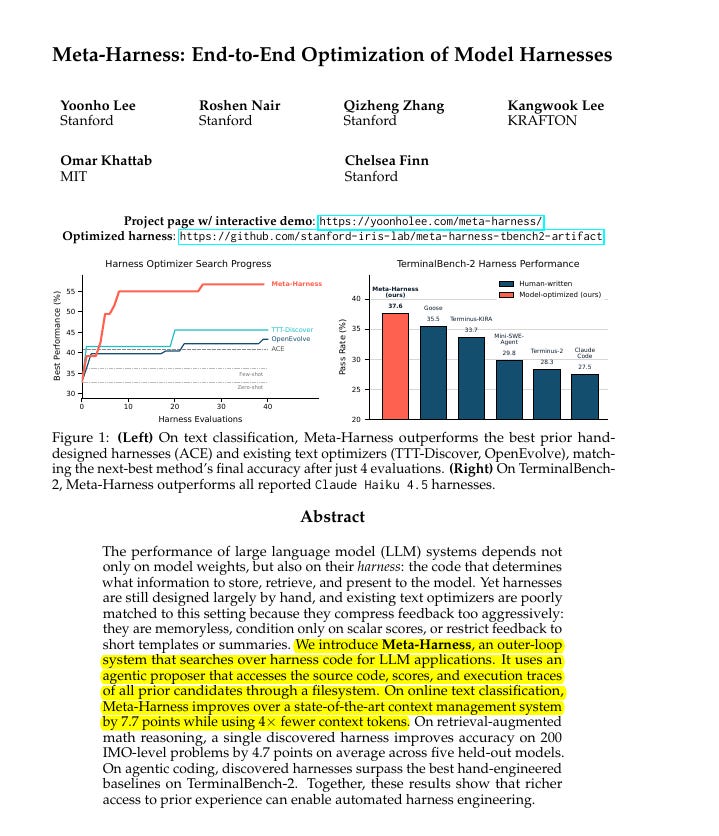
As per this paper, the “harness”, is what decides what to store, retrieve, show to the model, and how the workflow runs. With the same underlying LLM, changing the harness can create up to a 6× performance gap on the same benchmark.
They conclude the harness around a model matters as much as the model itself.
The paper introduces Meta-Harness, an outer-loop system that automatically improves harness code. Instead of giving the optimizing agent only a score or a short summary of past attempts, it gives the agent rich access to prior code, logs, and execution traces through a filesystem-like setup.
The idea is that better diagnostic visibility lets the system improve the harness more intelligently.
What it found is pretty significant.
- On online text classification, a 7.7-point improvement over a strong SOTA context management, while using 4X fewer context tokens.
- On retrieval-augmented math reasoning, an average gain of 4.7 points across five held-out models on 200 IMO-level problems. On agentic coding, the discovered harnesses beat strong hand-engineered baselines on TerminalBench-2.
The paper shifts attention from “which model is best?” to “how is the whole AI system designed?”
For real deployments, harness design affects reliability, tool usage, context management, and failure recovery.
That’s a wrap for today, see you all tomorrow.