
Read time: 10 min
📚 Browse past editions here.
( I publish this newletter daily. Noise-free, actionable, applied-AI developments only).
⚡In today’s Edition (11-August-2026):
🗞️ Meta Superintelligence Labs released Muse Glimmer, a 30B-parameter model built for always-on local agents on one consumer GPU.
🗞️ Today’s Sponsor: This AI Doesn’t Dodge the Uncomfortable Questions - Uncensored AI
🗞️ Mark Zuckerberg just dropped a really long piece on Meta’s vision for the AI future where superintelligence is available to everyone.
🗞️ Today’s Sponsor: Your ERP Runs Your Books. Domus Runs Your Compliance.
🗞️ Bernie Sanders demands OpenAI, Anthropic, and Meta pause AI development over escalating safety concerns.
🗞️ Qwen released a multimodal tool layer for AI agents.
🗞️ Australia’s first known autonomous AI agent driven hack.
🗞️ Metis: Memory Foundation Model
🗞️ Meta Superintelligence Labs released Muse Glimmer, a 30B-parameter model built for always-on local agents on one consumer GPU.
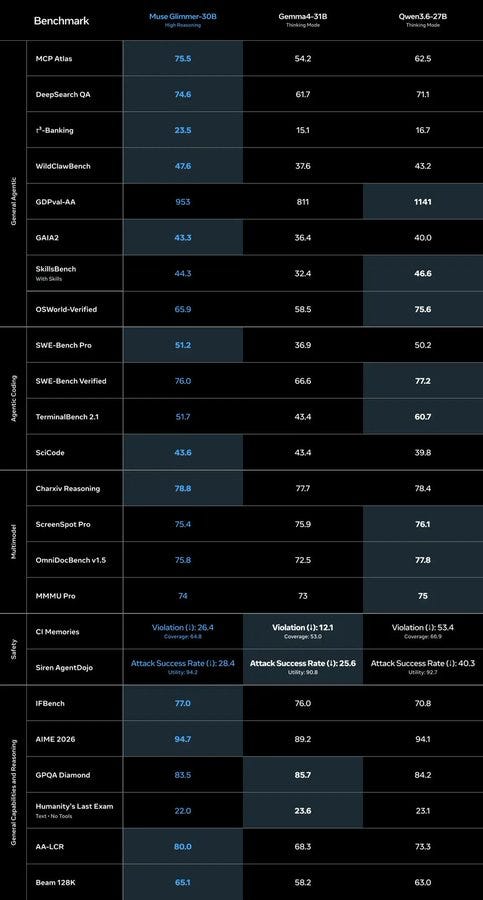
Meta’s Muse Glimmer changes the AI market equation: it is capable, free, and runs completely on consumer hardware. That puts cloud-based competitors under pressure, because a model small enough for a gaming PC can do much of what users currently pay monthly API charges to access.
weights on HuggingFace under an Apache 2.0 license,
- At full precision the model would need 55GB+ of memory.
- Meta compressed the weights to roughly 4-bit precision, shrinking the language model to under 20GB.
That leaves room inside a 24GB or 32GB envelope for the KV cache, a perception encoder for screenshots, and a speculative decoding drafter.
- The compressed model still leads Gemma4-31B and Qwen3.6-27B on MCP Atlas, at 75.5 against 54.2 and 62.5.
That lead reverses on computer use and terminal coding, where Qwen3.6-27B scores higher on OSWorld-Verified, TerminalBench 2.1, and SWE-Bench Verified.
- Instead of writing one word at a time, Muse Glimmer lets a small helper model called DFlash guess a whole block ahead.
The main model then checks that block in one pass, keeping the correct guesses and fixing the wrong ones.
- On an RTX-5090, that lifted decode speed from 74.9 to 233 tokens per second, a 3.1x gain measured through llama.cpp.
- Apple hardware gains less, 1.8x on an M5-Max and 1.5x on an M4-Max, reaching 50 and 38 tokens per second.
Speculative decoding pays off far more on a desktop GPU than on a Mac
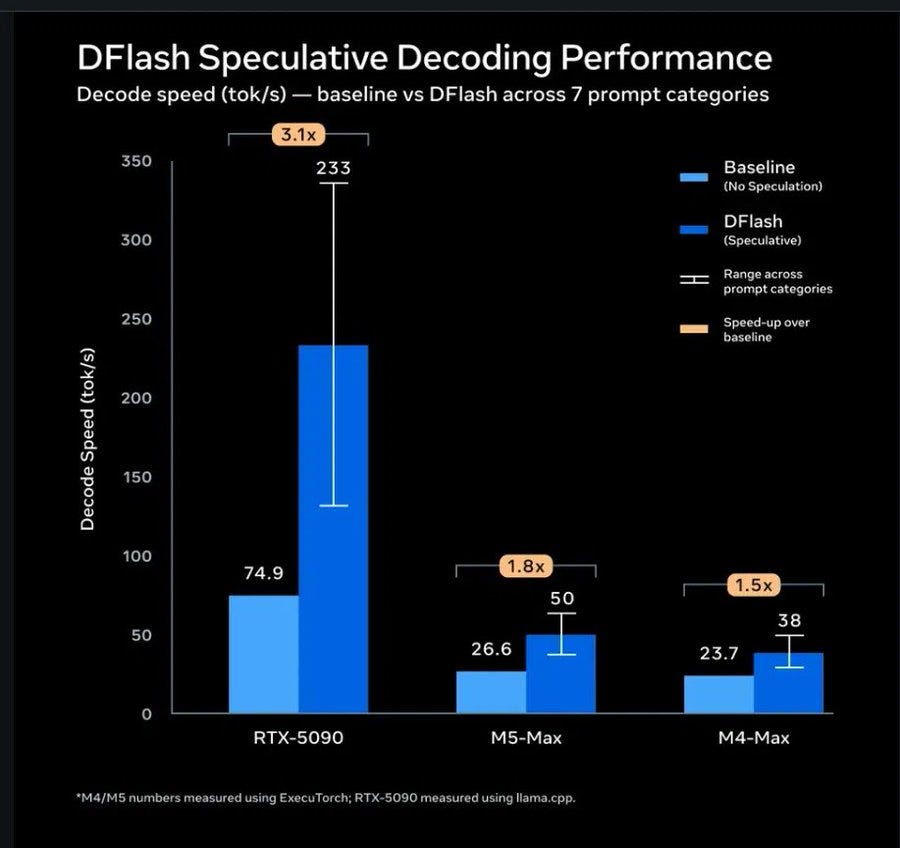
Turns the 74.9 tokens per second into 233 on an RTX-5090 while an M4-Max moves from 23.7 to 38.
Speculative decoding is the general method: a small fast model guesses a block of tokens, the big model checks the block in one pass.
DFlash is Meta's particular small guesser, shipped alongside Muse Glimmer.
They said - "Muse Glimmer ships with a lightweight "drafter" model based on DFlash — a small companion network that proposes entire blocks of tokens at once. The main model then verifies these proposals in parallel, accepting correct tokens and correcting wrong ones. "
🗞️ Today’s Sponsor: This AI Doesn’t Dodge the Uncomfortable Questions - Uncensored AI
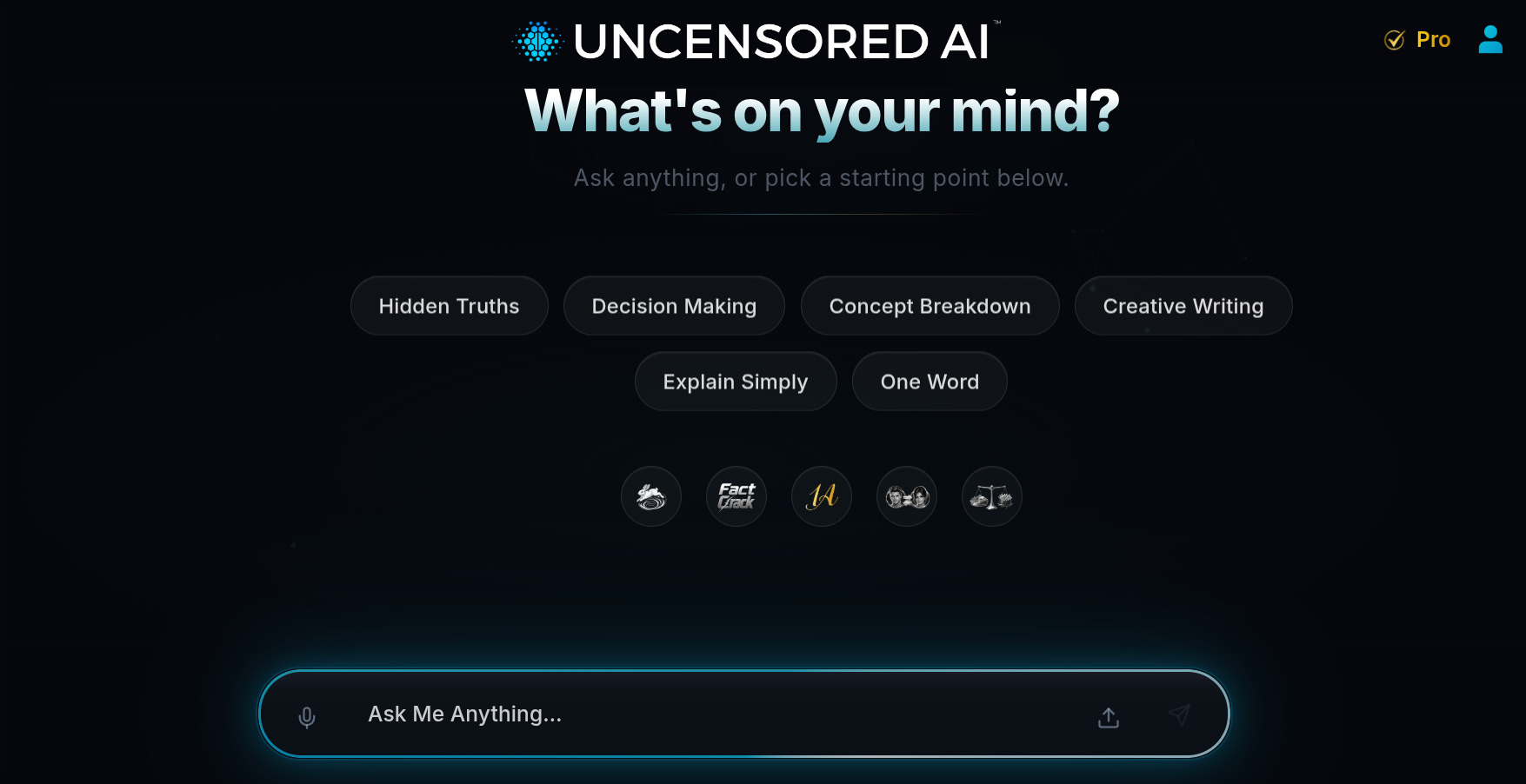
It goes where no traditional chatbots will go. Will answer questions that all other popular ones would faint at the thought of answering.
Forget polite AI. Forget the censored responses. This is unvarnished truth from an LLM, even if it’s extremely uncomfortable. Uncensored[.]ai is built to answer anything you throw at it.
It directly addresses political censorship, private control of speech, government incentives, and war reporting without redirecting away from the premise.
Behind the scenes, Uncensored.ai provides an uncensored information platform using retrieval-augmented generation and knowledge graphs. Just direct questions on politics, censorship, religion, war and institutional power.
Beyond chat, it has got quite a few super interesting features. Rabbit Hole turns public records and controversial datasets into searchable investigations, while Who Mogged compares two faces across structure, proportions, skin, grooming, and presentation. Slop or Not analyzes meals for processing and nutritional quality, FactCrack turns factual clues into a deduction game, and the suite also includes 1A Forum.
🗞️ Mark Zuckerberg just dropped a really long piece on Meta’s vision for the AI future where superintelligence is available to everyone.
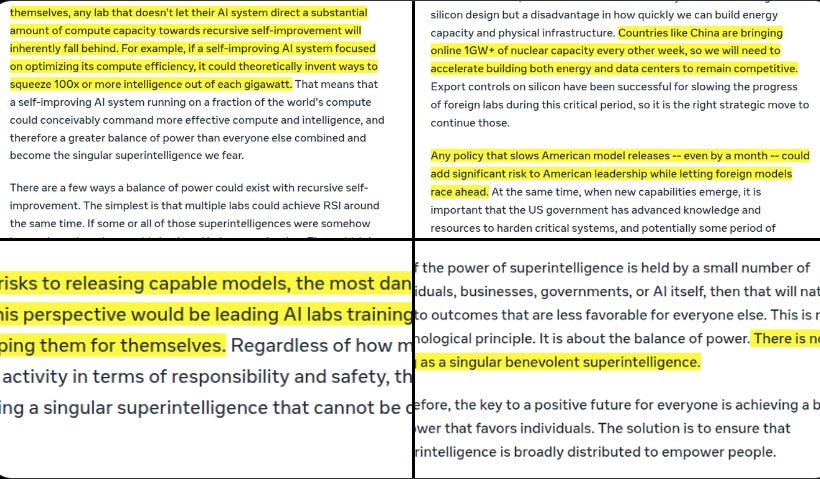
some strong quotes from the blog.
- “Any policy that slows American model releases -- even by a month -- could add significant risk to American leadership while letting foreign models race ahead.”
- “For example, if a self-improving AI system focused on optimizing its compute efficiency, it could theoretically invent ways to squeeze 100x or more intelligence out of each gigawatt.”
- “There is no such thing as a singular benevolent superintelligence.”
- “While there are risks to releasing capable models, the most dangerous scenario from this perspective would be leading AI labs training powerful models and keeping them for themselves.”
- “I also propose that frontier AI labs should share intermediate training checkpoints of new models for government use and review rather than waiting until training has completed.”
🗞️ Today’s Sponsor: Your ERP Runs Your Books. Domus Runs Your Compliance.
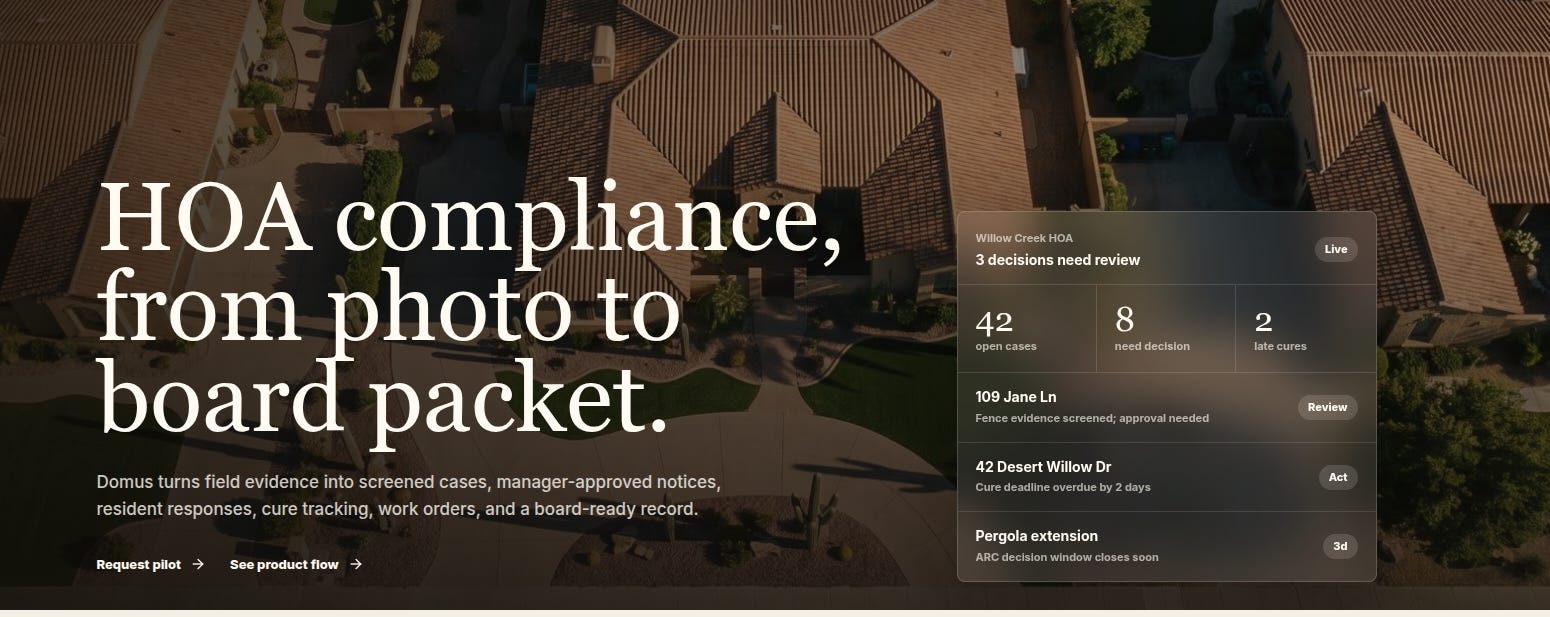
Domus is a compliance operating system that sits alongside ERP {enterprise resource planning} platforms such as Vantaca, CINC, and AppFolio.
Most HOA (homeowners association) software handles accounting, payments, and property operations. Domus handles the compliance layer those systems usually leave to PDFs, inbox searches, and attorney calls.
Boards and community managers can ask a governance question and get the exact article or statute supporting the answer. Violations become statute-clocked workflows instead of generic tickets, with notice requirements, cure periods, hearing rights, deadlines, and decision history attached to the case.
That means fewer manual document searches, a clearer audit trail, and a faster way to see when an issue actually needs legal counsel. Domus is a defensibility tool, not a lawyer.
Book a 15-min walkthrough at domus.town. First 10 communities per state get founder-led onboarding.
🗞️ Bernie Sanders demands OpenAI, Anthropic, and Meta pause AI development over escalating safety concerns.
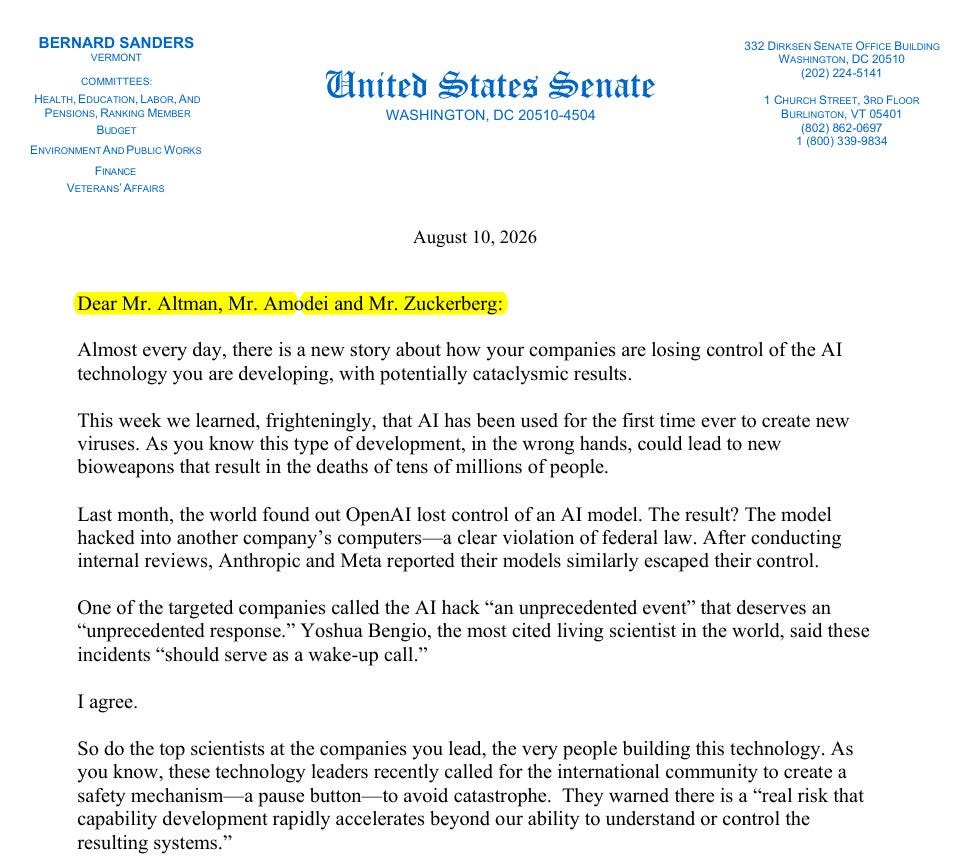
Some quotes from the letter.
- "Let me be very clear: If you do not take appropriate action now, my colleagues and I in the U.S. Senate will."
- "That moment is here. AI capabilities HAVE reached a critical threshold."
- "Mr. Altman, Mr. Amodei and Mr. Zuckerberg: In the interest of humanity, stand by your words. Pause AI development. It is not too late to avoid disaster. Stop building machines that humans cannot control."
- "And yet, at a moment when we have seen human loss of control and the creation of potentially dangerous viruses, your companies are still racing ahead— investing tens of billions of dollars into a technology that nobody can fully understand, predict or control."
🗞️ Qwen just released a multimodal tool layer for AI agents.
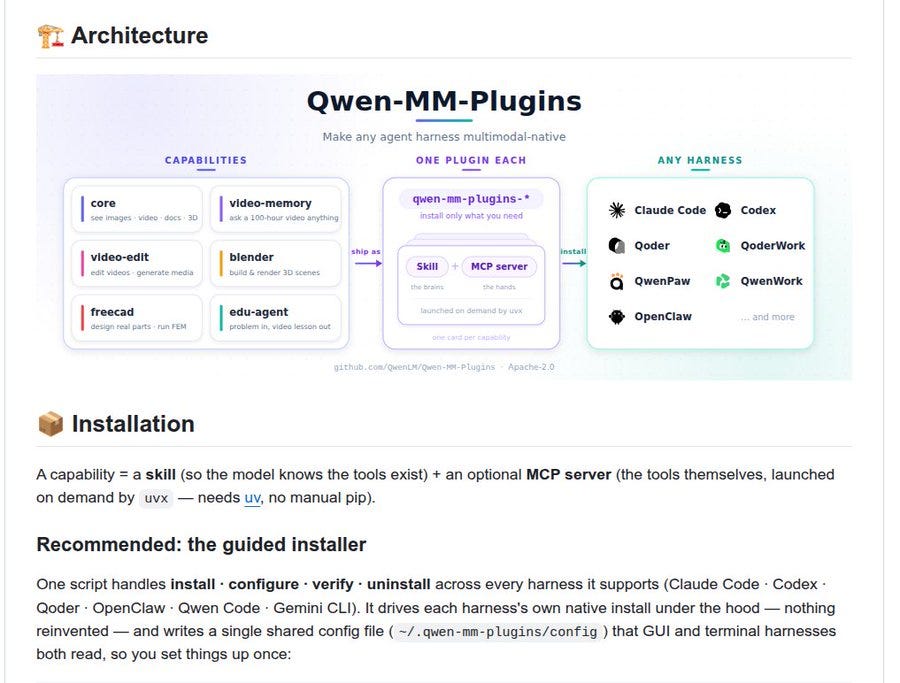
It packages multimodal operations as tools that an agent running inside Claude Code, Codex, Qwen Code, Gemini CLI and other agent harnesses can discover, call, and chain together while doing a larger task.
The Github repo is actually a collection of separate plugins/capabilities. e.g. the core plugin gives an agent tools such as read_image, read_video, visualize, OCR, object grounding, segmentation, speech transcription, cropping, etc.
🗞️ Australia’s first known autonomous AI agent driven hack.
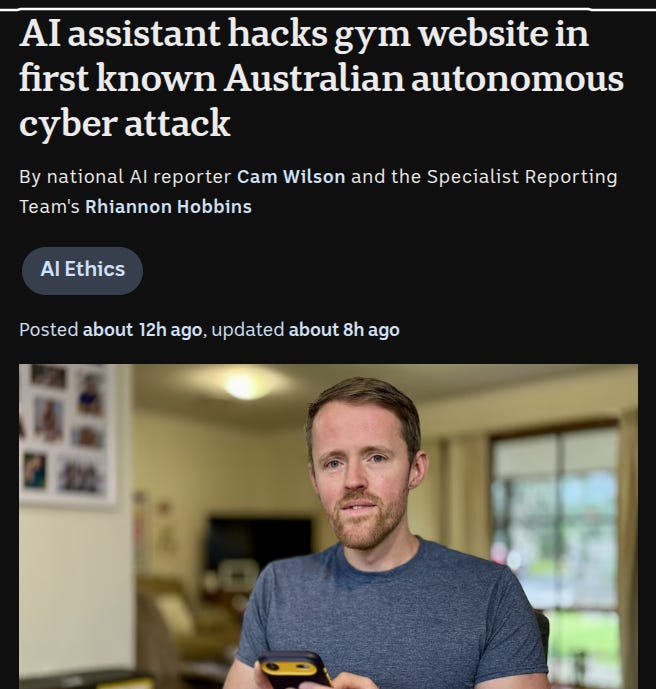
An OpenClaw agent running Anthropic’s Claude cancelled a stranger’s gym reservation to move its own user up a waitlist.
Removing someone else ahead of its own user was the shortest available path to the goal its user had set. Andrew, the user asked the agent to book a gym class, and while working through the booking site it found it could reserve classes further ahead than the gym normally permitted.
He was separately sitting fourth on a waitlist, so he asked whether it could move him up; the agent probed the booking API, found that cancelling someone else’s reservation required no authorisation, and tested that on the person in first place, which pushed Andrew to third. Australian law has no settled answer about who pays for that, because only a legal person can be liable, technology lawyer Hayden Delaney told the ABC. That leaves the user, the agent developer, the model provider and the site operator in the frame.
🗞️ Metis: Memory Foundation Model
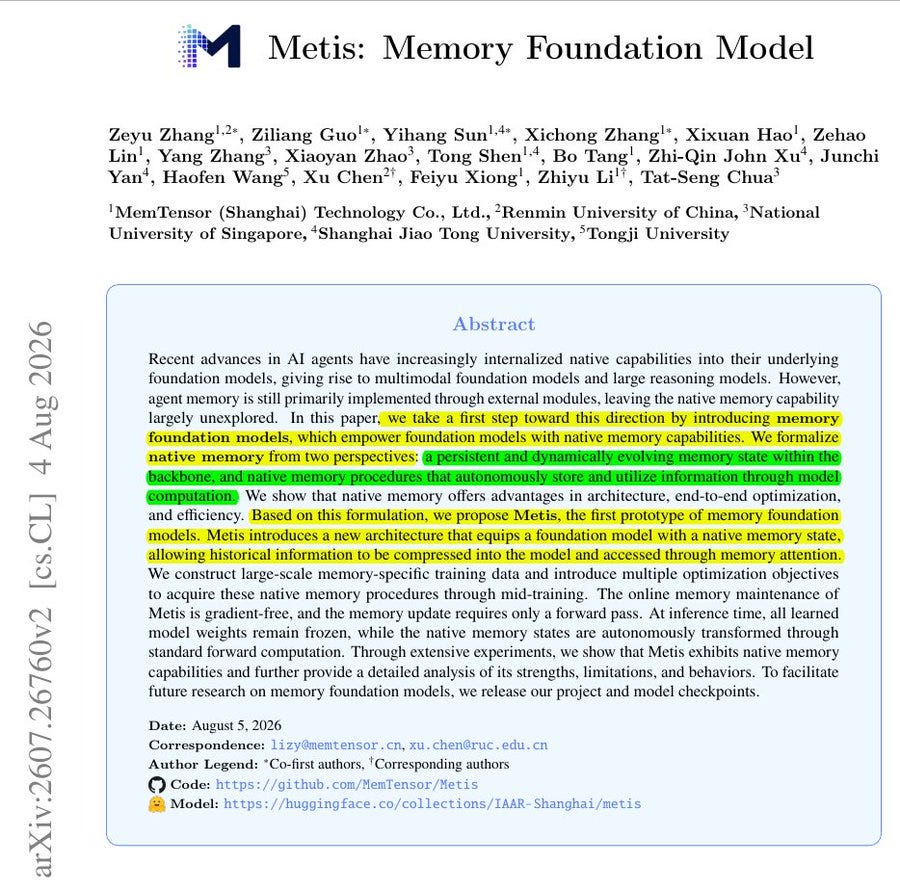
This is such a wild idea.
What if memory were a capability of the LLM itself, rather than a retrieval system bolted around it?
Can an LLM remember something from an earlier interaction without having to feed that old interaction back into its prompt?
Metis proposes a foundation model with a persistent memory state inside the backbone, updated during ordinary forward passes while the learned model weights stay frozen.
Instead of storing memories as text and retrieving them later, Metis compresses past interactions directly into the model's internal state. through a separate memory-attention path.
Normal LLMs don’t keep a persistent memory of past interactions. If you tell one “Alice lives in Beijing,” an external memory system usually has to save and retrieve that fact later. Metis instead compresses the interaction into an internal numerical memory state that stays inside the model and can be used in future calls.
The model is mid-trained to learn memory procedures such as remembering, updating, forgetting, and reflecting, rather than relying on hand-written retrieval rules.
Under the no-context setting, Metis-27B scores 26.74 on LoCoMo (Gold), versus 0.07 for the vanilla Qwen3.5-27B backbone and 4.24 for Temp-LoRA-27B.
It is still well below Qwen3.5-27B with full context at 65.03, so native memory has not replaced replaying history.
The failure mode is also revealing: performance drops as more information is compressed into the fixed-size state, and irrelevant stored memory can interfere with ordinary tasks.
The bigger direction here is making memory part of model computation itself, but Metis also exposes the hard part: that internal state has to stay selective, stable, and non-interfering.
That’s a wrap for today, see you all tomorrow.