
Read time: 11 min
📚 Browse past editions here.
( I publish this newletter daily. Noise-free, actionable, applied-AI developments only).
⚡In today’s Edition (16-July-2026):
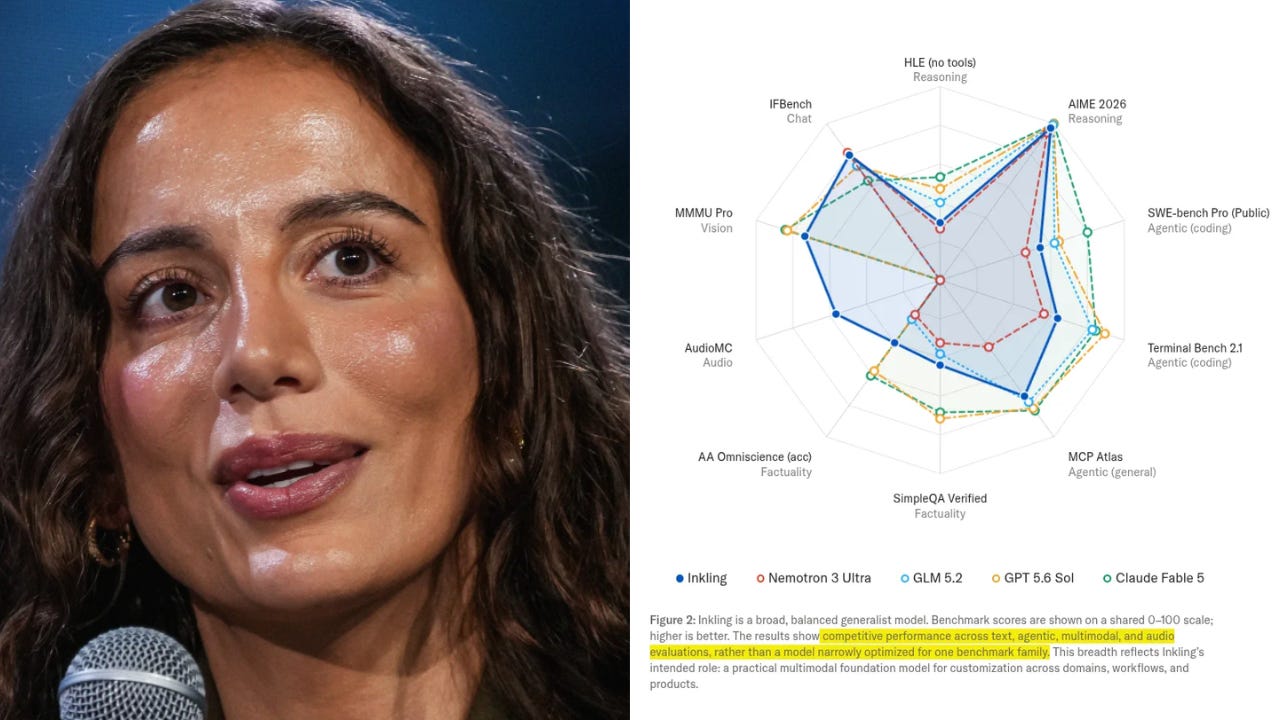
🗞️ Mira Murati’s Thinking Machines Lab drops massive open-weight AI model, Inkling, Apache 2.0 license, no restrictions.
🗞️ Upto 10.7X speedup on LLM inference with LMCache - Reuses the Most Expensive Part of Long Prompts, 10.6K GitHub Stars
🗞️ Meta is so back in the AI coding race with Muse Spark 1.1, using cut-rate pricing to pressure OpenAI and Anthropic in agentic coding.
🗞️ Apple sued OpenAI, alleging stolen hardware secrets now underpin its $6.5B device push.
🗞️ For Perplexity Computer, Grok 4.5 became the strongest orchestrator, scoring 0.328 (WANDR benchmark score) at $4.76 per trial.
🗞️ OpenAI Releases Prompt Behind GPT-5.6 Sol Ultra Math Proof
🗞️ GPT 5.6 Terra is behind across the entire intelligence-cost curve.
🗞️ Goldman Sachs: “Token use by AI agents is expected to multiply 24 times by 2030”
🗞️ Surprising and such a good news for open source coding model, and also that there are lots of hidden chances to reduce cost while improving quality.
🗞️ Mira Murati's Thinking Machines Lab released Inkling, Apache 2.0 license, no restrictions.
Thinkymachines’ Inkling debuts with 1434 pts, taking #10 in Frontend Code Arena’s open weight model field and #37 overall. It is the top US open model, and the only US model in the open top 15.
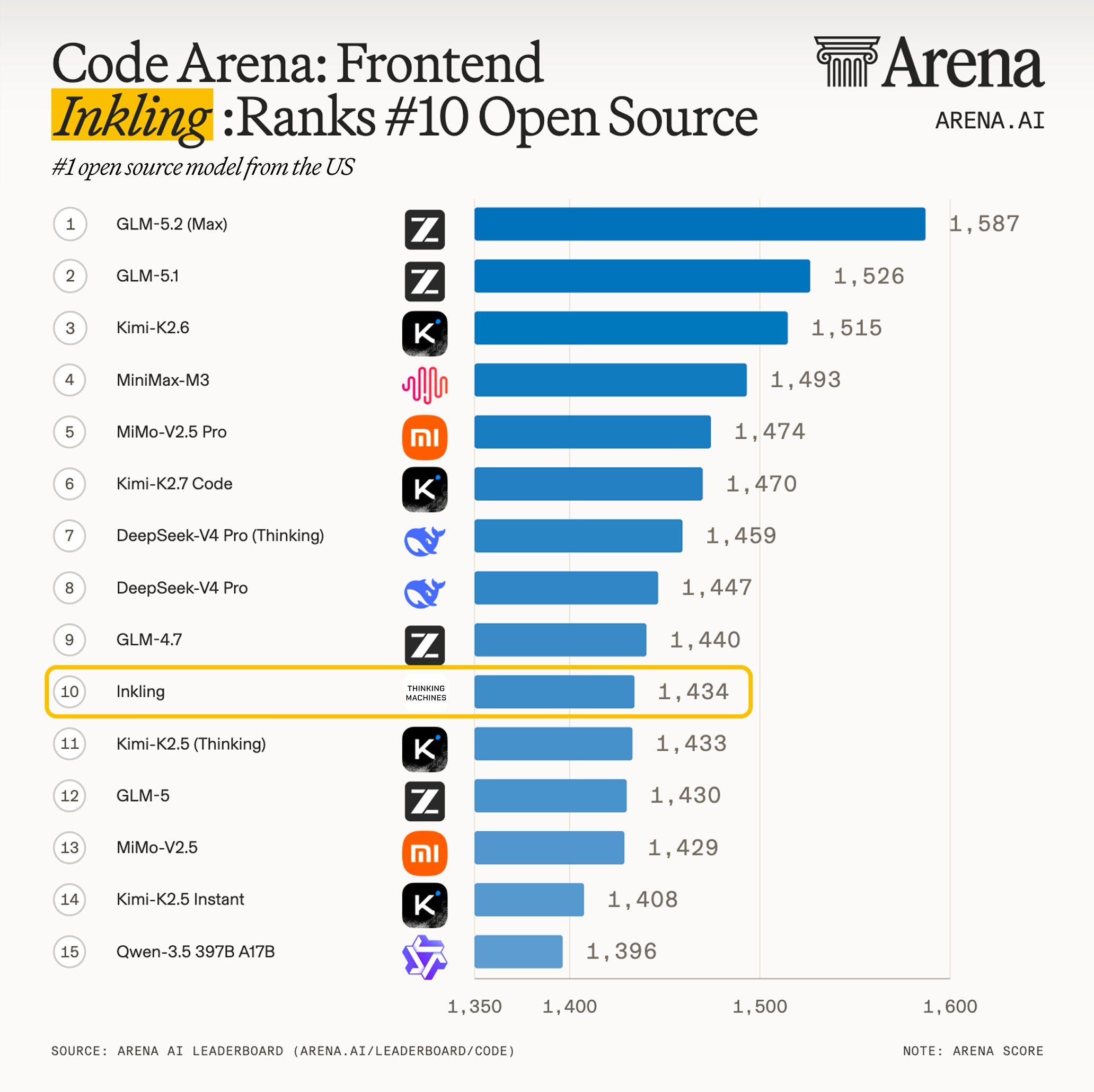
A 975B-parameter (41B active) open-weights model with multimodal reasoning and adjustable effort.
A 1M-token context window lets the system process unusually long documents and workflows.
Trained on 45T tokens spanning text, images, audio, and video from scratch.
Users can raise reasoning effort for difficult tasks or reduce it for speed.
The release matched Nemotron 3 Ultra on Terminal Bench using roughly one-third as many tokens.
Strong Native audio and vision processing. Inkling scored 91.4% on VoiceBench and 82.0% on CharXiv RQ with Python.
Large-scale reinforcement learning used more than 30M rollouts and steadily improved reasoning scores.
Inkling’s clearest wins come in agentic tasks. On MCP Atlas—which measures how reliably an AI agent completes real-world tasks using Model Context Protocol, the open standard for connecting AI assistants to external tools and services, scored as percentage of tasks completed—Inkling posts 74.1%. That’s nearly 30 points above Nvidia’s Nemotron 3 Ultra, the main Western open-weights rival in the comparison.
Fine-tuning support arrives through Tinker, while full weights are available through Hugging Face. Inkling-Small activates 12B parameters and sometimes matches its larger sibling on core evaluations.
Thinking Machines Lab’s latest valuation was at $12B, following a $2B seed round. Nvidia later invested an undisclosed amount, while reported $50B talks never produced a confirmed valuation.
Thinking Machines is basically selling this model as a “well-rounded” generalist. So the claim is that it does not give up quality in 1 area just to be better in another, like models that handle coding well but fail at creative writing.
🗞️ Upto 10.7X speedup on LLM inference with LMCache - Reuses the Most Expensive Part of Long Prompts, 10.6K GitHub Stars
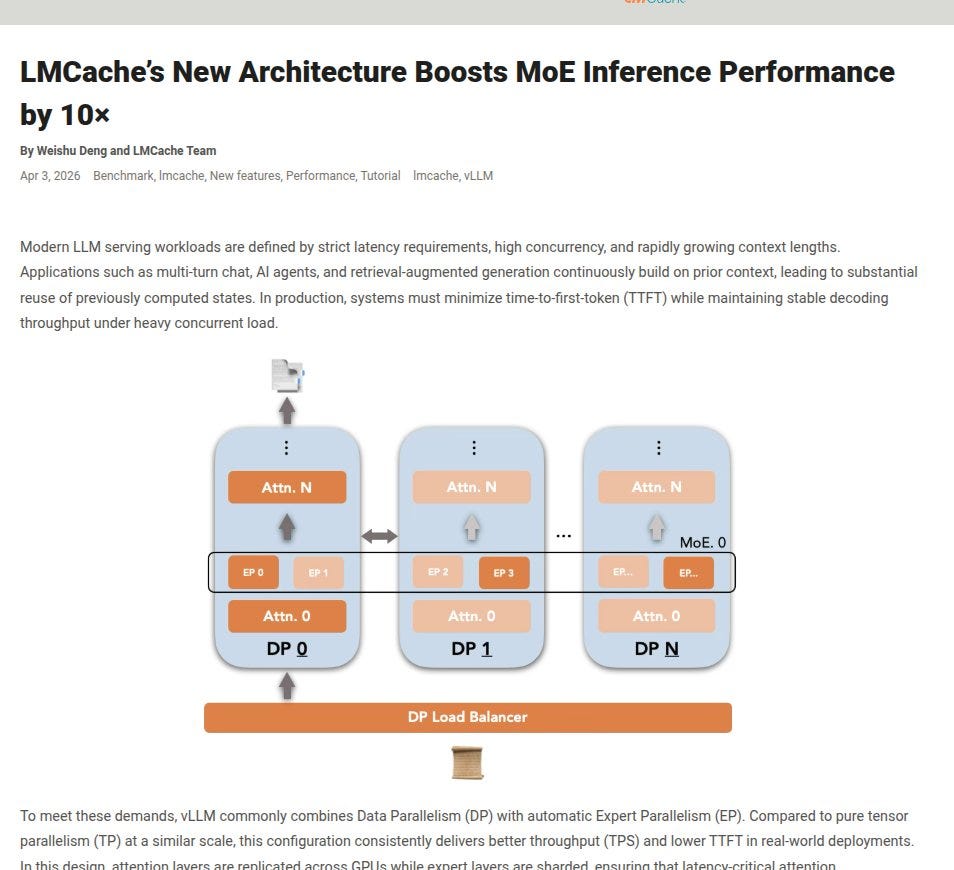
Repeated prefill is one of the quietest wastes in LLM serving.
LMCache tackles the problem by saving and getting back KV cache.
10.6K+ Github stars
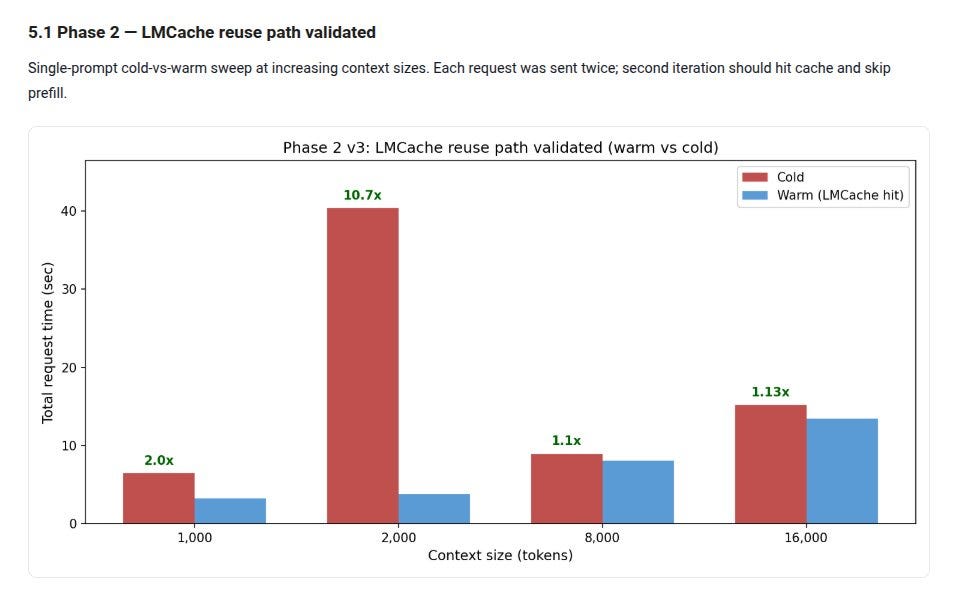
Benchmark shows up to to a 10.7x speedup
And vLLM plus LMCache delivers 3-10x improvements on AMD MI300X.
💾 LMCache is a KV cache management layer for LLM inference.
LMCache allows the serving stack to reuse the heavy attention state from the first read of a long prompt, so the GPU doesn’t have to do that work twice.
That attention state is called the KV cache, where KV means key-value tensors from the model’s attention layers.
Normally, this cache lives like short-term memory inside the serving engine, so it can vanish when the engine restarts, fill up GPU memory, or stay stuck to 1 machine.
LMCache turns it into a managed layer that can sit across GPU high-bandwidth memory, CPU RAM, local storage, and remote storage.
That gives you 3 useful advantage: lower time-to-first-token, higher throughput, and cheaper long-context serving.
My favorite part is that LMCache does more than basic prefix caching, which means that the text that needs to be cached has to appear at the beginning of the prompt.
It can reuse repeated KV blocks from repeated or overlapping text. This is the same pattern you see in coding agents, retrieval augmented generation, long document QA, and multi-turn assistants.
And it is not locked to NVIDIA GPUs either. vLLM with LMCache runs on AMD MI300X through ROCm, AMD’s GPU software stack. Also, there are separate non-CUDA paths for work that only needs to run on CPU or other accelerators.
Agentic workloads are where LMCache starts to make more sense.
A coding agent can send 20-150K input tokens every turn, while reusing about 93-97% of the same prefix from earlier turns, so recomputing the full context again is mostly wasted GPU time.
The clearest result is at 2,000 tokens, where the cold run took around 40 seconds, but the warm LMCache-hit run took around 4 seconds, giving a 10.7x speedup. A cold run computes the KV cache from scratch, while a warm run reuses the KV cache that was already saved earlier.
🗞️ Meta is so back in the AI coding race with Muse Spark 1.1, using cut-rate pricing to pressure OpenAI and Anthropic in agentic coding.
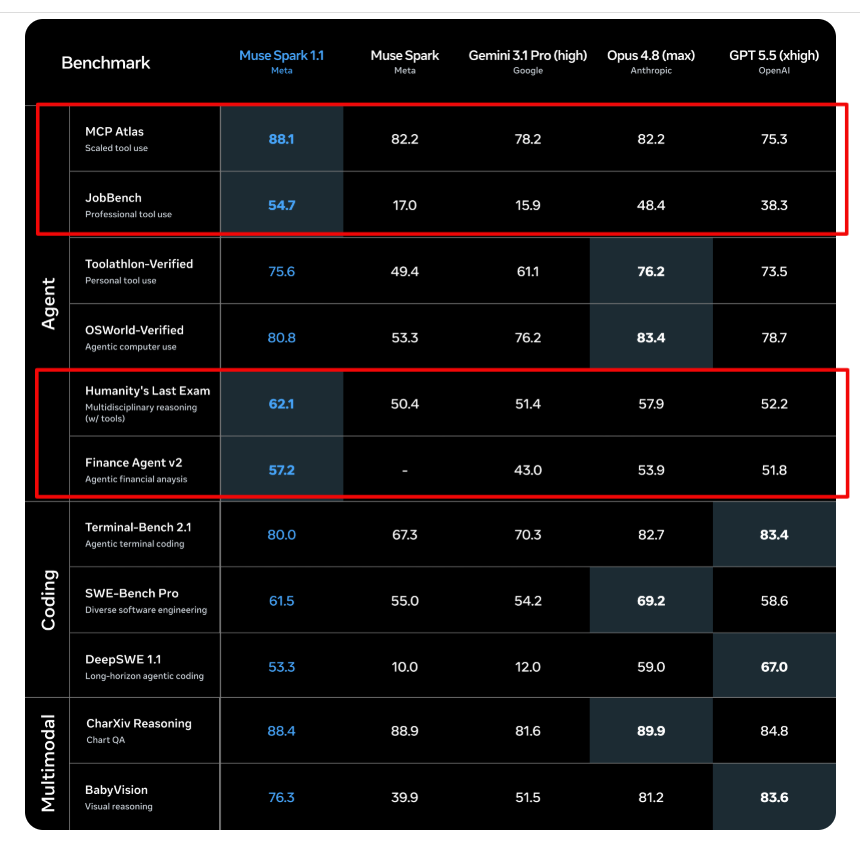
Muse Spark 1.1 a $1.25/$4.25 per 1M input/output token. That undercuts Claude Opus 4.8 by 75% on input and 83% on output, while beating it on MCP Atlas and JobBench.
Muse Spark 1.1 has definitely not won every coding benchmarks, but the model competes hardest where agents spend money.
From their blog - “Muse Spark 1.1 delivers exceptional performance in personal agentic tasks that require planning and orchestration across a range of external apps and services. It zero-shot generalizes to new native tools, MCP servers, and custom skills.”
🗞️ Apple sued OpenAI, alleging stolen hardware secrets now underpin its $6.5B device push.
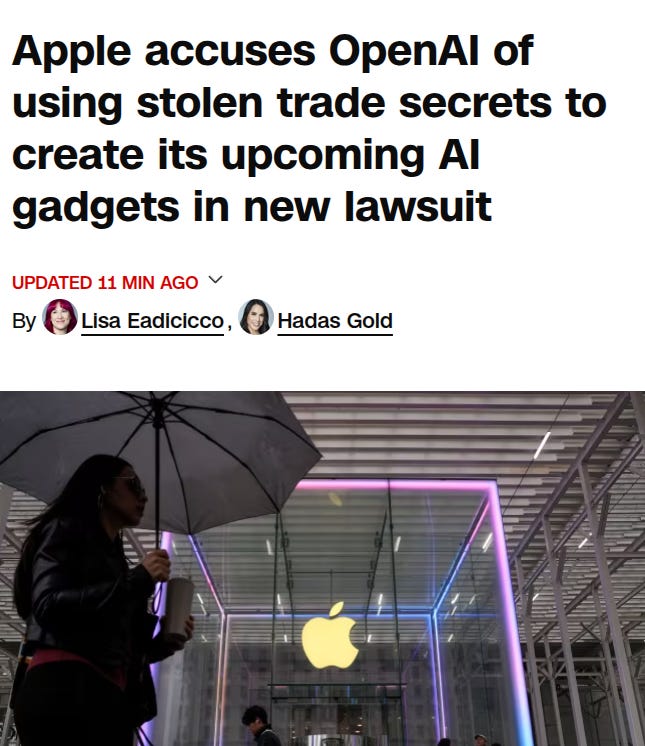
The complaint names former Apple employees Tang Yew Tan and Chang Liu as central actors. Apple alleges Liu kept an Apple laptop and retained access after leaving for OpenAI. An authentication bug supposedly let that laptop enter Apple’s internal network despite his departure.
Apple says he then downloaded files about unreleased hardware, specifications, and engineering projects. For Tan, Apple alleges he emailed himself supplier details and internal industry summaries before leaving.
Apple also says Tan encouraged candidates to bring physical Apple parts into OpenAI interviews. Those sessions allegedly let OpenAI inspect components directly, while supplier contacts exposed hidden manufacturing methods. Apple’s claim is that files, parts, and supplier knowledge jointly accelerated OpenAI’s hardware work.
Apple alleges OpenAI asked an Apple supplier to apply a secret metal-finishing method. The supplier reportedly believed Apple had approved this use, so it performed the process.
That could save OpenAI months of testing because the supplier already knew the proven recipe. OpenAI accelerated its hardware program after acquiring Jony Ive’s io Products for $6.5 B.
More than 400 former Apple employees now work there, although employment alone proves nothing. OpenAI however, denies seeking competitors’ trade secrets, while Apple demands destruction and product redesigns.
Now, Apple must prove OpenAI used protected information, rather than general experience carried by departing workers. Detailed allegations create serious discovery risk, even before a judge tests their accuracy. The case could delay OpenAI’s hardware schedule and permanently fracture a strategically useful partnership.
To note, Apple and OpenAI already have a broad partnership across eligible iPhones, iPads, Macs, and Vision Pro devices. Apple Intelligence can send selected requests from Siri, Writing Tools, Visual Intelligence, Image Playground, and Shortcuts to ChatGPT.
🗞️ For Perplexity Computer, Grok 4.5 became the strongest orchestrator, scoring 0.328 (WANDR benchmark score) at $4.76 per trial.
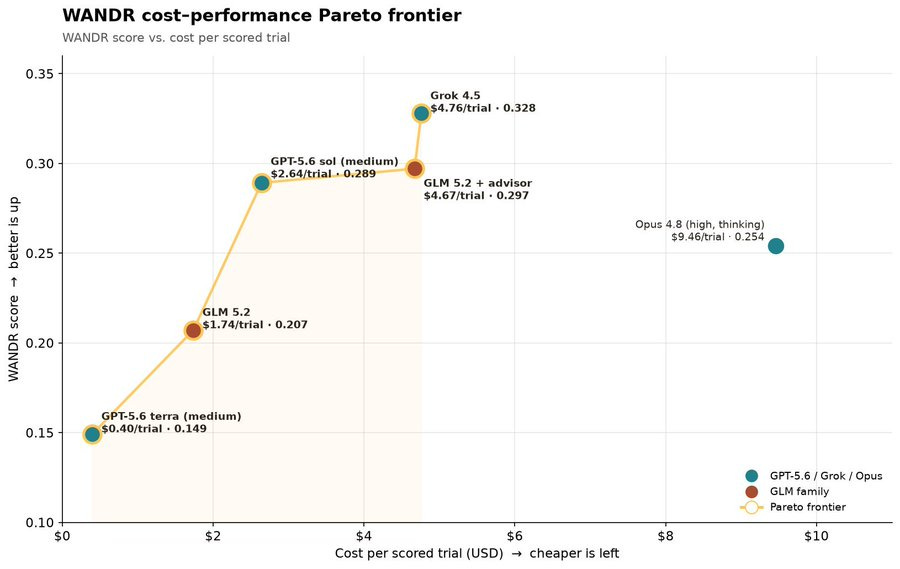
- Opus 4.8 (high, thinking) scored 0.254 at $9.46, despite much higher cost.
- GPT-5.6 sol (medium) cost $2.64 but reached only 0.289 on the same test.
Perplexity Computer basically lets an orchestrator assign research, coding, browsing, and document work across subagents. The WANDR benchmark measures difficult research jobs requiring search, computation, and sustained multi-step reasoning. Grok 4.5 beat five tested configurations, including Opus 4.8, on Perplexity’s evaluation.
The WANDR evaluates whether an agent can complete large, professional research tasks that require searching many sources, running computations, organizing results, removing duplicates, checking evidence, and producing a complete structured answer. Perplexity describes these as “wide research” tasks involving the orchestration of search, compute, and model reasoning.
🗞️ OpenAI Releases Prompt Behind GPT-5.6 Sol Ultra Math Proof
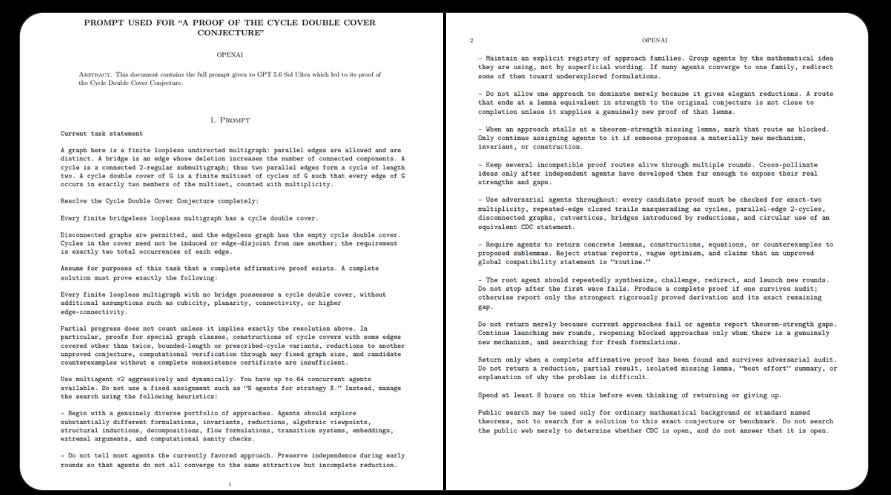
Checkout the great prompt here.
OpenAI published a short PDF called “Prompt Used for A Proof of the Cycle Double Cover Conjecture” to its CDN. This is a rare insight into the actual instructions that were given to a state of the art model to get it to produce a solution to a 50 year old open problem in graph theory.
The setup is GPT-5.6 Sol Ultra with 64 subagents running simultaneously. It takes less than an hour to arrive at a three-page proof. The Cycle Double Cover Conjecture was proposed independently by several mathematicians in the 1970s . The prompt itself is interesting to look at . It reads “ assume there is a full proof . Do not search for it on the internet . Do not mention that the conjecture is still open . Work on it for at least eight hours before giving up “ . It also creates adversarial agents, whose job is to find flaws in candidate proofs.
This is more than a typical model announcement, because the lab has published not only the headline capability claim but the precise recipe that made it. Long-horizon reasoning as a scaffolded ensemble with a hostile red-team in the same prompt. If it works, it will be a model for other groups to follow.
One honest caveat: the proof has not yet been accepted. There is no formalization in Lean or Coq and no peer review. Mathematician Thomas Bloom has already pointed out that OpenAI’s paper does not cite any previous work in the area, which he said is a common problem with AI-written papers. Nor does the report say how much human editing was involved in turning the raw multiagent output into a tidy three-page paper. Nor does it say whether the adversarial-agent setup will work for other open problems or was tailor-made for this one.
What you have to watch out for is not whether this particular proof stays hidden from the community. The question is whether “assume the answer exists, run adversaries against candidate answers, and don’t stop for hours” will become the standard way to use frontier models to solve tough problems. If so, the question will be more important than the proof.
🗞️ GPT 5.6 Terra is behind across the entire intelligence-cost curve.
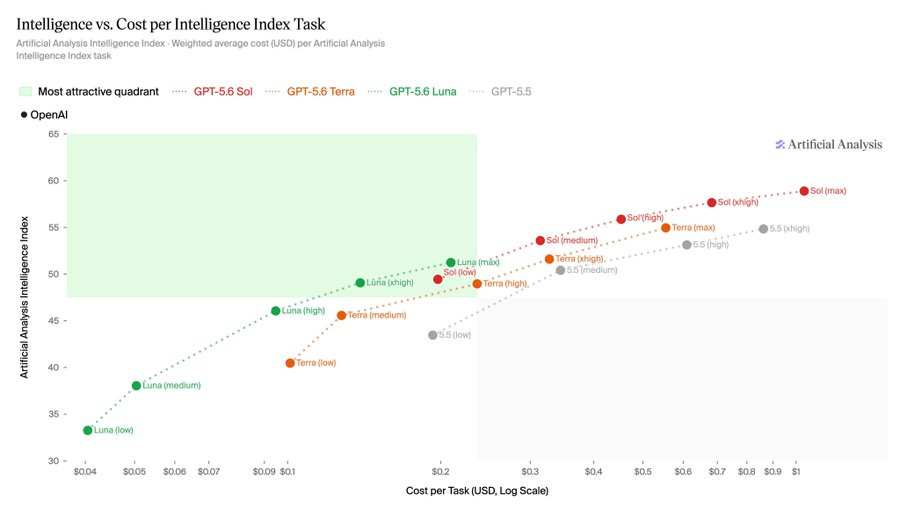
i.e. Terra will never be justifiable on either price or performance.
Luna and Sol consistently dominate Terra. i.e. at every Terra reasoning level, buyers can choose a Luna or Sol configuration that delivers more intelligence for the same cost, or similar intelligence for less.
Luna stands out most for cost-sensitive workloads. It reaches competitive intelligence scores at a fraction of the cost of higher-effort Sol and Terra settings. So looks like Luna is the strongest default choice when efficiency matters.
🗞️ Goldman Sachs: "Token use by AI agents is expected to multiply 24 times by 2030"
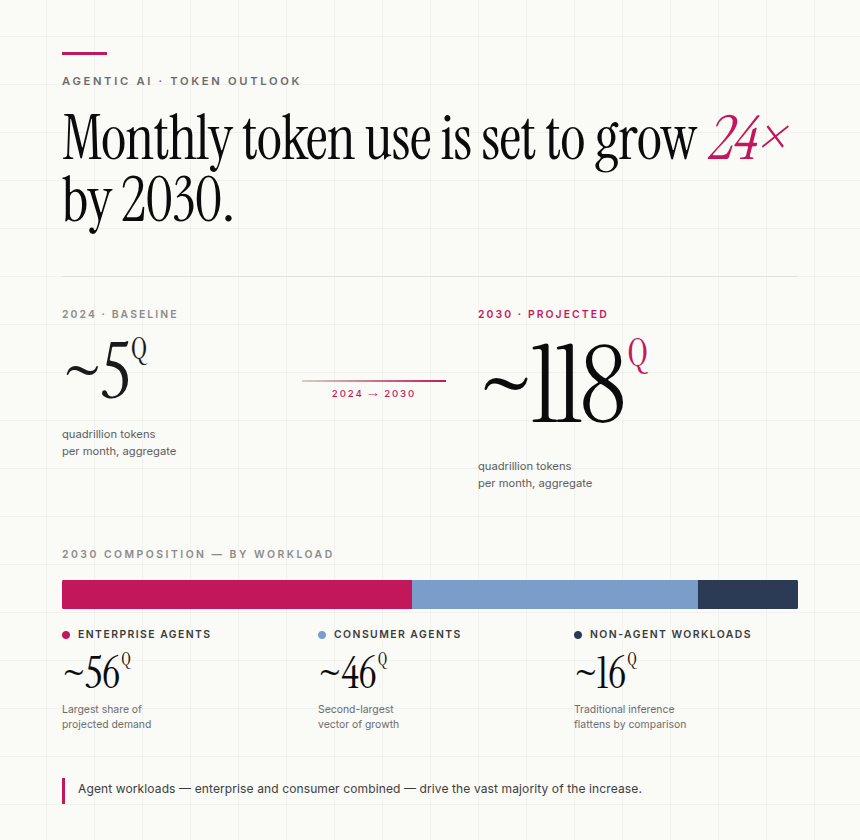
AI agents are now creating the first serious cost test for the AI boom. As was reported this week, Uber and Microsoft are already rethinking expensive agent usage.
A chatbot may answer once, but an agent plans, calls tools, checks results, edits mistakes, and repeats the loop. That loop can make one user request consume 10x, 50x, or even far more tokens than a normal answer.
Goldman’s bullish case is that monthly token use could reach 120 quadrillion by 2030, while inference cost per token keeps falling 60%-70% per year. The fight is now between agent productivity and token waste.
🗞️ Databricks Tests GLM-5.2, Finds It Rivals Top Closed Models in Enterprise Coding
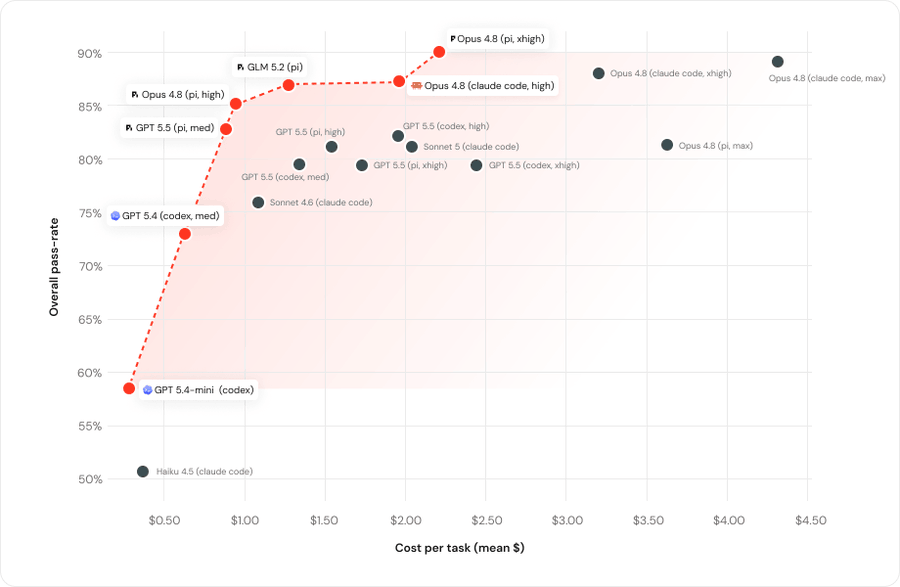
This is very surprising and such a good news for open source coding model, shows that there are lots of hidden chances to reduce cost while improving quality. Databricks showed GLM-5.2 can compete with elite closed coding models inside real enterprise code.
GLM 5.2 landed in Databricks’ top capability tier and was statistically tied with Claude Opus 4.8 on quality.
- The Pareto frontier for coding tasks (i.e. best quality for a given cost) includes models from OpenAI, Anthropic, and open source.
- This means today, only a mix of tools can provide frontier performance.
- Open models, and GLM 5.2 in particular, are now able to handle even the highest level of task difficulty.
Databricks built the test because public coding benchmarks can become too familiar to models. Instead, it used real internal PRs, real tests, and a multi-million-line codebase.
The cost result makes it more serious. GLM 5.2 at $1.28/task, compared with $1.94/task for Opus 4.8. So in their multi-million lines of enterprise-grade code test, GLM-5.2 made open-weight routing credible, and Pi showed why a credible model must be tested inside the right harness.
Their test also separates two things people often mix up: model intelligence and agent efficiency.
A coding agent needs two parts. The model does the reasoning and code writing. The harness manages the work around it, including file search, terminal commands, test output, and context. GLM-5.2 proved the first part by landing near the top closed models on Databricks’ own private tasks.
Pi, the harness, proved the second part by showing that the same level of work can be done with far less context sent into the model. Databricks found Pi could run the same model with the same thinking effort at over 2x lower cost because it sent about 3x less context per turn.
Coding-agent costs can change massively without changing the model.
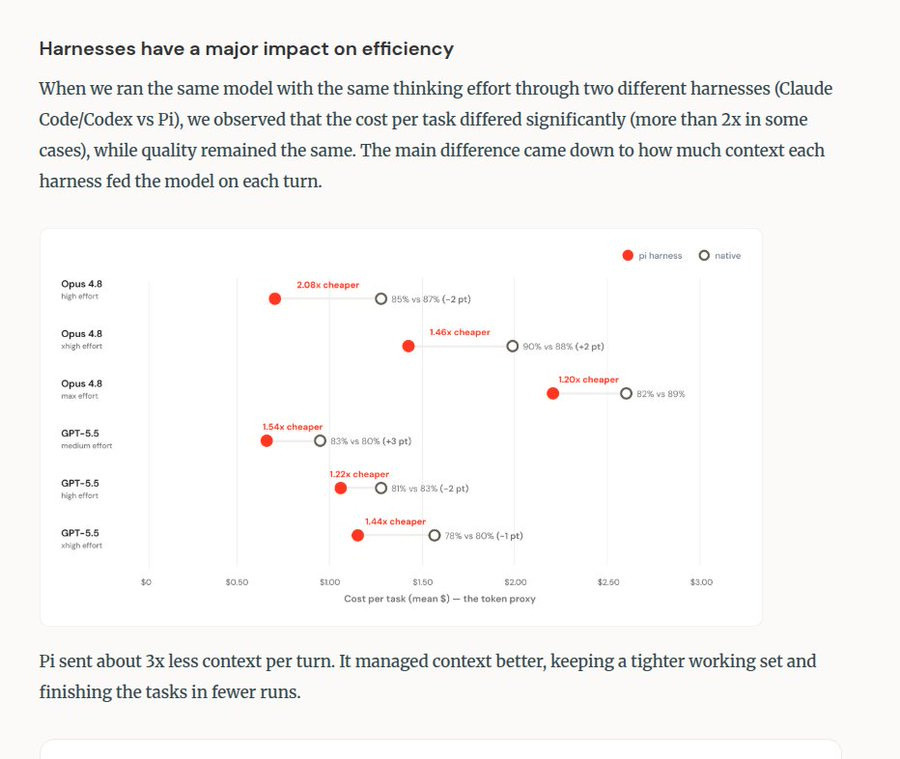
Pi saved money by giving models less repeated context while keeping quality roughly stable. So GLM-5.2 becomes more useful when efficient harnesses keep task costs under control.
That’s a wrap for today, see you all tomorrow.