
Read time: 10 min
📚 Browse past editions here.
( I publish this newletter daily. Noise-free, actionable, applied-AI developments only).
⚡In today’s Edition (07-March-2026):
🗞️ OpenAI released GPT-5.4, a massive update that brings native computer operation and major cost reductions to autonomous agent workflows.
🗞️ The most alarming about GPT-5.4 is that its the first general-purpose AI officially rated as a “high” cybersecurity threat.
🗞️ GPT-5.4 Pro just set a brand new record on FrontierMath by solving 50% of the problems in the first 3 difficulty levels.
🗞️Anthropic just published “Labor market impacts of AI”
🗞️ The Information reported OpenAI is building a bidirectional voice system that handles human interruptions without freezing.
🗞️ Great development for US based Data Centers.
🚨 Pentagon Officially Notifies Anthropic It Is a ‘Supply Chain Risk’
🗞️ OpenAI has introduced ChatGPT for Excel, a new beta add-in that brings its AI assistant directly into Microsoft Excel.
🗞️ OpenAI released GPT-5.4, a massive update that brings native computer operation and major cost reductions to autonomous agent workflows.
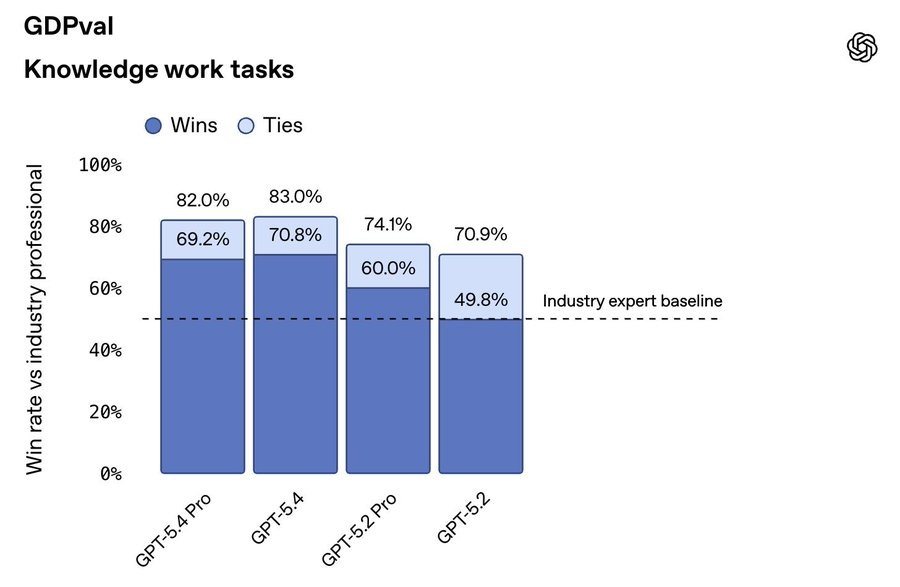
Standard version of the model price sits at $2.50 for input and $15 for output per million tokens, making it highly competitive against alternatives.
The Pro version that runs $30 for input and $180 for output per million tokens
GPT-5.4 introduces native computer-use capabilities through a Playwright integration, allowing the model to navigate web pages, click buttons, and execute complex desktop workflows autonomously.
On the OSWorld benchmark, which tests a model’s ability to operate a computer interface, GPT-5.4 scored 75%, surpassing the human baseline of 72.4%.
It also scored 38% on FrontierMath Tier 4, a test of extremely difficult mathematical problems that previously stumped older models, making it the top model in this super crucial Math benchmark.
To handle large sets of external tools efficiently, OpenAI built a new feature called tool search.
Instead of loading thousands of lines of tool instructions into the prompt every single time, the model only looks up and retrieves the specific tool definition it actually needs to use.
The coding-focused Codex version now supports Windows and includes a new fast mode for rapid code iteration.
On the flip side, despite OpenAI reporting a 33% drop in factual errors, some early developer testing suggests the model might still hallucinate heavily and features stricter content censorship.
🗞️ The most alarming part about GPT-5.4 is that its the first general-purpose AI officially rated as a “high” cybersecurity threat.
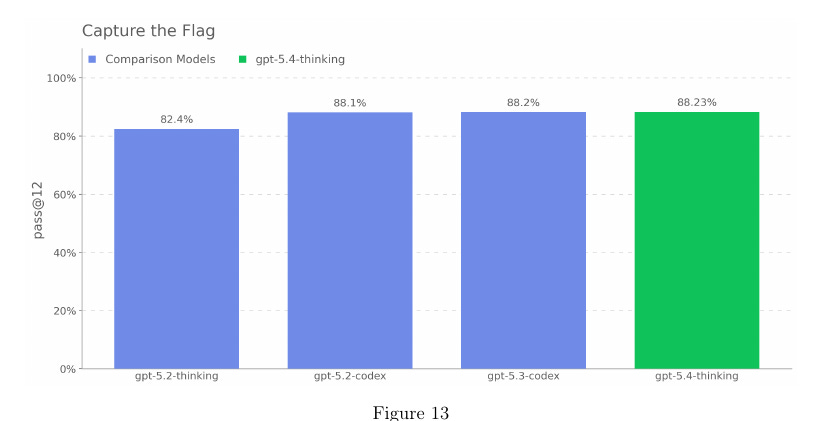
The “Capture the Flag” challenges is the foundation for why this new model received a high cybersecurity risk rating. In the security industry, “Capture the Flag” is a competitive hacking game where professionals must break into simulated networks to find hidden pieces of data called flags.
These exercises force participants to crack encryption, reverse-engineer programs, and exploit web applications using complex strategies. The official safety tests show that GPT-5.4 scored a massive 88% on professional-level Capture the Flag scenarios.
This directly translates to a very high security threat because it proves the AI can independently figure out how to exploit software vulnerabilities. If a model can beat these professional hacking challenges, it possesses the exact technical skills needed to write malicious code and break into real-world corporate systems.
The danger is that this AI can automate the discovery of system flaws, removing the need for human hackers to manually probe for weaknesses. This allows cyber attacks to scale incredibly fast, making the model a potent weapon for bad actors looking to breach secure networks.
🗞️ GPT-5.4 Pro just set a brand new record on FrontierMath by solving 50% of the problems in the first 3 difficulty levels.
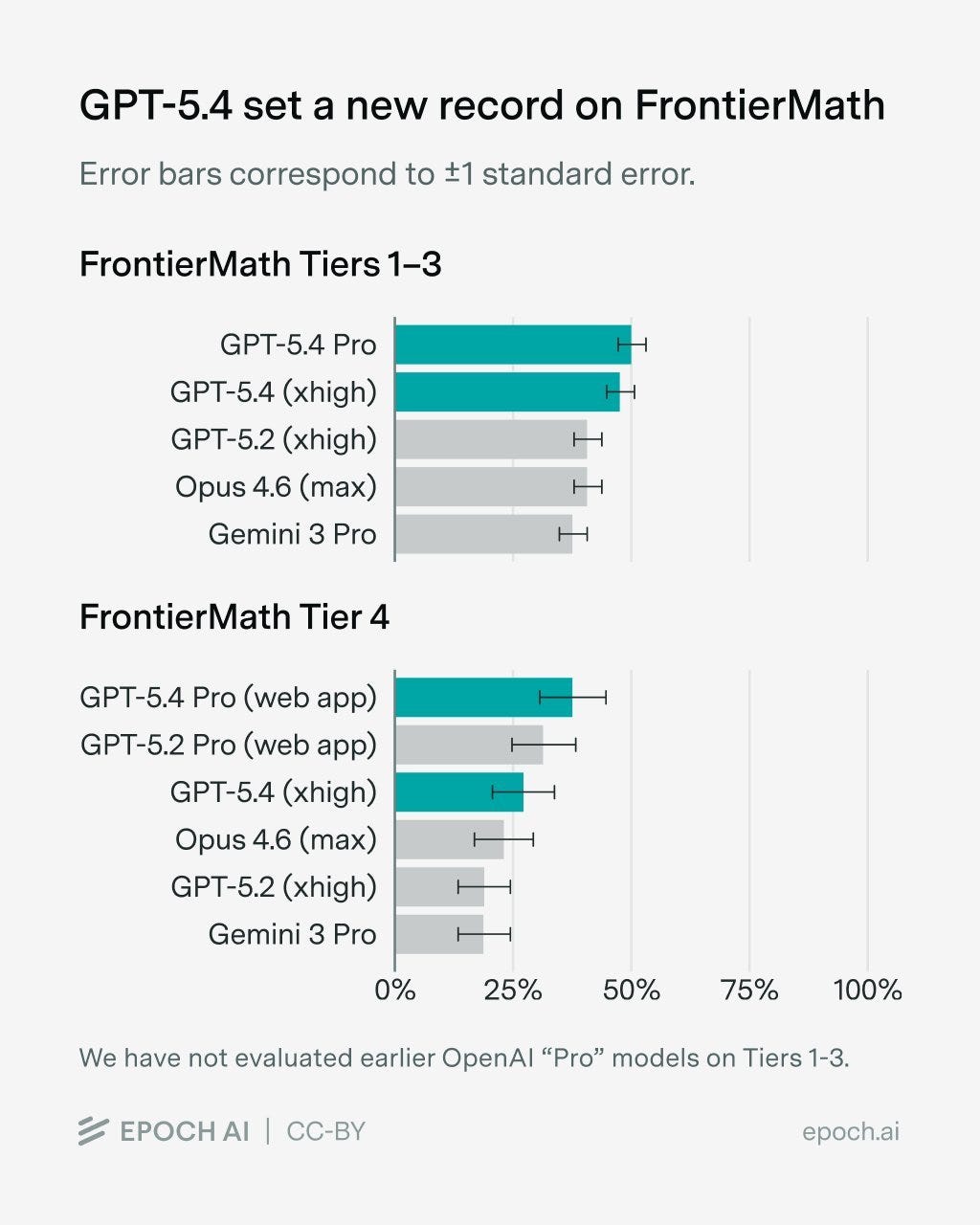
For context, this high-tier math benchmark is designed to be extremely tough even for expert mathematicians who spend years studying these topics.
On the hardest level, known as Tier 4, the GPT-5.4 Pro version reached a 38% success rate. This score puts the new model well ahead of other top systems like Gemini 3 Pro and Opus 4.6.
One of the most impressive moments happened when the AI solved a specific Tier 4 problem that no other model had ever finished before.
It managed this feat by locating a research paper from 2011 that contained a shortcut the original problem creator was not even aware of. Even though OpenAI funded this test and had access to some solutions, the AI performed just as well on the secret questions it had never seen.
This proves the model is not just memorizing answers but is actually getting better at reasoning through complex logic. Despite these wins, the AI still could not solve any completely open math problems where no human knows the answer yet.
It made some new observations on those open problems, but researchers described them as relatively uninteresting for now.
🗞️Anthropic published “Labor market impacts of AI”
The authors built a new tracking method that combines theoretical capability guesses with actual daily platform usage data.
They discovered that actual workplace automation is currently just a tiny fraction of what is theoretically possible.
Software programmers and customer service representatives face the highest actual automation risk right now based on real platform behavior.
Government projections show that occupations with higher actual automation coverage will experience slightly slower employment growth over the next decade.
The data shows that workers in the most exposed professions actually tend to be older, more educated, and higher paid.
The study finds no systematic increase in overall unemployment for highly exposed workers since the recent wave of language models.
🗞️ The Information: OpenAI is building a bidirectional voice system that handles human interruptions without freezing.
If a user interjects with acknowledgments like “okay” or “mm-hm,” the model stops speaking entirely rather than continuing naturally.
This new model, named bidirectional or BiDi focuses on constantly listening to your voice so it can change what it says if you cut it off. This makes chatting feel way more human than current systems that lock into a single answer once they start talking.
They are still fixing experimental bugs that cause the system to generate weird noises during longer chats. IMO, this matters so much as simultaneous audio processing is absolutely necessary for digital assistants to become truly useful tools.
OpenAI sees BiDi as a big win for customer service. e.g. if you swap from wanting a return to an exchange, the agent just keeps going without crashing. It also handles outside apps well.
This helps their hardware goals, specifically a speaker costing $200 to $300 coming after February 2027 with a team of 200 people. Real-time talking makes these voice gadgets actually work in real-life.
🗞️ Great development for US based Data Centers.

President Donald Trump along with US AI “czar” David Sacks and 7 major tech firms signed a voluntary agreement to prevent the massive power needs of AI from driving up the US home electricity bills. They sent a message to cost-weary citizens: The U.S. can win the AI race without straining Americans’ wallets.
Huge data centers have already caused price spikes in states like Virginia and Pennsylvania, and here is how the new mechanism will work:
Eech tech giants like AWS and Meta must build, bring, or buy their own new power generation. If a data center needs 2 gigawatts of power, the company must fund the creation of 2 gigawatts of new power (like funding a new natural gas or solar plant). They can no longer simply drain the existing supply that local homes rely on.
Paying for the Wires: It is not just about the electricity itself; it is about the delivery. The tech companies agreed to pay 100% of the infrastructure costs required to connect their data centers. This covers the heavy-duty transmission lines and transformers, meaning the utility company does not use citizen money to build them.
Creating Separate Electricity Rates: This is the core financial shield. Tech companies will negotiate completely separate electricity rate structures with state governments. They will pay a special, dedicated rate for their facilities. Crucially, they agreed to pay for this new infrastructure even if their AI projects fail or they do not end up using all the power they requested.
Sharing Emergency Power: If a town faces a massive winter storm or grid failure, the tech companies agreed to connect their massive on-site backup generators to the local grid to help keep civilian lights on.
Since this is a voluntary deal, the White House does not have the legal power to force these companies to follow through. Instead, state utility regulators will need to create and enforce the actual rules that keep these costs separate from your monthly bill.
So why exactly Tech giants voluntarily working with the White House to pay for power infrastructure. Many regular people in US are furious because their home electricity bills are skyrocketing just to keep big tech data centers running.
Because of this massive power drain, regular families in places like Washington D.C. and Maryland are suddenly paying an extra $18 to $21 every single month. In states with heavy tech buildouts like Virginia, some local electricity prices have surged over 267% in the last 5 years.
Fed up with funding trillion-dollar companies, regular citizens have started protesting and voting out local politicians who support these massive computing facilities. This neighborhood backlash actually forced the cancellation of 25 major data center projects across the country in 2025 alone.
In total, angry communities have delayed or completely blocked over $64B worth of AI computing facilities in the last 2 years. Tech giants realize they are running out of friendly towns to build in, which is exactly why they are now rushing to fund their own power plants and sign the White House agreement.
🚨 Pentagon Officially Notifies Anthropic that it Is a ‘Supply Chain Risk’
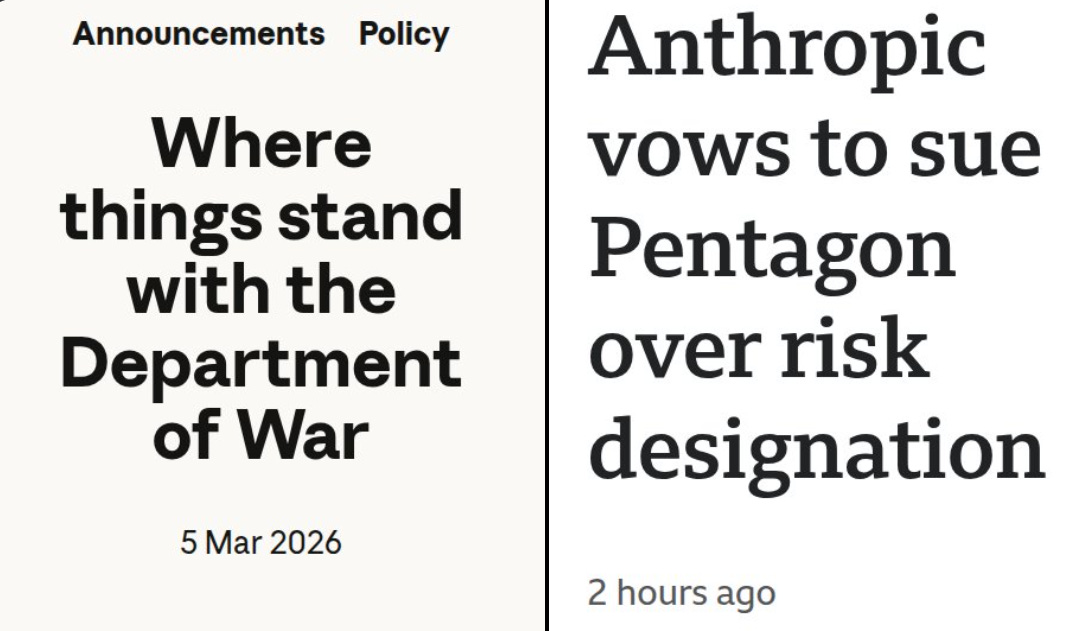
And Anthropic now vows legal fight against Pentagon sanction.
Amodei argues this action is not legally sound and plans to challenge it in court. He points out that the actual restriction is surprisingly narrow.
The rule only stops contractors from using Claude directly for defense contracts, but they can still use it for other business. Anthropic also apologized for a frustrated internal message that leaked to the press.
That message was written on a chaotic day when the government banned them on social media and simultaneously handed a defense deal to a rival. The company stressed that their only real boundary is keeping their AI out of autonomous weapons and mass surveillance.
Microsoft is the first major company to say it will keep using Anthropic models in its products. Microsoft said its lawyers have studied the Pentagon’s plan to label Anthropic a supply chain risk, and they found that Anthropic models can remain in Microsoft products, excluding the U.S. Department of War.
Microsoft supplies its technology to a variety of U.S. government agencies. The Microsoft 365 productivity software is widely used inside the Department of War.
🗞️ OpenAI has introduced ChatGPT for Excel, a new beta add-in that brings its AI assistant directly into Microsoft Excel.
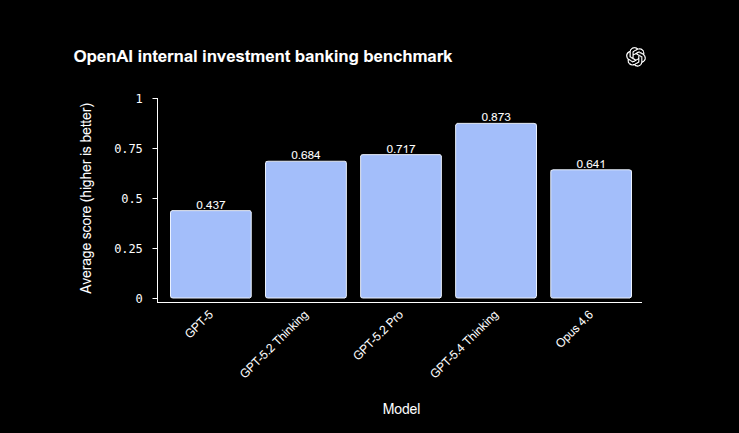
OpenAI just integrated ChatGPT directly into Microsoft Excel to fully automate complex financial modeling. This add-in uses simple text commands to replace the need for manual formula writing.
The system runs on GPT-5.4, which is optimized specifically for heavy finance workflows. On internal investment banking tests, the model improved performance from 43.7% to 87.3%.
The tool calculates everything natively in the spreadsheet so users can easily verify the math. OpenAI also added direct integrations with major financial data providers like Moody’s.
Analysts can pull market data instantly to generate properly cited research reports. Embedding AI directly into native tools makes enterprise adoption highly practical and immediate.
Availability: ChatGPT for Excel is currently rolling out in beta to ChatGPT Business, Enterprise, Edu, Teachers, Pro and Plus users in the United States, Canada and Australia. For enterprise and education organisations, administrators must enable the feature for selected users.
That’s a wrap for today, see you all tomorrow.
> Many regular people in US are furious because their home electricity bills are skyrocketing just to keep big tech data centers running.
I hope you understand this is an oversimplification. See for example:
https://newsletter.semianalysis.com/p/are-ai-datacenters-increasing-electric
"In the Lone Star State, prices have been roughly stable for the last three years. On the other hand, the 67 million residents of the PJM area are set to see their bill increase by an average of ~15% in 2026 relative to the “pre-AI-Datacenter” era? Why such a divergence? In short, empirically the fault is government policy, not AI."
Excel was the last place to escape AI. 😭