Smart prompt injection helps catch fake audio across different contexts using minimal computing power with just 0.02% extra parameters.
Teaching AI to spot fake voices with just a whisper of extra code.
Original Problem 🔍:
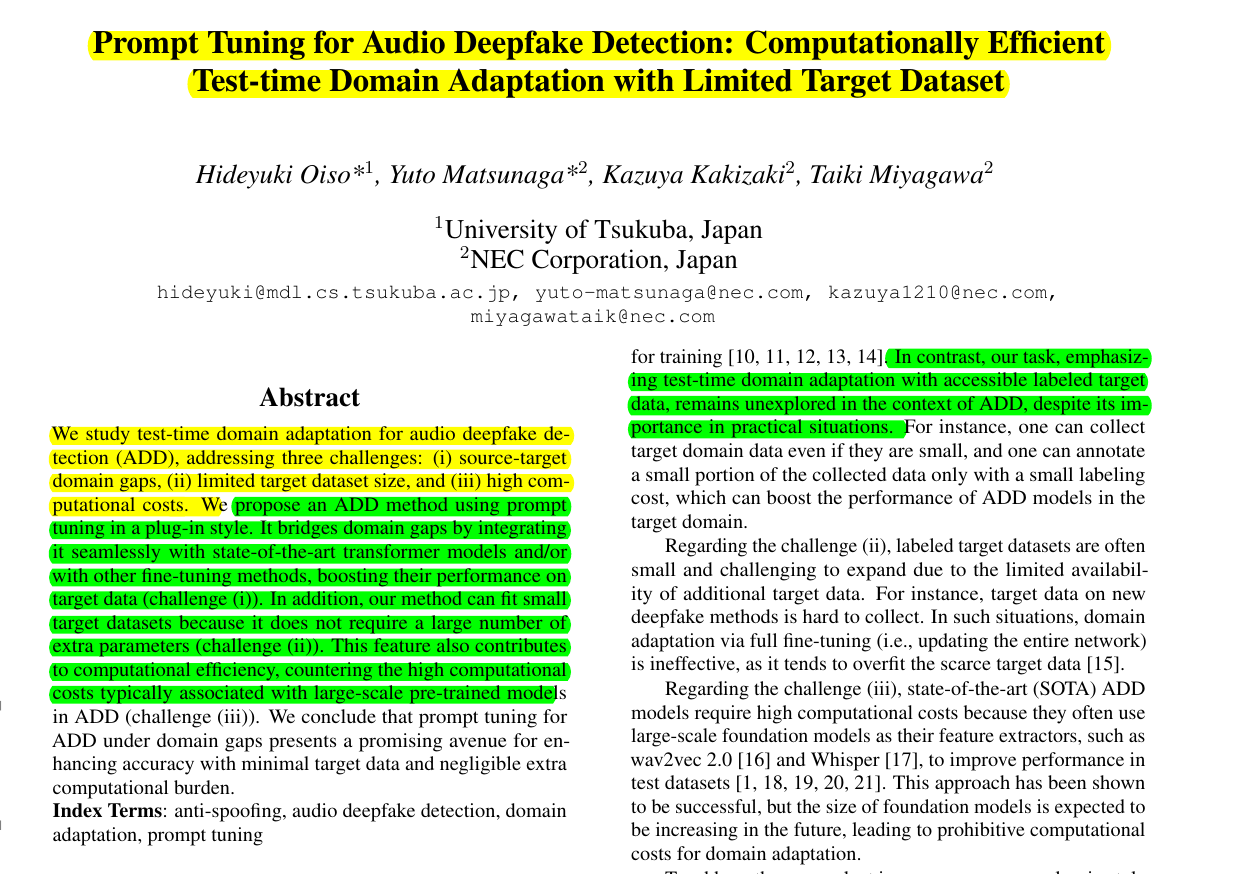
Audio deepfake detection faces challenges in domain adaptation, limited target data, and high computational costs when fine-tuning large pre-trained models.
Solution in this Paper 🛠️:
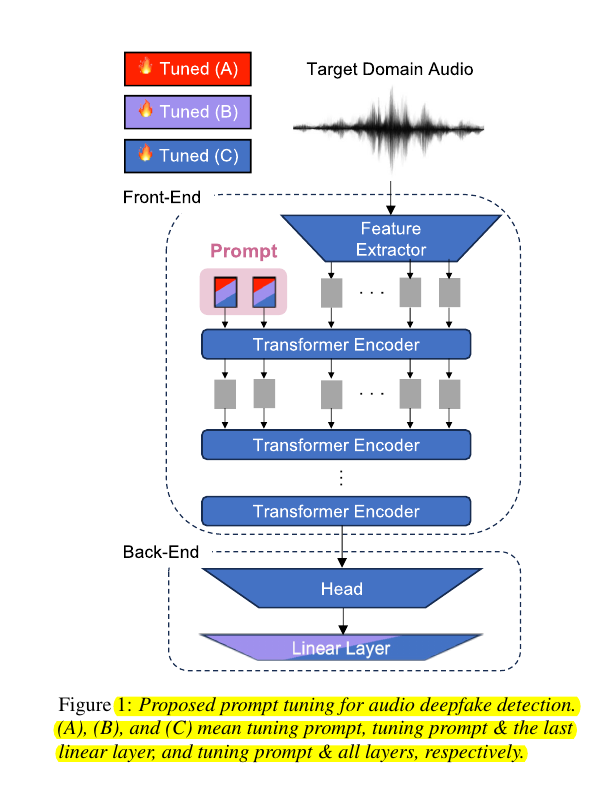
• Introduces prompt tuning for audio deepfake detection
• Inserts trainable prompt parameters into intermediate feature vectors
• Can be integrated with state-of-the-art transformer models
• Requires minimal additional trainable parameters (0.001-0.02%)
• Compatible with other fine-tuning approaches
• Effective with small prompt lengths (5-10)
Key Insights from this Paper 💡:
• Prompt tuning improves or maintains equal error rates across multiple target domains
• Performs well with as few as 10 target domain samples
• Outperforms full fine-tuning on very small target datasets
• Provides efficient domain adaptation with minimal computational resources
• Potentially applicable to other audio classification tasks facing similar challenges
Results 📊:
• Improves EERs across 7 target domains for two SOTA models (W2V and WSP)
• Effective with limited target data (10-1000 samples)
• Minimal additional parameters: 0.00161% (W2V) and 0.0251% (WSP)
• Outperforms full fine-tuning on small datasets (e.g., 10 samples)
• Rapid performance saturation with short prompt lengths (5-10)
🛠️ The way the proposed prompt tuning method works:
Inserts trainable prompt parameters into the intermediate feature vectors of the model's front-end
Fine-tunes only the prompt parameters and optionally the last linear layer on the target dataset
Keeps most of the pre-trained model parameters frozen
Can be combined with other fine-tuning approaches