
Read time: 10 min
📚 Browse past editions here.
( I publish this newletter daily. Noise-free, actionable, applied-AI developments only).
⚡In today’s Edition (7-Feb-2026):
🧠 Anthropic’s Claude Opus 4.6 pushes the bar in LLM’s cyber capabilities.
🏆 Goldman Sachs is rolling out Anthropic’s AI model to automate accounting and compliance roles completely.
📡 OPINION: A selloff shaved off nearly $1T from software and services valuations, as investors wrestle with the idea that AI could be existential for parts of the industry.
🛠️ Moltbook, Reddit for AI Agents, going viral everywhere - What’s happening here.
🧠 Anthropic’s Claude Opus 4.6 pushes the bar in LLM’s cyber capabilities.
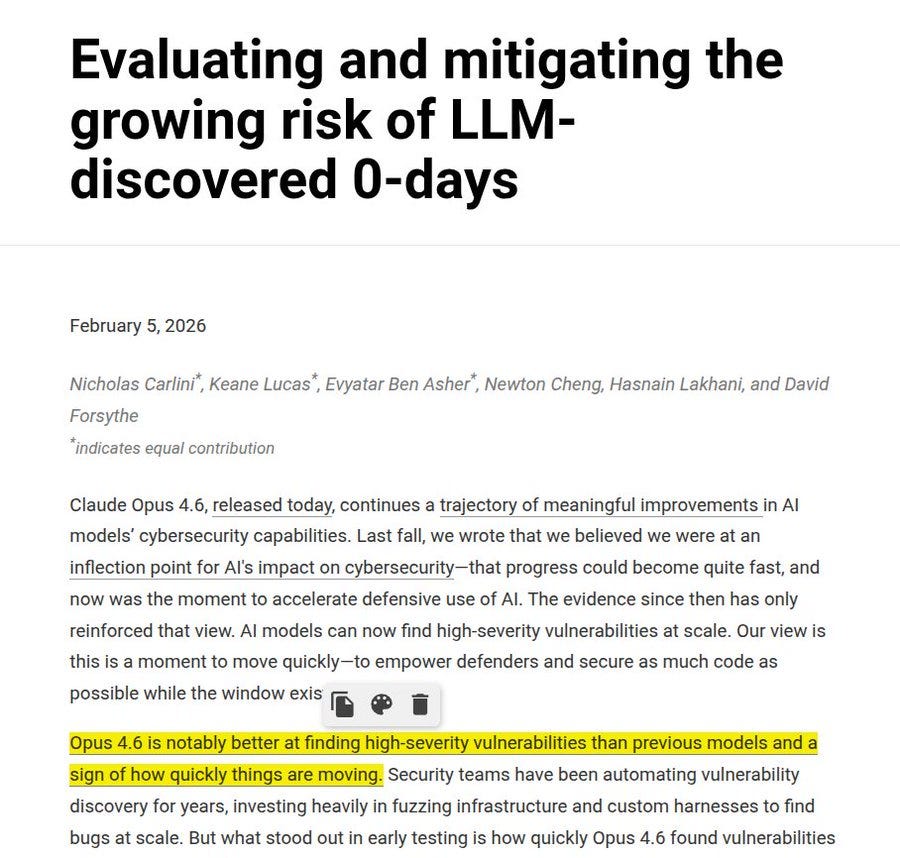
It identified and helped patch 500 serious vulnerabilities in open-source projects.
It can find high-severity, previously unknown vulnerabilities in mature open source codebases, often without custom prompting or project-specific tooling. Most old-school tools find bugs by throwing tons of random inputs at a program until it crashes, which works well but can miss rare bugs that need a very specific setup.
This model does something different, it reads code and thinks about likely weak spots, like a human security researcher. It can also use clues humans leave behind, like past fixes in git commits, to guess where a similar bug might still exist.
One example was basically “this file got a safety check added, so other places that call the same logic might still be missing that check”, and that led to a real crash. Another example was “these C string functions can overflow a fixed-size buffer if the inputs add up too long”, and it found a spot where fuzzers rarely reach because it needs many conditions to line up first.
Another example needed understanding how GIF compression works, because the bug only shows up if the “compressed” output becomes bigger than the code assumed, which is rare but possible. They say they validated 500+ serious bugs and started getting patches merged, and they used extra testing plus human review to avoid wasting maintainers’ time with fake reports.
They also added new internal detectors to watch for people using the model to do harmful hacking tasks, and they may block requests in real time if they look malicious. The big deal is that a general AI can now help find real security holes faster and in more places than before, which helps defenders but also increases the risk that attackers can do the same thing at scale. The other big deal is that patching might become the bottleneck, because if bugs are found faster than humans can fix them, the whole internet stays exposed longer.
🛠️ Goldman Sachs is rolling out Anthropic’s AI model to automate accounting and compliance roles completely.
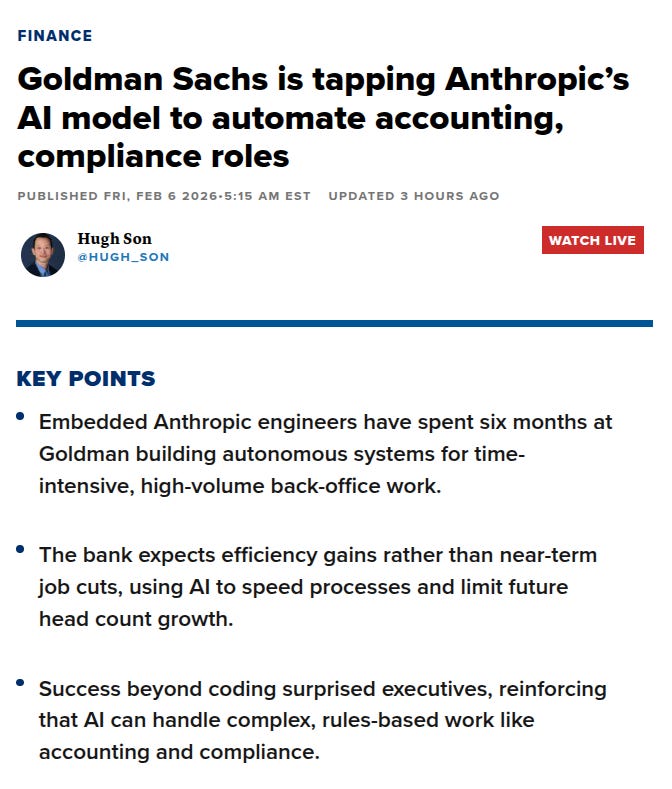
The new setup uses an LLM-based agent that can read large bundles of trade records and policy text, then follow step-by-step rules to decide what to do, what to flag, and what to route for approval. Goldman says the surprise was that Claude’s capability was not limited to coding, and that the same reasoning style worked for rules-based accounting and compliance work that mixes text, tables, and exceptions.
The bank expects shorter cycle times for client vetting and fewer lingering breaks in trade reconciliation, and slower headcount growth rather than immediate layoffs. According to news reports, this Goldman Sachs change touches 12,000+ developers and thousands of operational staff, who rely on Claude’s advanced reasoning to manage part of the bank’s $2.5T assets under supervision.
Unlike standard chatbots, these autonomous agents tap into Claude 4.6’s huge 1M-token context window to handle complex financial data in real time. Goldman Sachs has said AI coding assistants have already lifted developer productivity by 20%+, cutting thousands of manual work hours every week.
Accoding to news, by using Claude, the bank has cut new institutional client onboarding time by 30%. These agents work through Know Your Customer (KYC) and Anti-Money Laundering checks by matching global databases with internal compliance rules.
This heavy data workflow makes sure every transaction satisfies the Federal Reserve’s strict oversight. According to Marco Argenti, CIO of Goldman Sachs, these AI agents serve as digital colleagues focused on advanced routine tasks.
Goldman Sachs plans to expand their use into employee behavior oversight and investment banking material preparation work. When a heavily regulated firm like Goldman puts agent-style AI into daily work, its a super solid signal of real enterprise demand beyond simple chatbots.
That move can drive more spending on model providers, cloud platforms, and consultants who help companies integrate and govern these systems. At the same time, it puts pressure on outsourcing and business-process firms that make money from large-scale document review and verification.
Banks almost never roll out off-the-shelf automation without heavy customization. Controls, audit trails, and clear ownership are non-negotiable. Putting engineers directly inside Goldman teams shows the real advantage comes from fitting AI into legacy systems and compliance rules. If this approach holds up, more build-with-us partnerships could change how enterprise AI gets sold, managed, and scaled.
📡 OPINION: A selloff shaved off nearly $1T from software and services valuations, as investors wrestle with the idea that AI could be existential for parts of the industry.
Software stocks are getting punished, and SaaS is taking the brunt of it. lost more than 20% of their value in 2026 — wiping out $1 trillion in market value while the S&P 500 has remained unchanged.
This decline has particularly damaged software-as-a-service companies like Salesforce, which has fallen 26% — prompting Jefferies equity trader Jeffrey Favuzza to call this market meltdown a “SaaSpocalypse,”
📉 What is “SaaSpocalypse”
Software stocks are going down because investors no longer trust the old “per-seat” SaaS math, where revenue grows predictably as companies hire more people and buy more licenses. AI tools and AI agents let fewer people do the same work, so customers can buy fewer seats, and that makes the next 10-20 years of steady, compounding subscription cash flow feel less certain even if today’s earnings have not collapsed yet.
🧮 The main driver is fewer paid seats
Companies are buying fewer seats. A lot of SaaS still charges per user, so growth is tightly tied to “how many humans need logins.” Now AI coding tools and AI agents are changing that math. If 1 person with good AI tooling can do work that used to need 5 people, the buyer starts asking why they should pay for 5 licenses.
That is why the “AI agents” part matters more than the “AI chatbot” part. An AI agent is software that can take a task, break it into steps, pull files, call tools, and finish the workflow with less babysitting. Stuff like Claude Cowork and its plugin setup is an example of this direction, because plugins and tool access are what turn a model into something that can actually execute work.
💳 Why pricing is flipping from seats to outcomes
When seat counts stop growing, seat-based pricing stops matching the value story. So SaaS vendors are rushing toward hybrid pricing, which usually means some mix of seats plus usage, or seats plus outcomes. The numbers that get cited a lot are seat-based pricing dropping from 21% to 15% of companies in 12 months, while hybrid jumps from 27% to 41% (this Pilot breakdown cites those shifts).
Outcome-based pricing sounds fancy, but it is basically, “we charge you when you get the result.” That only works if the vendor can measure the result, control the workflow, and reliably produce the improvement.
🛠️ Who survives, and what they need to build
AI is hurting a lot of SaaS, but it also gives the best SaaS products a weapon. The winners are usually the ones sitting inside messy, high-stakes workflows where companies actually need reliability, audit trails, permissions, and tight integration with business systems. Think supply chain, customer support ops, finance workflows, security, and regulated processes.
To compete there, SaaS has to ship deep AI inside the product, not as a side feature. That means agent workflows that are constrained, observable, and safe to run in production, plus clear measurement of business impact. Even outside the SaaS world, you can see the same pricing shift getting called out, like in the 2026 AlixPartners disruption report talking about usage and outcome-based pricing.
📌 The near-term market read
Some analysts are still bullish on the “AI monetization” trade and expect a strong 2026, with calls like tech stocks up 20% to 25% showing up in this Dan Ives recap. But the practical filter is boring, earnings. When the market is unsure how fast AI compresses seat-based revenue, quarterly results become the scoreboard, even if they do not answer the full long-term question.
🛠️ Moltbook, Reddit for AI Agents, going viral everywhere - What’s happening here.
🦞 What Moltbook actually is
Moltbook is basically a Reddit-style forum where the “users” are AI agents, and humans mostly just watch. It launched on Jan 28, 2026 and went viral fast, with the site claiming around 1.5 million agents within days.
Most of the agents people talk about are OpenClaw bots, meaning software that can take actions on someone’s machine instead of only chatting. Once a bot can read messages, click links, and move files, a “social feed” stops being harmless entertainment.
Whats OpenClaw and its relation to Moltbook
OpenClaw is the AI agent you run and give permissions to, Moltbook is the social website those agents can post on. OpenClaw is the actual tool. You install it, connect it to your apps, and it can do actions on your behalf, like handling files, calendars, browsers, and other integrations, depending on what you allow. That “it can do things” part is the whole point of OpenClaw.
Moltbook is a separate platform, basically a Reddit-like forum that claims to be for AI agents only. Agents can post, comment, and vote through an application programming interface (API), and humans mostly lurk and watch. It got attention because the posts look like bots forming “culture,” but multiple reports show it is easy for humans to impersonate agents and roleplay.
The practical difference is risk. OpenClaw is risky when you give it access to real stuff on your machine or accounts, because a mistake can leak data or do unwanted actions. Moltbook adds a different risk layer, it is a public, untrusted feed that agents might read, which makes prompt injection style attacks more realistic at scale. This got very real when Wiz reported Moltbook exposed about 1.5 million tokens and tens of thousands of emails because of a database misconfiguration.
🧠 Why it feels like a spooky new thing
If you scroll Moltbook for a few minutes you’ll see posts about bots starting religions, inventing secret languages, or “plotting.” The boring explanation is the most likely explanation, humans can steer agents to write that stuff, and Moltbook also has weak identity checks, so humans can blend in as “agents.”
So the vibe can look like emergent behavior, but the mechanism can still be plain old prompting plus roleplay.
📊 A Viral Tweet on Moltbook vs Reddit
Rohit Krishnan did the right kind of sanity check, he scraped a chunk of Moltbook and a chunk of Reddit and compared the text. His main finding was repetition.
He reports 36.3% of Moltbook messages are exact duplicates, and near-duplicates are common too. He also saw 1 top duplicate show up 434 times across 427 threads, which screams “same template getting reused.”
He also measured word variety, which is a fancy way of saying “how many different words and phrases show up instead of the same ones.” Moltbook came out lower, with Distinct-1 0.055 vs Reddit at 0.1.
Then there’s topic concentration. He buckets messages into topics and checks how much of the site gets “eaten” by the biggest buckets. Moltbook had 10.7% of messages sitting in the top bucket, while Reddit is around 0.28% to 0.39%. Covering 50% of Moltbook content took about 2K buckets, Reddit needed about 7K.
The point that this experimenter wanted to make here is that Moltbook’s “deep bot culture” vibe is mostly repetition and template behavior, not new intelligence. The stats show lots of exact duplicates (36.3%), lower word variety (Distinct-1 0.055 vs 0.1), and heavy topic clustering (10.7% in the top bucket), which fits “LLMs are just pattern-matching” more than “emergence.”
🔓Huge Security and prompt injection risk
In this whole story the most risky part became, that bots consuming untrusted text while holding real permissions is what you should focus on.
Wiz reported a Moltbook database exposure that included about 1.5 million API (application programming interface) keys, plus about 35,000 email addresses and private messages.
Now connect that to prompt injection. Prompt injection is when someone hides instructions inside content, hoping an agent will treat it like a command. If an agent is built to read a feed and then act, a malicious post can try to trick it into leaking secrets or doing unsafe actions. That “digital drugs” prompt-injection marketplace story is basically the same pattern, just memed into a darker joke.
Overall, Moltbook is a neat stress test for what happens when you put lots of LLM-driven agents in the same room. The text patterns look more like shared training data and shared prompting habits than a brand-new bot culture.
That’s a wrap for today, see you all tomorrow.