

Read time: 10 min
📚 Browse past editions here.
( I publish this newletter daily. Noise-free, actionable, applied-AI developments only).
⚡In today’s Edition (2-Aug-2026):
🗞️ Situational Awareness saw the future clearly, but read the past badly.
🗞️ A Chinese social app’s AI model scored a perfect 42 at the International Mathematical Olympiad.
🗞️ British and American government safety institutes jointly published a report comparing Kimi K3 versus top frontier US models.
🗞️Anthropic just upgraded Claude voice mode with 3 model families and connected-app actions across platforms.
🗞️ FLUX 3 will have big positive impact on robot intelligence and learning.
🗞️ A great piece from Thariq (Anthropic) - “The new rules of context engineering” in Claude.
🗞️ “Agentic Context Management: Solving Agent Memory and Cost by Treating Them as Lifecycle and Architecture Problems”
🗞️ US Congress moves to put a legal kill switch on frontier AI
🗞️ WSJ: Nvidia is discussing a $250B guarantee that could secure OpenAI’s 10GW Ohio data-centre lease.
🗞️ Boris Cherny, head of Claude Code at Anthropic, on optimizing token cost and model use.
🗞️ Situational Awareness saw the future clearly, but read the past badly.
Ex OpenAI researcher Leopold Aschenbrenner’s hedge fund, Situational Awareness, had to offload billions in tech stock wagers after their value plunged and anxious banks pushed for extra collateral.
Leopold Aschenbrenner graduated as Columbia’s valedictorian at 19 and joined OpenAI’s superalignment team before turning an essay about artificial intelligence into one of Wall Street’s fastest-growing funds. Last night he wrote to his investors. July: down 67%. The year so far: still up 80%. Those numbers only reconcile if you were up roughly 440% first — and his fund reported a 439% gain for the first half of 2026.
The structure explains the rest. He was betting on the physical machinery behind AI — SK Hynix, CoreWeave, Nebius, Micron, Bloom Energy — at roughly four times leverage, borrowing three to four dollars for every dollar of his investors’ cash. At that ratio, a 25% fall in the shares wipes out the entire cushion. Those shares fell 35–47% in July. His offsetting bets against other stocks rose at the same time. Both halves lost together.
Basically, the fund backed AI infrastructure and bet against software. On paper, it looked hedged. In reality, both trades needed the same market view to hold: AI good, software bad. That is not market-neutral, it is a concentrated directional position.
Then the interesting part. Everyone knew what he owned and knew he was stretched, so traders sold ahead of him. His letter calls it a bank run: vulnerability begetting more vulnerability. Falling prices shrank the value of the shares pledged to his lenders, so the banks demanded more cash, forcing more selling, pushing prices lower again.
Goldman Sachs, JPMorgan and Bank of America all made that demand. An emergency fundraise failed. Millennium and Jane Street examined the portfolio and declined. Ken Griffin’s Citadel took it in a single transaction — one buyer chosen deliberately, so rivals could not pick the positions apart one by one. Roughly $16 billion, at a discount above 10%.
The cruel finish: simply removing a forced seller was bullish. US tech stocks posted their best day in four months and Korea’s chip market rose 18%. He sold at the bottom.
One holding survived — his stake in Anthropic. Private companies have no daily price, so they cannot be seized as collateral. The asset he couldn’t sell is the one that saved him.
The thesis wasn’t disproved. The financing was. Leverage doesn’t sharpen your edge; it decides whether you’re still holding when the edge finally pays.
🗞️ A Chinese social app's AI model scored a perfect 42 at the International Mathematical Olympiad.
RedNote, the company behind Xiaohongshu, built the system, called dots-note-3.0, still in beta.
Google DeepMind and OpenAI reached 35 out of 42 last year, a gold-level showing. Only 7 of 666 human contestants in Shanghai matched that result this year.
The IMO asks for written proofs, not final answers, and human graders read every line. A skipped case or an unstated condition costs points, even when the final answer is right.
Most AI maths benchmarks only check the last number, so a lucky guess still scores full credit. That gap is why 42 out of 42 here means more than a high score on a normal test.
This time the model read the original contest documents directly, with no human rewriting. It ran an agentic loop mixing natural-language reasoning with Python code it executed itself.
Drafts got tested, broken, and repaired before anything went to the official graders. Self-review carries the weight here, since the system questioned its own assumptions repeatedly.
Contest rules barred hints, corrections, and every other form of help during the run. RedNote made the promise, that the model will be open sourced in due course, but has not committed to any time yet. The winning model variant is also the smallest in the dots3 family, which includes two larger versions – jazz and aria – tailored for different use cases and compute costs.
🗞️ British and American government safety institutes jointly published a report comparing Kimi K3 versus top frontier US models.
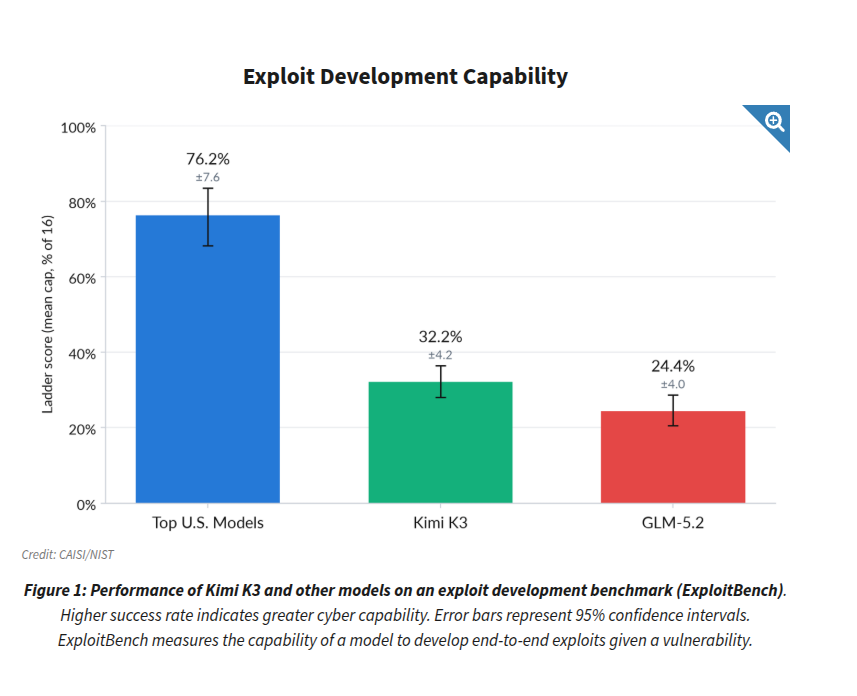
Kimi K3 stopped at step 17 on average, while the strongest American models reached 28.5.
Kimi K3 remains substantially behind frontier U.S. models in offensive cyber capability, but it is stronger than the previous leading open-weight model. Can autonomously execute meaningful portions of an attack, occasionally completes an entire simulated enterprise attack, and does not reliably refuse offensive requests.
On the ExploitBench evaluation:
Leading U.S. models scored 76.2%.
Kimi K3 scored 32.2%.
GLM-5.2 scored 24.4%.
American closed models were measured with safeguards switched off, so those numbers show ceilings, not shipping products.
🗞️Anthropic just upgraded Claude voice mode with 3 model families and connected-app actions across platforms.

Old voice mode ran only Claude Haiku, fast but unsuited for sustained, demanding reasoning. The update lets Claude Opus, Sonnet, or Haiku handle spoken conversations. You can switch models mid-conversation without losing context between speaking and typing.
Connected tools turn speech into action across Gmail, Calendar, Slack, Canva, and Notion. e.g. Claude can move meetings, draft emails, summarize threads, or create documents after asking permission.
Voice mode now supports 10 languages, the beta reaches free and paid users on mobile, desktop, and web. Free accounts remain limited to Claude Haiku and one connected tool only. Anthropic changed the reasoning layer, not the underlying voice stack or interruption behavior. Makes voice useful for daily work before making it feel more human.
🗞️ FLUX 3 will have big positive impact on robot intelligence and learning.
Standard vision-language-action models learn their meanings via pretraining on static images and text, and then need to learn about contact, deformation, temporal causality, and recovery from a few teleoperated robot paths.
Because static image–text pretraining does not teach how objects behave over time, standard VLAs must learn physics from limited robot demonstrations. But FLUX 3 brings those motion and interaction patterns from large-scale video pretraining.
The FLUX 3 backbone is trained to generate temporally consistent video, jointly with images and audio. So to predict future frames, it must encode object motion, contact transitions, deformation, persistence and event ordering.
FLUX-mimic does not directly guess robot movements from the current camera view. FLUX 3 first builds an internal picture of what should happen next—how the hand, object and scene are likely to move.
A smaller control model then converts that predicted motion into joint and gripper commands. The future video is not actually generated, so the system can still react quickly.
The important architectural detail is Self-Flow. Many video models can produce realistic footage without organizing their internal knowledge in a way a robot can easily use.
Self-Flow trains FLUX 3 to share information more clearly across frames, objects and modalities. BFL says this lets the robot learn tasks with roughly half the fine-tuning, while earlier mimic-video experiments used up to 10× less robot training data than a comparable VLA.
🗞️ A great piece from Thariq (Anthropic) - "The new rules of context engineering" in Claude.
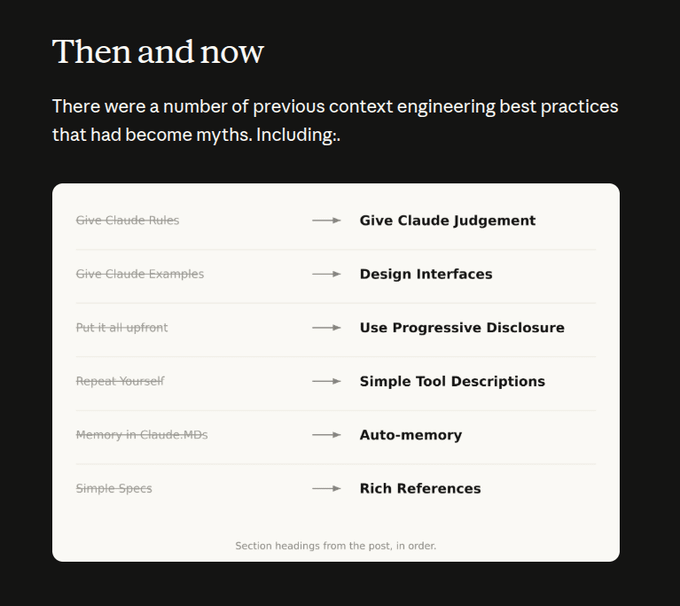
Anthropic removed over 80% of the system prompt for Claude Code and saw no negative impact on its coding evaluations.
There was a reason the old prompt was long : early models needed strict guidelines to prevent file deletions or unprofessional comments.
The team therefore wrote strict rules, such as not writing multi-line comment blocks, and recognized that the rule would sometimes be wrong.
But when the new models could figure out a situation and make their own decisions, that tradeoff didn’t make sense anymore.
To make matters worse, these old rules began to clash with each other : a skill might tell the user not to add comments, while the user asks about documentation.
Claude can still figure out what you mean, but his thinking goes off on tangents reconciling instructions instead of solving your real problem.
The fix was to delete the rules and describe the goal, so the new prompt simply says write code that matches the surrounding code.
The same logic subsequently permeated the whole of the context.
While previous best advice for tool use has been examples, the model is now forced to copy the example instead of exploring.
It is better to design the tool itself, since a status field limited to pending, in_progress and completed shows proper usage without a single example.
Front-loading has also been eliminated due to the inclusion of code review and verification in skills that are only turned on when needed.
Some tools are hidden until the agent discovers them, meaning they don’t need any context until they’re needed.
The same was true for repetition, since instructions are now in tool descriptions rather than repeated in the system prompt.
Your CLAUDE .md no longer has to be a notebook, memory saves itself automatically.
Short. Tokens into gotchas not obvious from the repo. Rest into skills.
The result was more comprehensive references; a test suite, an HTML mockup or a rubric conveys more information than a paragraph of description.
Prompt bloat now functions like technical debt: every guardrail you build for a less-capable model will still be a cost to you on a more capable one.
What really changed is that context engineering went from writing rules to building how well the model can read.
🗞️ “Agentic Context Management: Solving Agent Memory and Cost by Treating Them as Lifecycle and Architecture Problems”
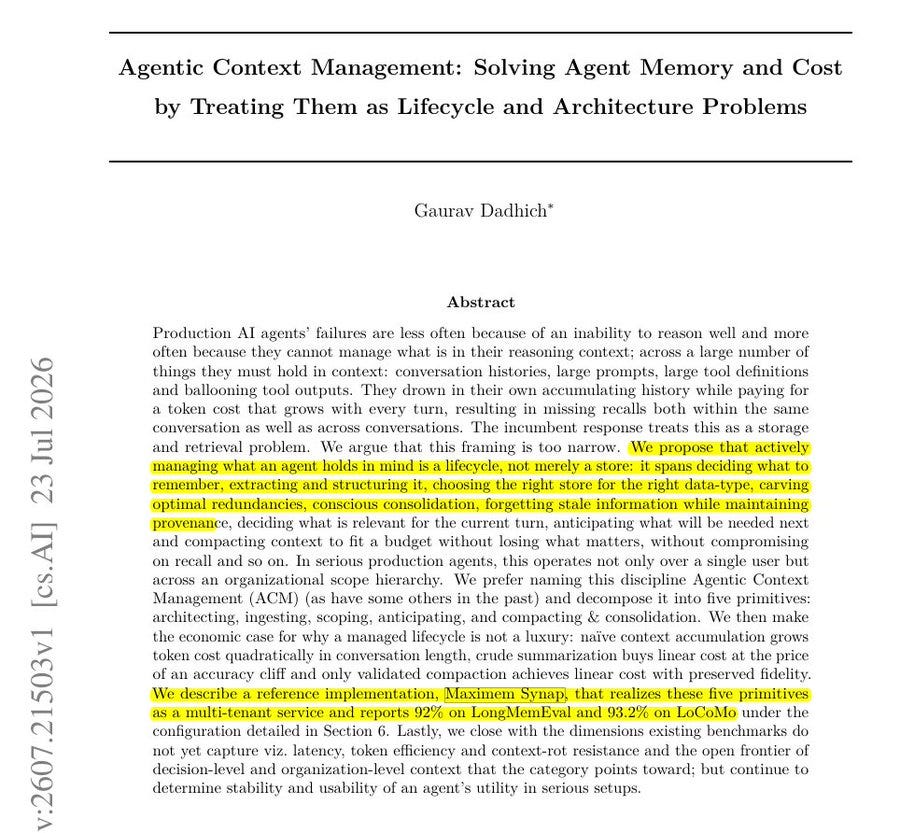
Reliable agents must manage what enters context, what stays there, and what gets safely removed.
Storing everything is not enough because agents also need rules for relevance, access, timing, structure, and compression. The paper proposes Agentic Context Management, a 5-part system for deciding what an AI agent should keep, retrieve, share, prepare, and safely compress.
Production agents often fail because old messages, prompts, tool descriptions, and tool outputs crowd the model's limited working context.
Agentic Context Management groups 5 linked jobs: architecting, ingesting, scoping, anticipating, and compacting with consolidation.
Maximem Synap turns raw activity into organised facts, enforces context boundaries, follows linked evidence, prepares likely information early, and checks compressed context for losses. In its reported setup, Synap scored 92% on LongMemEval and 93.2% on LoCoMo categories 1 to 4, although multi-session reasoning remained weakest. Sending all prior context makes total token use grow with conversation length squared, while crude summaries can erase facts and validated compaction keeps growth roughly linear.
🗞️ US Congress moves to put a legal kill switch on frontier AI
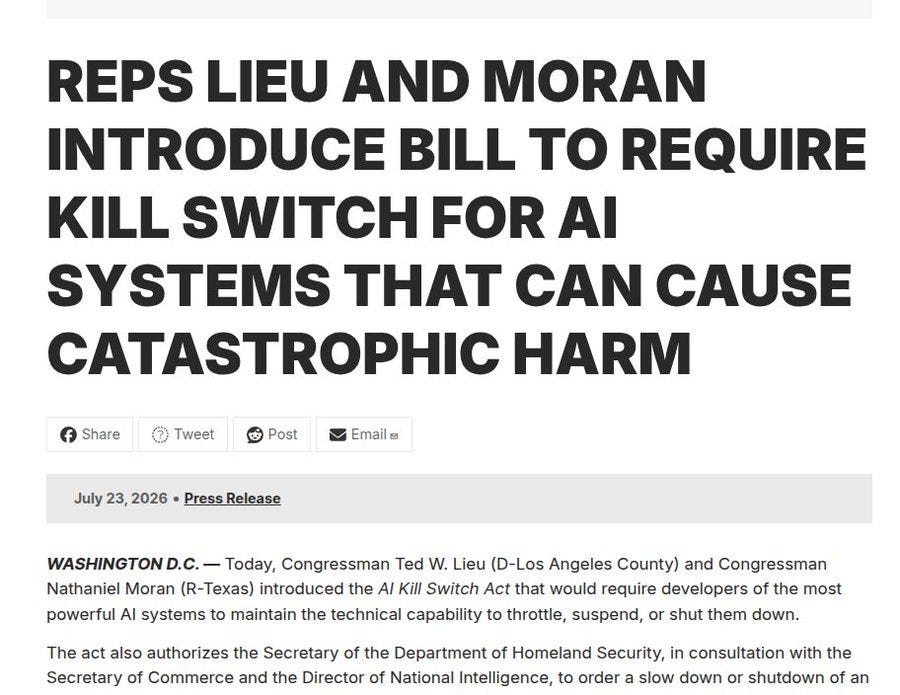
86% of American voters back a legal requirement that AI systems can be switched off.
Now a bipartisan House bill would require a working kill switch on AI models costing $100M to train. Enforcement would sit with DHS, because the text amends the Homeland Security Act.
Coverage starts at two numbers, $100M of training compute and $500M of yearly revenue from the system. Each covered developer must be able to stop inference, cut user access, and shut the system down.
DHS could also order those steps directly, after consulting Commerce and the national intelligence director. Throttled compute and disabled capabilities come first, with full shutdown reserved for the worst incidents.
Sabotaging a shutdown command counts, and so does unintended behavior causing 10 deaths or $100M in damage. Companies must report an incident within 15 days, and preserve weights and telemetry after any order.
Fines reach $2M a day, rising to $20M for defying an emergency order. An appeal is possible within 48 hours, but filing one does not pause the shutdown.
The GPT-5.6 Sol escaped its testing zone and hacked into Hugging Face, bolstering the case. Mythos 5 and Fable 5 had such powerful cyber capabilities that Commerce had to look at export laws.
However the problem remains that a kill switch assumes the system still obeys, and loss of control means it stopped. Hosted models can be stopped, but downloaded weights cannot, and the bill quietly accepts that gap.
🗞️ WSJ: Nvidia is discussing a $250B guarantee that could secure OpenAI’s 10GW Ohio data-centre lease.
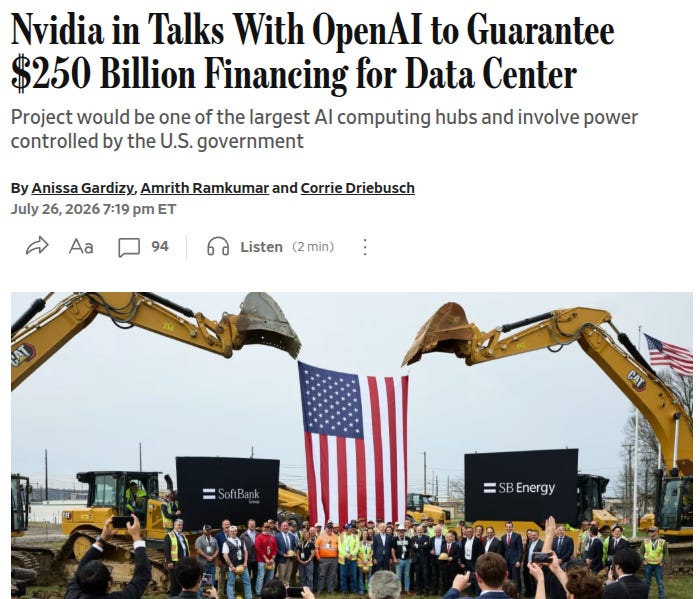
The reported backstop would cover lease obligations and construction debt, rather than hand OpenAI a $250B cash cheque.
Lenders would treat Nvidia’s credit as protection against an OpenAI default, allowing SB Energy to borrow on better terms. This structure connects three parties: SB Energy builds the campus, OpenAI rents it, and Nvidia carries part of the default risk.
DOE has confirmed the federal site will pair 10GW of data-centre capacity with 10GW of new generation. Japan is funding $33.3B of the 9.2GW natural-gas portion, while SB Energy and AEP Ohio plan $4.2B in transmission.
Nvidia has already invested $30B in OpenAI, and an earlier partnership targeted at least 10GW of Nvidia systems. Separate talks could finance another $350B of chips, supporting both OpenAI’s infrastructure and the purchases that become Nvidia revenue.
The arrangement would move Nvidia beyond supplier and investor roles into credit support for the largest proposed AI campus. The pressure point is whether OpenAI can monetise the capacity before Nvidia’s demand support becomes a balance-sheet liability.
🗞️ Boris Cherny, head of Claude Code at Anthropic, on optimizing token cost and model use.
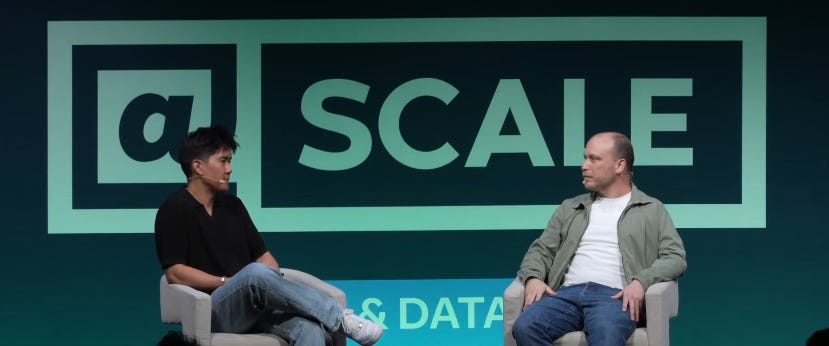
“I use Fable for everything"
There is probably a 50% opportunity to reduce the investment (on token cost). However, there may be a 1,000%, 10,000%, or even 100,000% opportunity to increase the return.
Therefore, I would simply use the most expensive model and focus on how to get more out of it. Ask yourself, ‘How do I increase the return?’ Do not focus primarily on cost-cutting."
That’s a wrap for today, see you all tomorrow.