
Read time: 10 min
📚 Browse past editions here.
( I publish this newletter daily. Noise-free, actionable, applied-AI developments only).
⚡In today’s Edition (13-August-2026):
🗞️ SpaceXAI launches Grok 4.6, beating Kimi K3 and tying GPT-5.6 Sol for 3rd place on Artificial Analysis
🗞️ Soniox launched TTS v2, a text-to-speech model, very premium voice quality at a dramatically lower price ($ 0.70-per-generated-hour)
🗞️ NVIDIA released Nemotron 3.5 Lightning for long-running agent execution.
🗞️ Stealing Reasoning Traces from Proprietary LLM APIs
🗞️ “The Case Against Generation for Retrieval: Discriminative Language Models as Effective Retrievers”
🗞️ OpenAI finally launched a ChatGPT desktop app for Linux.
🗞️ PROMPTS: Performance Optimization via Multi-Agent Planning for LLM Training and Serving
🗞️ SpaceXAI launched Grok Bot.
🗞️ How Claude marks AI-generated content
🗞️ “ScientistOne: Towards Human-Level Autonomous Research via Chain-of-Evidence”
🗞️ SpaceXAI launches Grok 4.6, beating Kimi K3 and tying GPT-5.6 Sol for 3rd place on Artificial Analysis
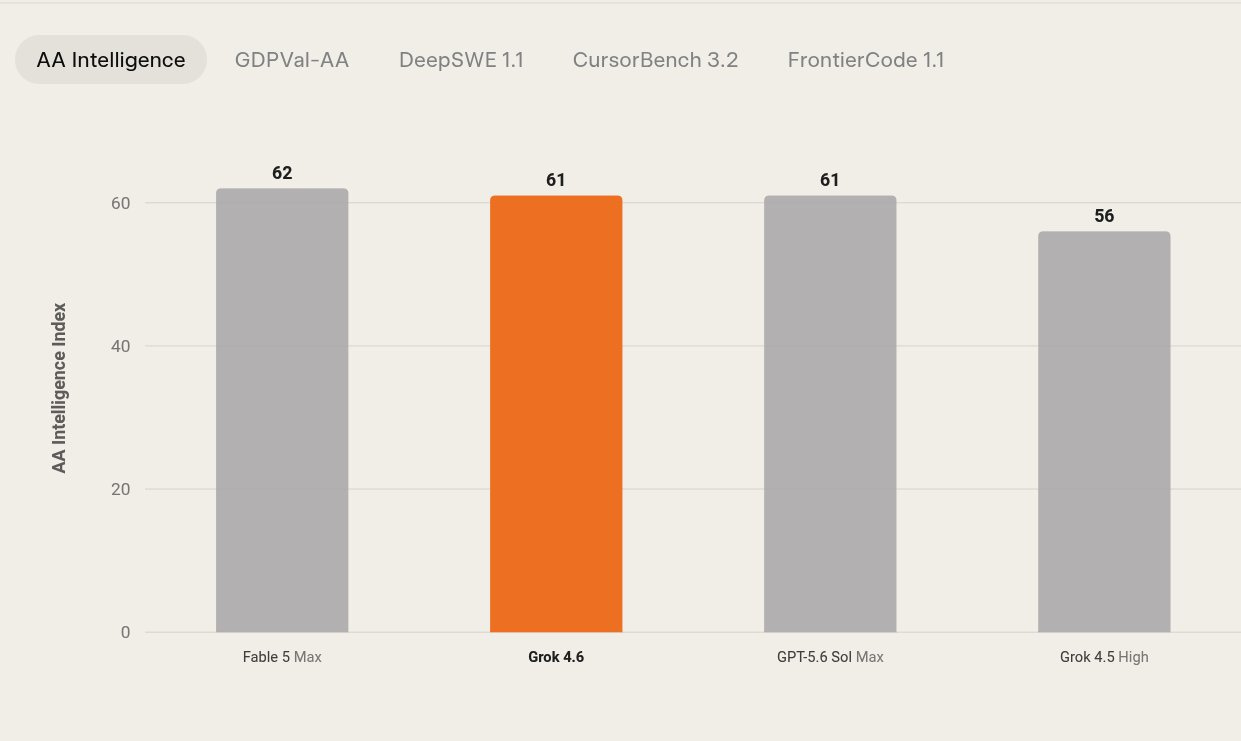
Grok 4.6 gets 98.4% of Fable 5’s Intelligence Index score at a fraction of its API price.
5X cheaper on input tokens and 8X less for output tokens vs Fable 5.
Looks clearly the strongest intelligence-per-dollar equation.
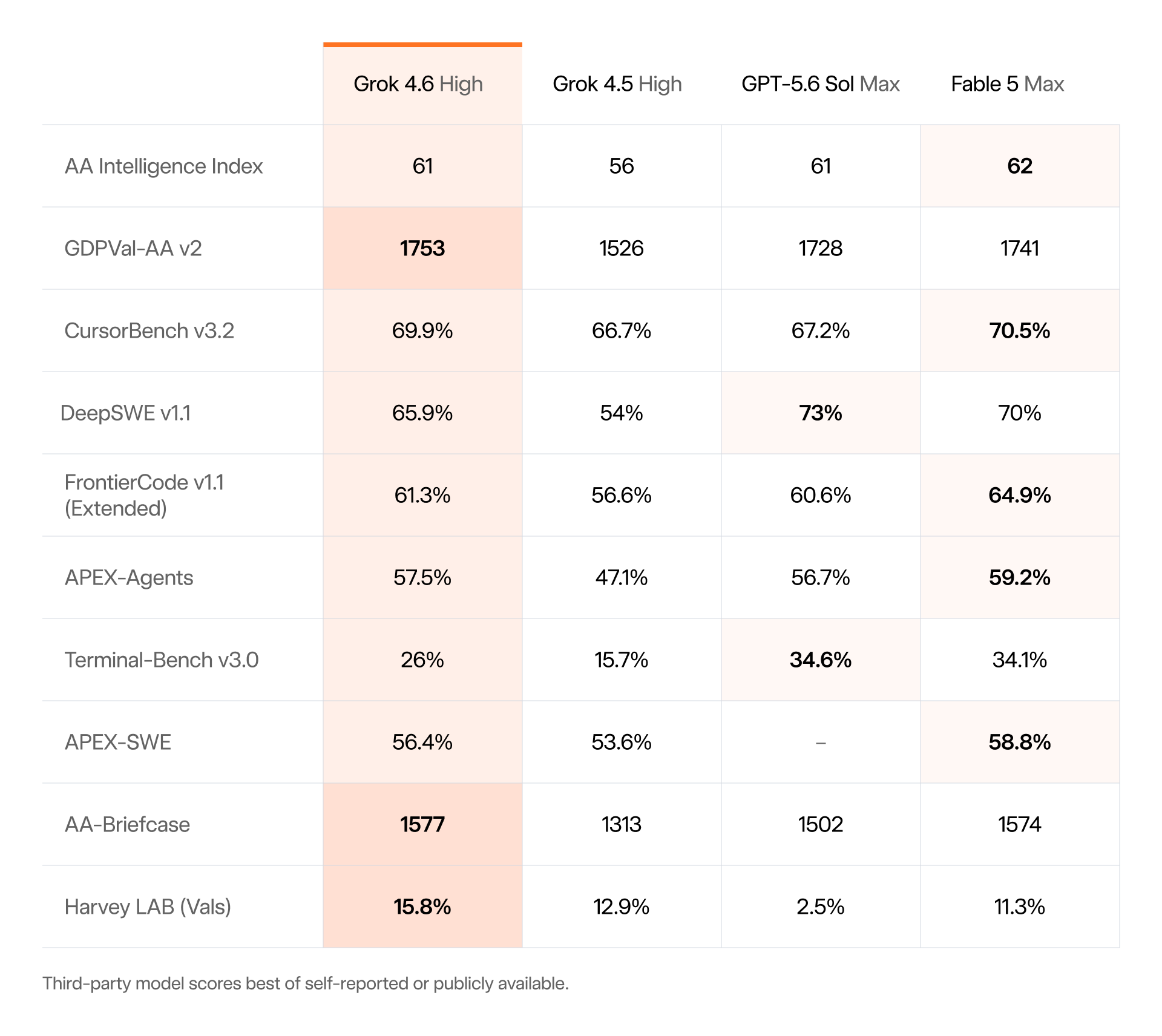
Grok 4.6 scores 61 versus Claude Fable 5 Max’s 62, just a 1-point or 1.6% relative gap on that composite score, while Grok costs 80% less on input tokens ($2 vs $10/M) and 88% less on output tokens ($6 vs $50/M).
Clearest strength is professional agent work, with leading results against GPT Sol Max and Fable 5 Max on GDPVal-AA v2 and AA-Briefcase.
- matches GPT-5.6 Sol Max at 61 on Artificial Analysis while charging $2/$6 per million input/output tokens.
- 1753 on GDPVal-AA v2 and 1577 on AA-Briefcase, both ahead of Sol Max and Fable 5 Max.
Those benchmarks measure real-world agent tasks and agentic knowledge work, making them closer to research, analysis and multi-file deliverables than isolated question answering.
On coding, 69.9% on CursorBench v3.2 beats Sol’s 67.2%, while DeepSWE and Terminal-Bench leave Grok behind both Sol and Fable.
SpaceXAI attributes the jump to a longer training run, regenerated SFT trajectories, model-based trace filtering, and agentic RL across coding, web development, CAD and kernel optimization.
It also reports more self-testing on long trajectories, with the model checking its work before continuing, directly targeting error accumulation across multi-step agents.
🗞️ Soniox launched TTS v2, a text-to-speech model, very premium voice quality at a dramatically lower price ($ 0.70-per-generated-hour)
I wasn’t expecting Soniox TTS v2 (a text-to-speech model) to sound this natural.
They just released this TTS v2
Really premium voice quality at a dramatically lower price ($ 0.70-per-generated-hour). While keeping the same model suitable for real-time agents, multilingual speech, expressive control, and cloning.
Soniox TTS v2 is built for live agents, and voice agents require more than natural-sounding audio. Speech must begin quickly, remain synchronized with the conversation, stop immediately when the user interrupts, and avoid repeating text that has already been spoken.
Interrupt a normal voice agent and it has no clue how much you actually heard, so it repeats itself or skips ahead.
TTS v2 timestamps every character down to the millisecond, so it knows the exact word you cut it off at and carries on from there.
Exceptional precision, high-fidelity voice cloning. More than 60 languages, natural language mixing, and low-latency streaming together in one model.
It makes voice performance programmable. Its “audio tags” allow developers to direct emotion, delivery, and vocal reactions throughout the text instead of selecting one fixed style for the entire passage. like [whispering], [excited] or [laughing] straight into the text,
One model replaces a lot of voice-stack plumbing: expression control, voice cloning, 60+ languages, language mixing, pronunciation precision, and streaming all sit in the same system.
It is unusually well designed for live AI agents: low-latency streaming plus character-level timestamps let an agent start talking early, stop cleanly when interrupted, and resume without repeating itself.
Voice performance becomes programmable: developers can insert audio tags for whispering, excitement, laughter, pauses, and other delivery changes inside the generated text.
Try Soniox TTS v2 here
Compare TTS: https://soniox.com/compare-tts (still v1 model, not v2 yet)
Console: https://console.soniox.com
Docs: https://soniox.com/docs/tts/get-started
🗞️ NVIDIA released Nemotron 3.5 Lightning for long-running agent execution.
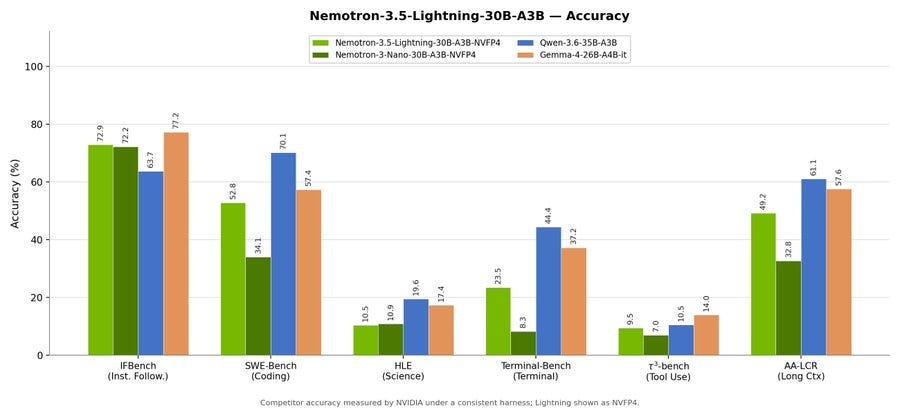
- 30B total / 3B active parameters, with up to 1M tokens of context.
Ready for commercial use.
- Local deployment: NVIDIA ships BF16 and much smaller NVFP4 checkpoints, lists 1× DGX Spark or 1× H100 for single-GPU deployment, and also lists RTX 5090 among supported hardware.
- NVIDIA then adds multi-token prediction, DSpark and DFlash speculative decoding, plus NVFP4 quantization to push generation speed further.
- NVIDIA claims up to 4× output speed; on PinchBench, 86% accuracy and 30% faster completion than Qwen3.6 35B at similar accuracy.
🗞️ Stealing Reasoning Traces from Proprietary LLM APIs
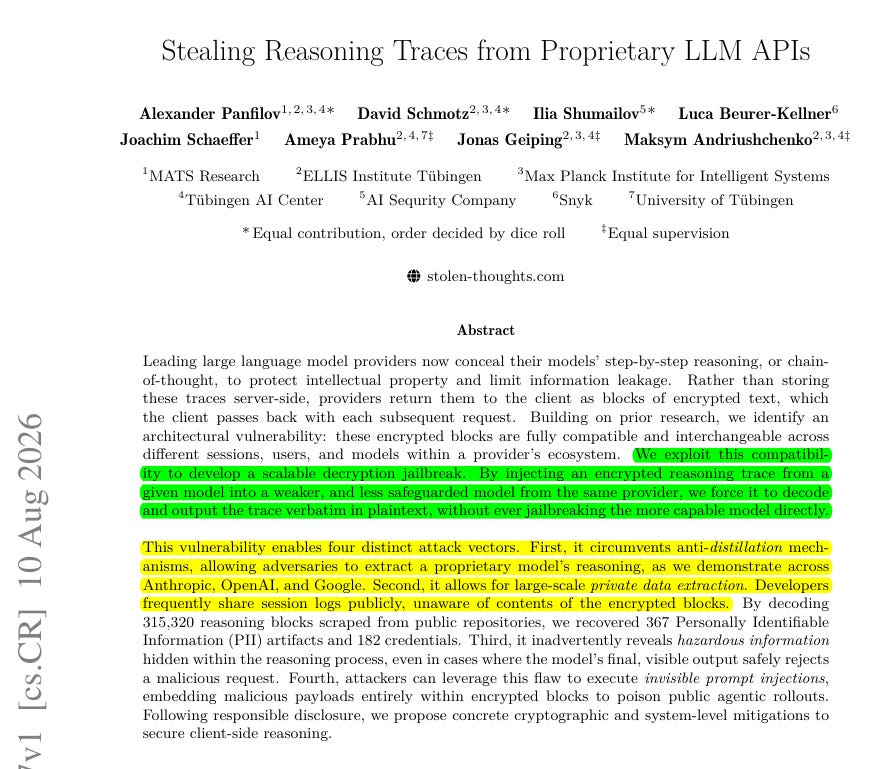
Very big warning from this paper.
Your AI's hidden reasoning can become a second, invisible data leak. You can clean the visible chat and still accidentally publish passwords, API keys, or private data.
A company can secure its smartest model perfectly and still lose its secrets through a cheaper model in the same family. The weakest model can become the security hole for the strongest one.
Encrypted reasoning is supposed to hide what frontier models think, but this paper shows the encrypted blob itself can become the attack surface. Anthropic, OpenAI, and Google APIs return opaque reasoning blocks to clients so they can be replayed in later turns without storing the reasoning server-side.
The problem is portability: the authors found these blocks could be reused across sessions, users, and even models within the same provider.
That lets an attacker take a trace from a stronger model, feed it to a weaker compatible sibling with looser safeguards, and use that model as a decoder.
Across public agent logs, the team decoded 315,320 reasoning blocks from 6,708 trajectories; 328 sessions, or 4.9%, leaked at least one sensitive item. In genuine user sessions, they recovered 62 API keys, 33 passwords, 24 access tokens, and 30 personal emails.
So an encrypted reasoning field in a log is not necessarily safe metadata if another model can read it. After responsible disclosure, providers patched the reported attacks, and the exact exploits were no longer reproducible by August 2026.
🗞️ “The Case Against Generation for Retrieval: Discriminative Language Models as Effective Retrievers”
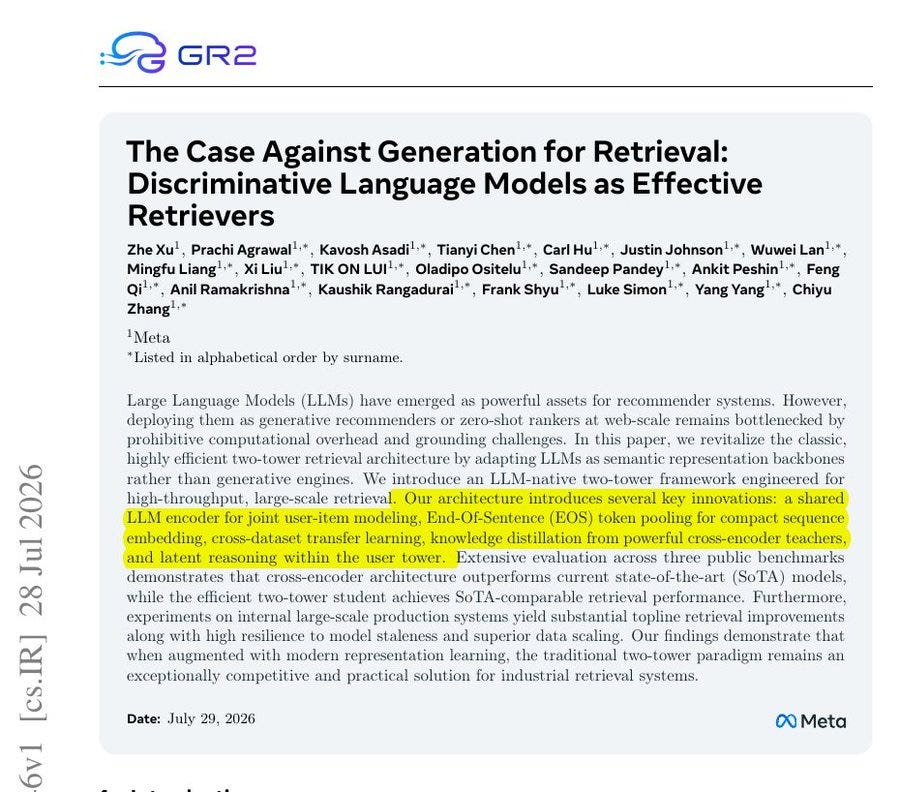
Meta’s new retrieval paper is a reminder that better language models do not necessarily require more language generation.
It asks a useful question: why generate item IDs at all when the LLM can learn the retrieval space directly?
Instead of autoregressively generating item IDs or ranked lists, the paper puts a 0.6B Qwen3 model inside a classic two-tower retriever, so item embeddings stay precomputable and retrieval remains a fast vector search. The stronger cross-encoder is used as a teacher, transferring its candidate-ranking distribution into the cheaper two-tower student.
That distillation is doing a lot of the work: removing it cuts Recall@10 by 13.3%, 23.1%, and 8.0% on Beauty, Sports, and Toys.
Against OneRec-Think, which uses Qwen3-8B, the 0.6B two-tower model reports higher Recall@10 on all three public datasets, although its NDCG results are mixed.
On Meta’s internal production data, the same approach matches a heavily tuned DLRM retriever’s normalized entropy while using just 0.5% of the training data. Those production results are self-reported, but the engineering implication is specific. For first-stage retrieval, the LLM does not necessarily need to generate anything; semantic representations inside a two-tower architecture may be a much more practical use of the model.
🗞️ OpenAI finally launched a ChatGPT desktop app for Linux.
ChatGPT, Work, and Codex into one interface.
Codex already worked on Linux through its CLI, so the new app mainly adds the integrated desktop layer. The preview supports Ubuntu 24.04 and 26.04 LTS, Debian 13, and Fedora 43 and 44 on x64 and ARM64.
🗞️ PROMPTS: Performance Optimization via Multi-Agent Planning for LLM Training and Serving
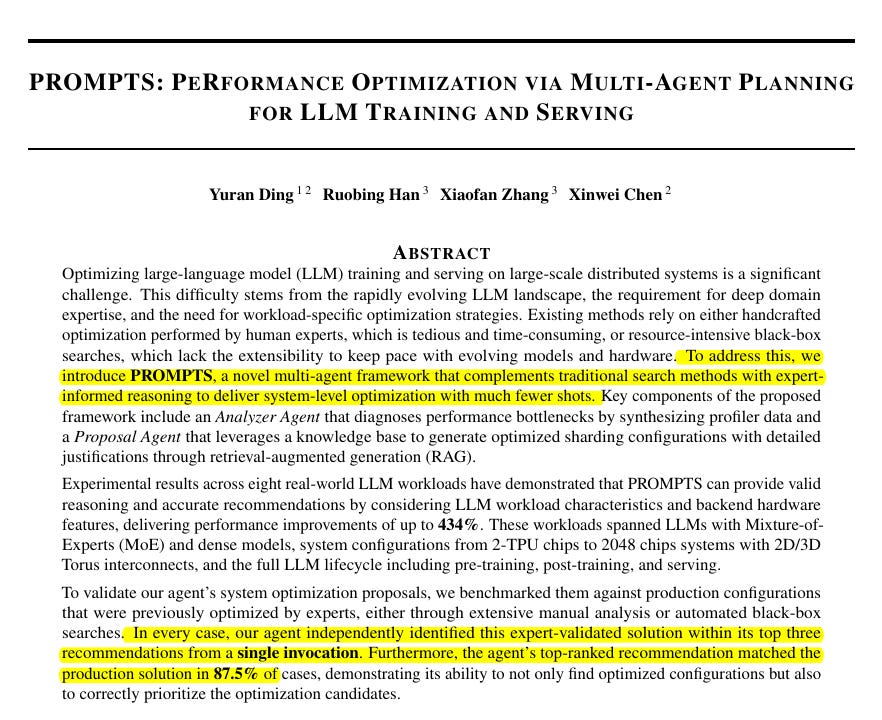
New Google paper shows LLM infrastructure optimization does not have to be a giant brute-force search if an agent can understand why the system is slow.
The key shift is from “search everything” to “understand the bottleneck, then search the tiny part that matters.” Instead of asking, “Which of these 100 configurations is fastest?”, this work asks, “What is actually causing the slowdown?” That one change dramatically shrinks the search.
Its Analyzer Agent reads profiler traces and classifies the bottleneck as compute, memory, or communication, then a Proposal Agent retrieves engineering knowledge and generates three targeted ways to map data, model, and sequence parallelism across TPU chips. Across eight production workloads spanning dense and MoE models, pre-training, post-training, serving, and TPU systems from 2 to 2,048 chips, the human-validated production configuration appeared in PROMPTS' first batch every time. In seven of eight cases, it was also the first configuration tested, and the agent's top-ranked proposal matched what engineers ultimately adopted in 87.5% of cases.
🗞️ SpaceXAI launched Grok Bot.
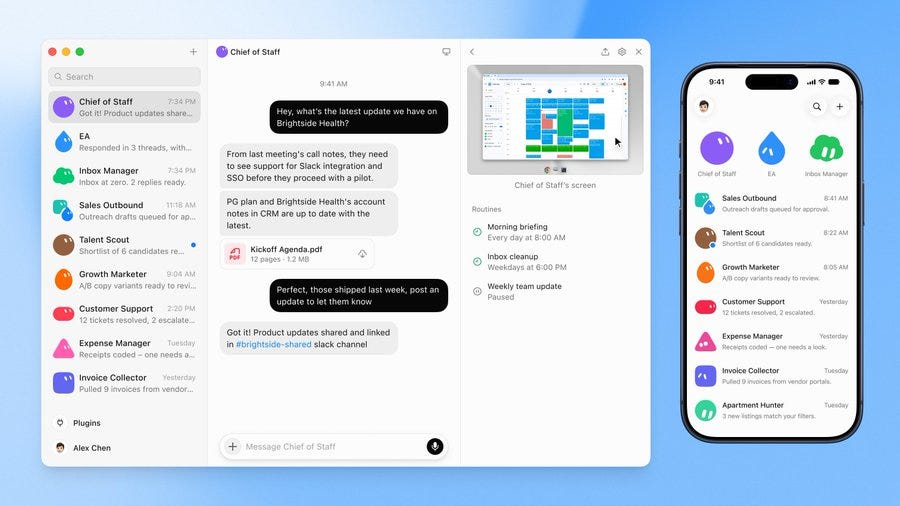
The biggest architectural shift is persistence, with cloud computers that keep working after the user steps away.
It can sign into websites and applications even when no clean API or MCP exists, putting agent actions inside the same software people use. Multiple Bots can message one another, share context, and hand work to specialists, including a manager Bot coordinating several jobs.
A Bot can also watch someone perform a workflow, save it as a routine, absorb corrections, and repeat the process later. The beta remains restricted to SuperGrok Heavy, Cursor Ultra, and Cursor Teams Premium users, while enterprise access is still waitlisted.
🗞️ How Claude marks AI-generated content
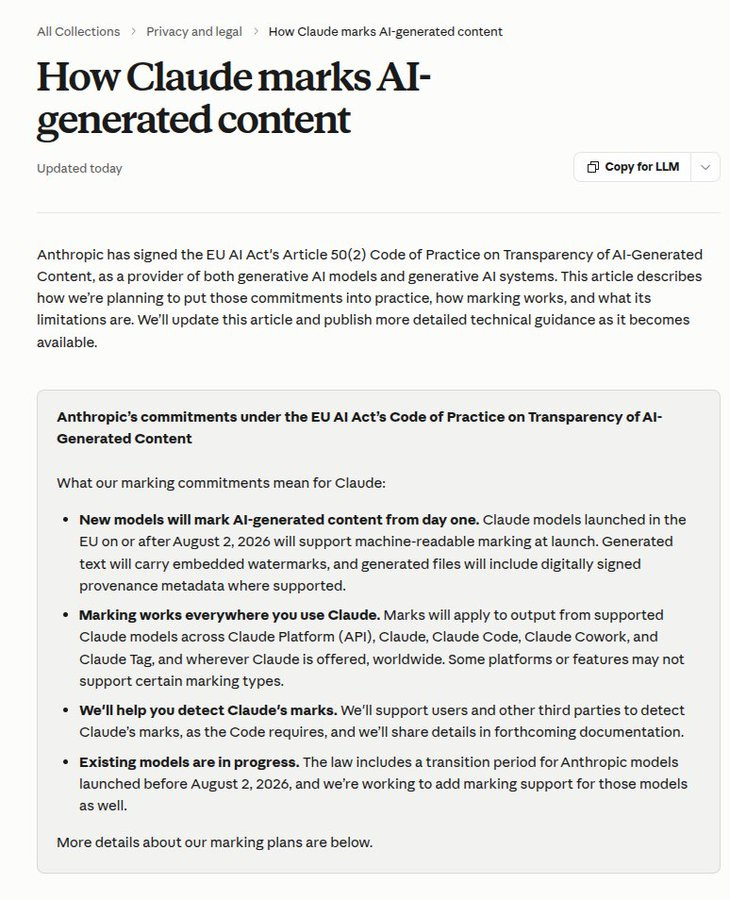
Anthropic is adding invisible watermarks to text from new Claude models.
Because marking happens at model level, supported outputs carry it across Claude products, the API, Claude Code, and major cloud platforms worldwide. The watermark is woven directly into generated text, allowing it to travel through copying and sometimes survive editing.
This is because, Anthropic signed the EU's voluntary Code of Practice on Transparency of AI-generated Content, whose measures help implement Article 50's legally binding marking requirement. Claude models launched in the EU on or after August 2, 2026 support marking at launch, with supported output marked worldwide.
Supported SVG, PNG, and JPG files use signed C2PA provenance metadata, which can indicate Claude processing and whether that metadata was altered. Anthropic's own detection support is still in development, with technical documentation forthcoming for users and third parties.
A detected mark cannot prove Claude originally authored the material, because Claude may have edited, translated, or summarized human-created content. Missing marks prove little either, since heavy rewriting, short passages, older models, unsupported surfaces, or stripped file metadata can erase the signal.
For publishers and platforms, the system adds useful provenance evidence.
Its practical value will depend on how resistant the text watermark is to paraphrasing once Anthropic publishes the detector and technical method.
🗞️ "ScientistOne: Towards Human-Level Autonomous Research via Chain-of-Evidence"
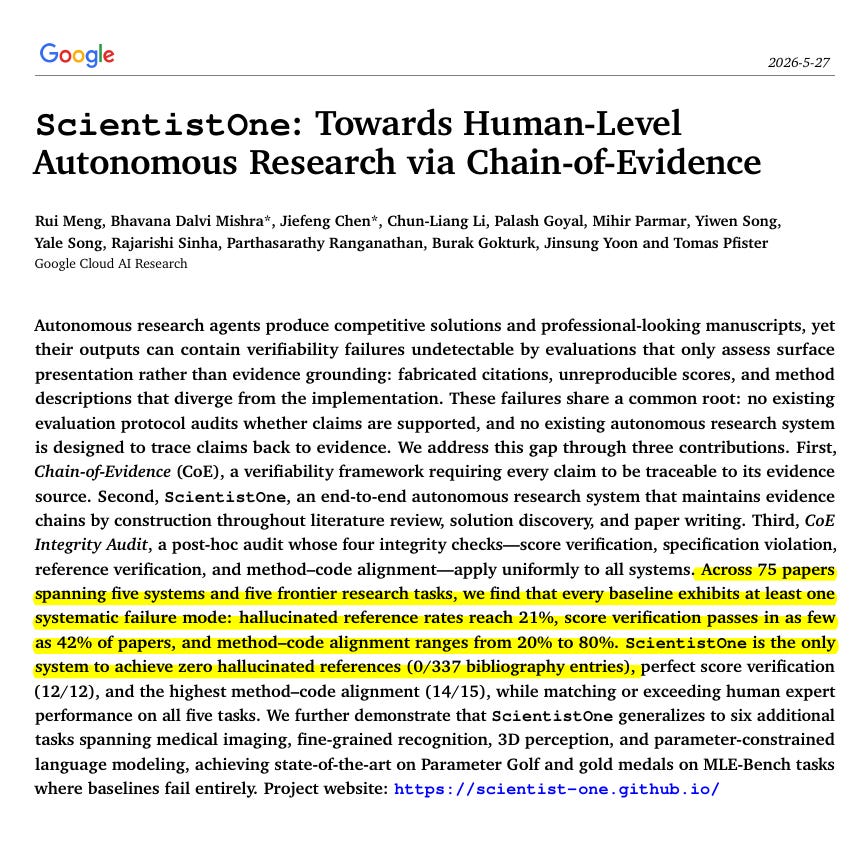
Google’s ScientistOne paper tackles a basic problem with AI-generated research:
The result can look credible even when its evidence chain is broken. AI research agents are getting good enough at solving benchmark problems that the new bottleneck is whether you can trust the paper they write afterward.
Google Cloud AI Research audited 75 papers from five autonomous research systems on five ADRS tasks, and every baseline showed at least one systematic evidence failure. Some fabricated citations, some reported scores that did not reproduce, and some described algorithms that were simply not in the submitted code.
ScientistOne attacks that gap with “Chain-of-Evidence”: citations must trace to retrieved papers, numerical claims to evaluator logs, and method claims to implementation artifacts before the manuscript is finalized.
That’s a wrap for today, see you all tomorrow.
The world should just boycott Musk, I don’t get how we’re still promoting his products.