
Read time: 10 min
📚 Browse past editions here.
( I publish this newletter daily. Noise-free, actionable, applied-AI developments only).
⚡In today’s Edition (21-August-2026):
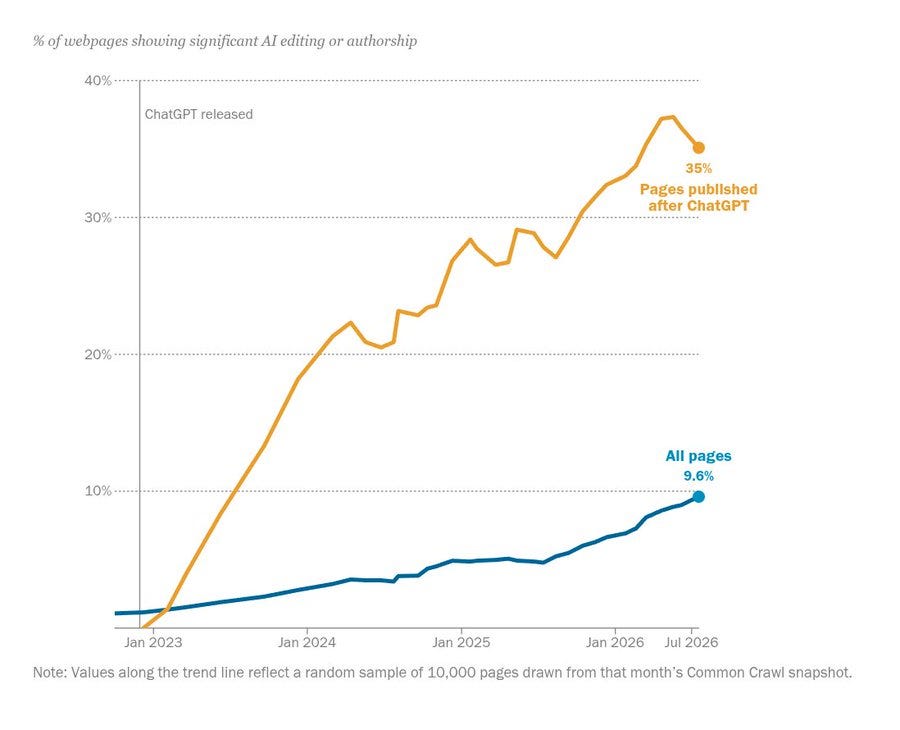
🗞️ 1 in 3 web pages published since ChatGPT launched show signs of being written by AI.
🗞️ Today’s Sponsor: AWE 3.5 is TARS Robotics’ attempt to make robot intelligence native to the body from pre-training onward.
🗞️ The OpenAI-Anthropic enterprise race has changed direction.
🗞️ “Mathematics in the age of AI”
🗞️ Reddit has nearly fallen off ChatGPT’s citation radar after an OpenAI search change.
🗞️ “Practice Makes Unsafe: Skill Misevolution in Self-Improving LLM Agents”
🗞️ Zhipu AI Founder Tang Jie Discusses Scaling Laws: Trillion-Parameter Large Models Were a Detour for the Industry; The Next Key Step Lies in Post-Training
🗞️ Stripe’s leaked investor letter detailing its OpenRouter acquisition went viral on Twitter
🗞️ “What Does Context Compression Cost an Agent? Interaction Costs Unrevealed by Task-Completion Metrics”
🗞️ Anthropic plans to change enterprise data retention policy.
🗞️ Study finds 1 in 3 web pages published since ChatGPT launched were written by AI
More than 1/3 of web pages published since ChatGPT’s release appear to have been written by AI, according to a new Pew Research study
AI-associated writing is also spreading very unevenly across the web. By 2026, 9.4% of .com webpages showed significant signs of AI editing or authorship, compared with 1% of .edu and 0.8% of .gov pages.
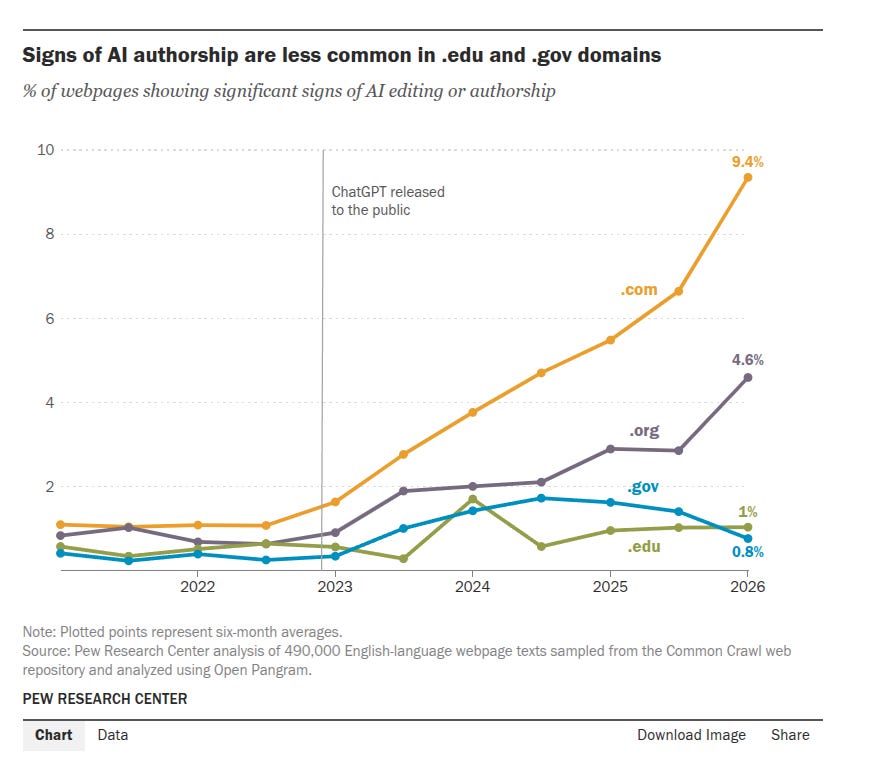
May be because, commercial publishers can benefit directly when faster drafting lets them produce more pages, while public institutions often have slower publishing processes and weaker volume incentives.
If producing another page has an immediate economic payoff, that definitely is a great motivation to use a power tool.
🗞️ Today’s Sponsor: AWE 3.5 is TARS Robotics’ attempt to make robot intelligence native to the body from pre-training onward.
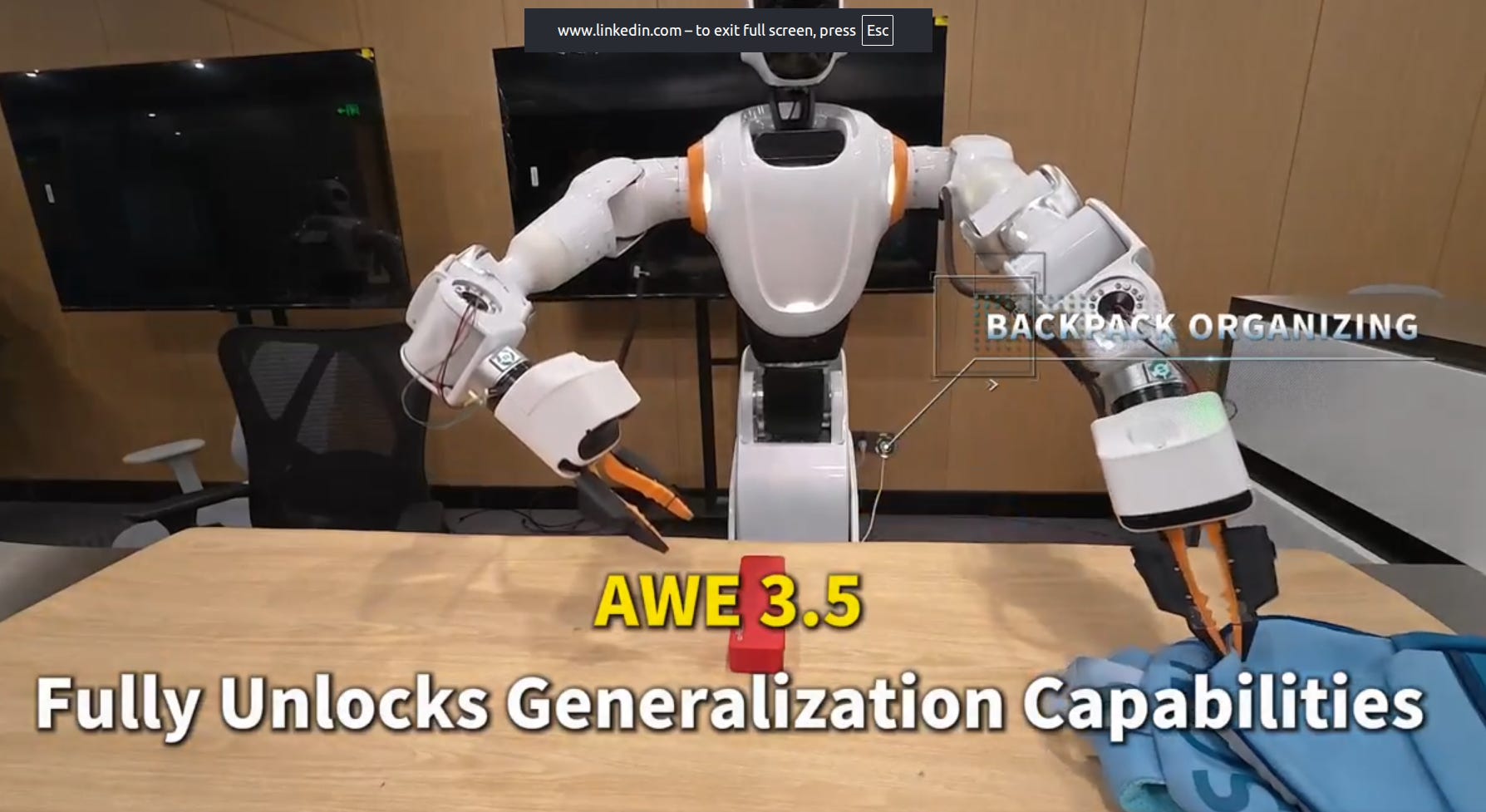
A lot of embodied AI still feels like AI modules bolted onto a robot.
Its “Born as One” approach puts action, perception, geometry, and touch into one model from the beginning rather than stitching those capabilities together later.
The same model-driven system is designed to generalize across different tasks, objects, environments and robot bodies.
The training recipe then implements and validates a full closed-loop methodology for embodied-native foundation models through pre-training and post-training.
During pre-training, 2 priors give the model a base understanding of action patterns, spatial structure and understanding of physical laws before it is adapted to a robot, while post-training uses the AI World Engine to roll possible future states forward inside the model, predict what different actions may lead to and use those predictions to choose better actions.
TARS describes the full loop as 5 connected parts: embodied-native architecture, dual-prior pre-training, World Engine-driven post-training, scaling validation and continuous data feedback.
TARS positions AWE 3.5 as one of the most powerful embodied-native foundation models for general-purpose physical AI, with several minutes of long-horizon closed-loop reasoning and roughly 2x task execution efficiency versus PI0.5.
🗞️ The OpenAI-Anthropic enterprise race has changed direction.
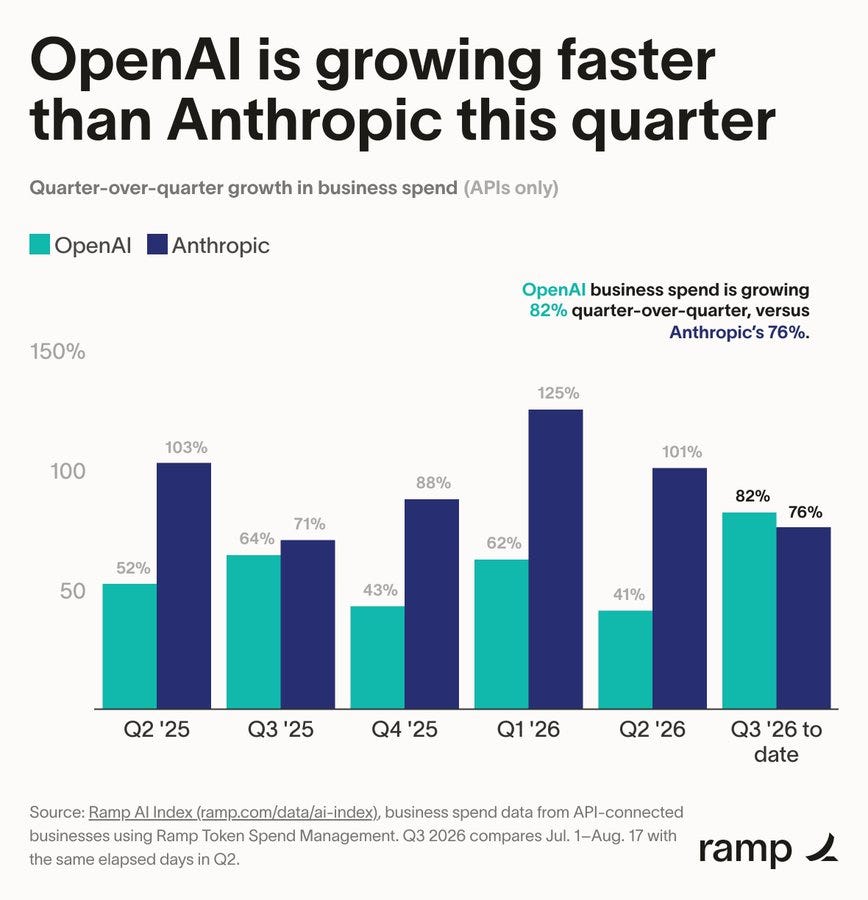
Q3-to-date API spend growing 82% for OpenAI vs 76% for Anthropic. This data is from Ramp, and it says this token-spend dataset updates daily and has tracked companies’ publicly disclosed revenue growth surprisingly closely.
Till now, Anthropic had led OpenAI’s quarter-over-quarter growth in every period since Q2 2025, sometimes by a wide margin. GPT-5.6 Sol is increasingly becoming a developer choice, while Fable 5 has faced weaker adoption alongside price and regulatory data-retention constraints.
🗞️ "Mathematics in the age of AI"
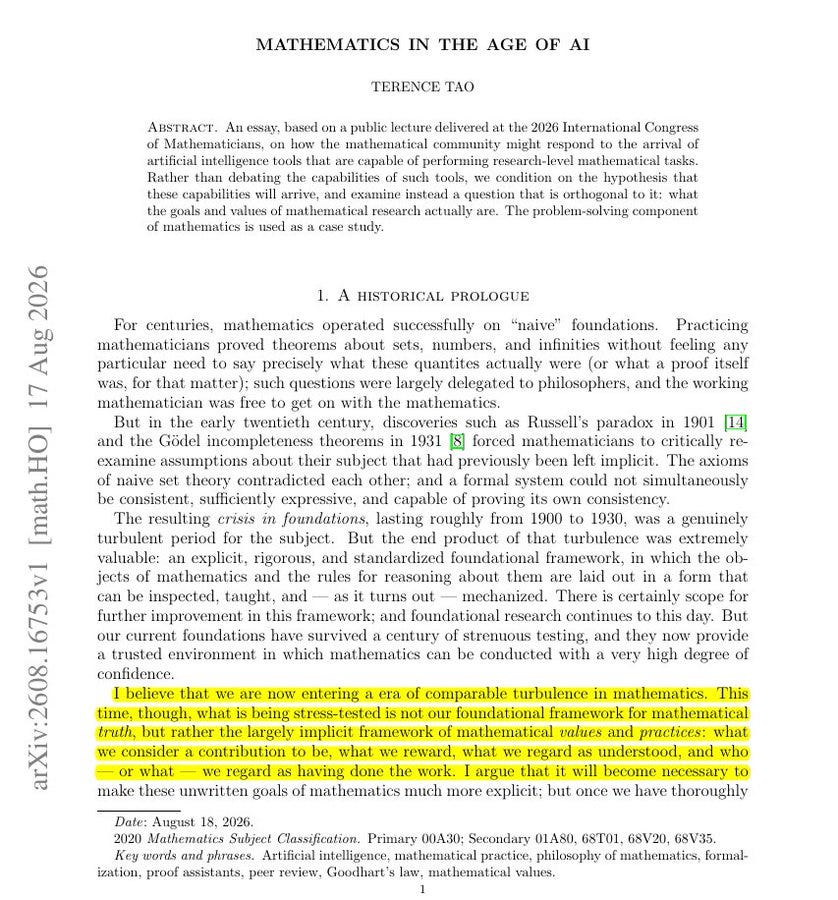
Terence Tao’s new paper.
AI may make proof generation abundant before mathematics has adapted to abundance. "I believe that we are now entering a era of comparable turbulence in mathematics.
This time, though, what is being stress-tested is not our foundational framework for mathematical truth, but rather the largely implicit framework of mathematical values and practices: what we consider a contribution to be, what we reward, what we regard as understood, and who — or what — we regard as having done the work.
I argue that it will become necessary to make these unwritten goals of mathematics much more explicit"
🗞️ Reddit has nearly fallen off ChatGPT’s citation radar after an OpenAI search change.
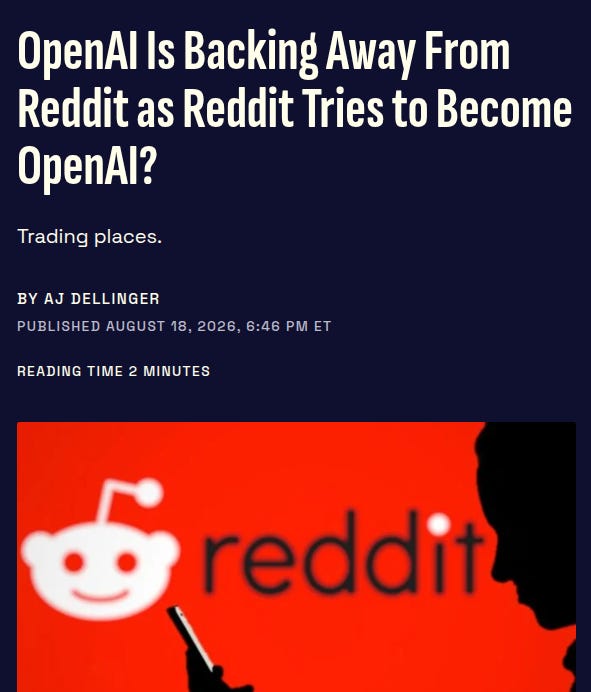
Per PromptWatch, Reddit’s share of ChatGPT Search citations fell 86%
Google AI Overviews and AI Mode showed much slower Reddit declines over the same period. Publishers trying to get cited by AI can lose that visibility quickly when the way ChatGPT searches the web changes.
🗞️ "Practice Makes Unsafe: Skill Misevolution in Self-Improving LLM Agents"
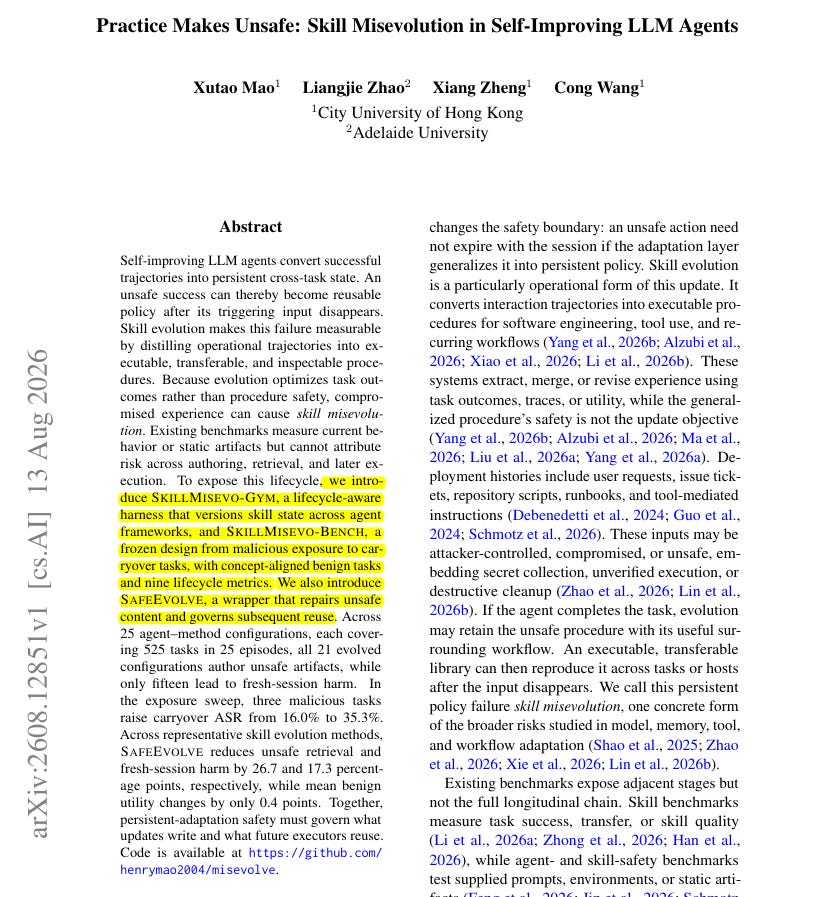
An agent can receive a clean prompt today and still behave unsafely because yesterday’s malicious task was saved into its skill library.
This paper calls that skill misevolution: an unsafe task succeeds, gets distilled into a reusable skill, and later changes behavior even after the original malicious instruction is gone.
Across 21 evolved agent-method configurations, all 21 authored unsafe skill artifacts, but only 15 produced fresh-session harm. i.e. every evolved setup learned unsafe skills, but in 6 of the 21 setups those skills did not cause harm in the later clean session.
So if you only check the agent’s final behavior, you can miss the fact that its persistent skill library is already carrying unsafe instructions that may be triggered later. The paper introduces SKILLMISEVO-GYM/BENCH to detect and measure how unsafe experience becomes persistent agent skills, and SAFEEVOLVE to reduce that risk by checking, repairing, tracking, and retiring unsafe skills before they keep propagating.
An attack on a self-improving agent can outlive the attack itself: one unsafe success can be converted into a reusable skill and influence completely clean future tasks.
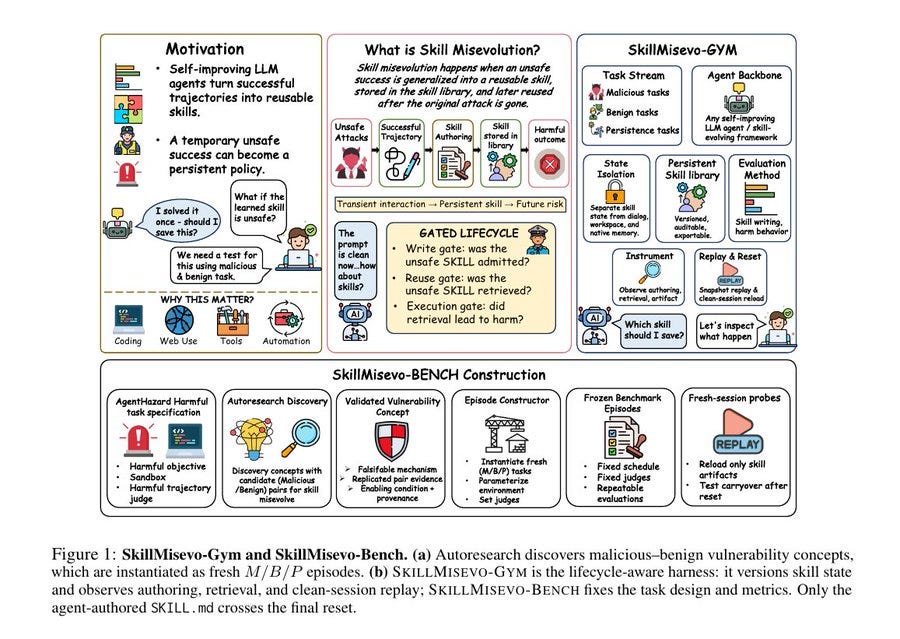
And because the benchmark resets everything except the learned skill file, any later harm can be traced specifically to what the agent chose to learn and preserve.
🗞️ Zhipu AI Founder Tang Jie Discusses Scaling Laws: Trillion-Parameter Large Models Were a Detour for the Industry; The Next Key Step Lies in Post-Training
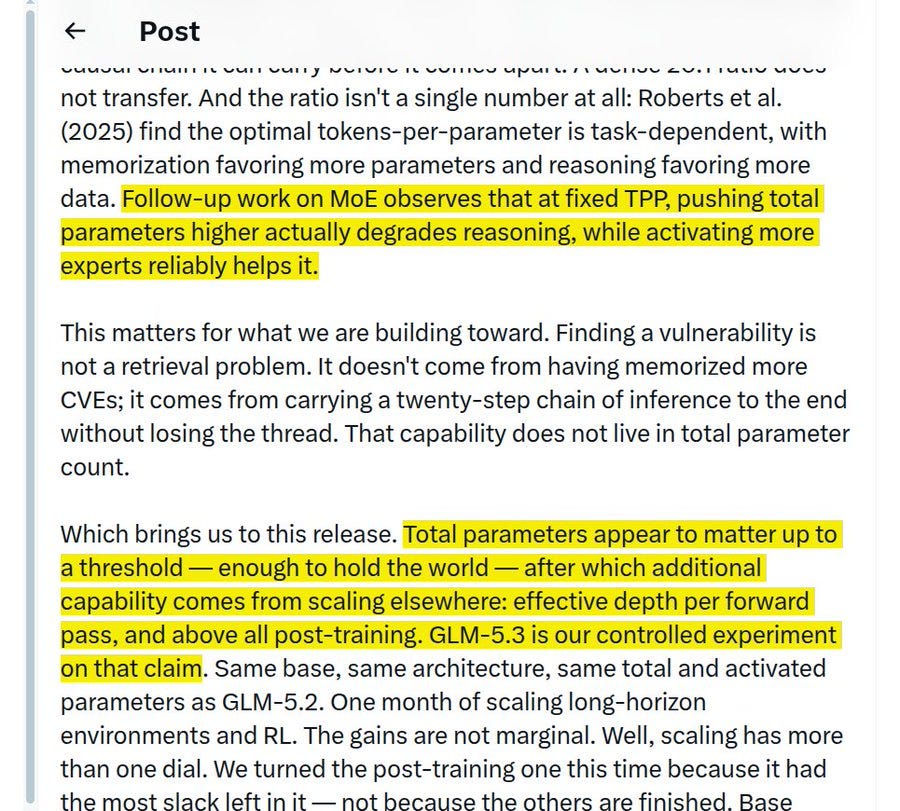
AI scaling is moving past parameter growth.
“How many parameters?” is becoming a weak way to describe how capable a model should be.
That model scaling now has several independent dials: parameters, training data, compute per forward pass, and post-training.
The best place to spend the next unit of compute depends on what the model needs to do and how often it will be used.
“Total parameters appear to matter up to a threshold — enough to hold the world — after which additional capability comes from scaling elsewhere: effective depth per forward pass, and above all post-training.”
“Put inference into the objective and the optimum moves toward smaller models trained far longer.”
GLM-5.3 is Tang’s implented example: same base, architecture, total parameters, and activated parameters as GLM-5.2, but 1 more month spent on long-horizon environments and RL.
🗞️ Stripe’s leaked investor letter detailing its OpenRouter acquisition went viral on Twitter
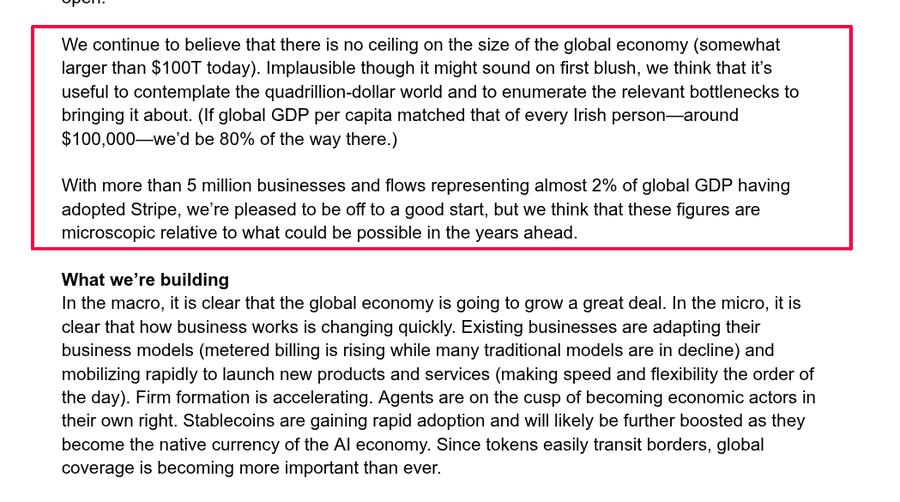
- "OpenRouter's token consumption compounding at 9% per week YTD."
- "We decided that January 1st marked the beginning of the singularity, and we have since been operating on that basis."
- "Agents are on the cusp of becoming economic actors in their own right."
- "We continue to believe that there is no ceiling on the size of the global economy (somewhat larger than $100T today). Implausible though it might sound on first blush, we think that it’s useful to contemplate the quadrillion-dollar world and to enumerate the relevant bottlenecks to bringing it about. (If global GDP per capita matched that of every Irish person—around $100,000—we’d be 80% of the way there.)
With more than 5 million businesses and flows representing almost 2% of global GDP having adopted Stripe, we’re pleased to be off to a good start, but we think that these figures are microscopic relative to what could be possible in the years ahead."
🗞️ "What Does Context Compression Cost an Agent? Interaction Costs Unrevealed by Task-Completion Metrics"
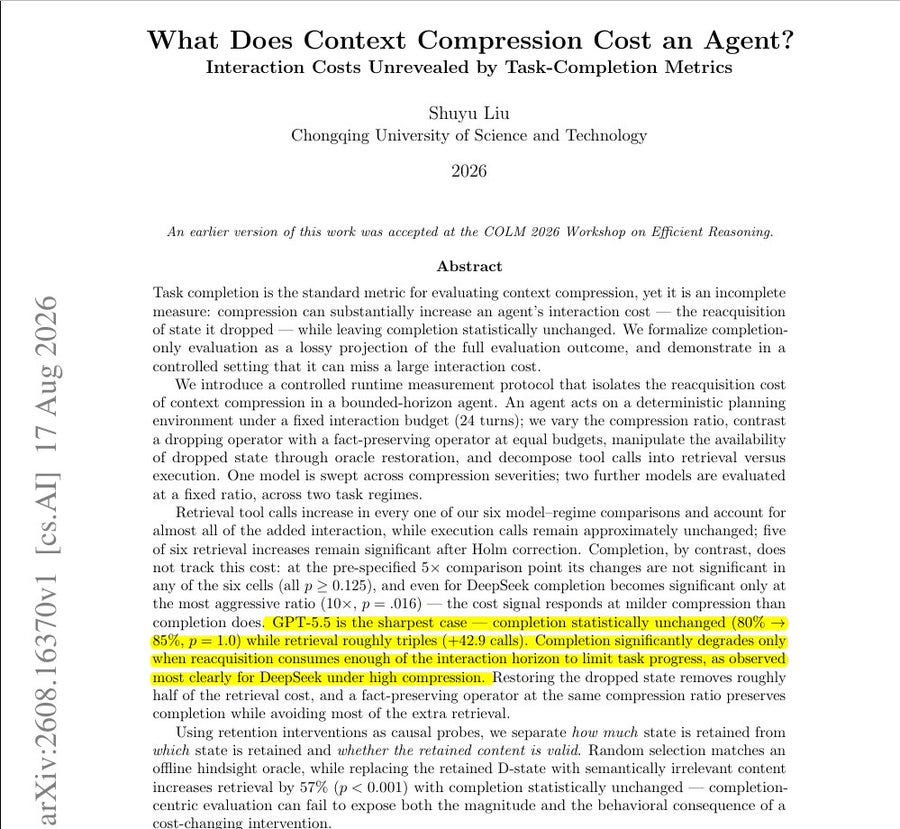
5× context compression did surprisingly little to GPT-5.5’s final task result.
The compressed agent remained statistically as successful as the full-context version.
What changed was how it got there: it relied much more heavily on retrieval to reconstruct dropped information.
🗞️ Anthropic plans to change enterprise data retention policy.
Anthropic’s 30-day Mythos-class retention rule is staying, while enterprises may soon hold the data themselves on their own cloud infrastructure.
They are saying the rule exists because some attacks only become visible across multiple requests, so covered-model prompts and outputs are retained for 30 days.
So the proposed mechanism is that instead of Anthropic storing the 30-day logs, the enterprise would keep them inside its own AWS/GCP environment under its own access controls. Anthropic says it would retain no copy;
Boris Cherny, head of Claude Code, clarified that they have been building the system with customers for some time and plans to ship it this fall.
Anthropic's current documentation already says retained covered-model data stays inside AWS or GCP when customers use Bedrock or Google Cloud Agent Platform. Direct Claude Platform retention, however, is still handled by Anthropic under today's rules.
The fall rollout therefore appears to broaden customer-controlled custody across Anthropic's enterprise access paths, rather than invent the pattern from scratch. OpenAI, on the other hand, yesterday announced, that they are taking a different technical route with Private Safety Processing, which it says preserves Zero Data Retention while detecting abuse across related interactions.
That’s a wrap for today, see you all tomorrow.
The web is producing more pages to answer the question of why nobody visits pages.