
Read time: 7 min
📚 Browse past editions here.
( I publish this newletter daily. Noise-free, actionable, applied-AI developments only).
⚡In today’s Edition (16-August-2026):
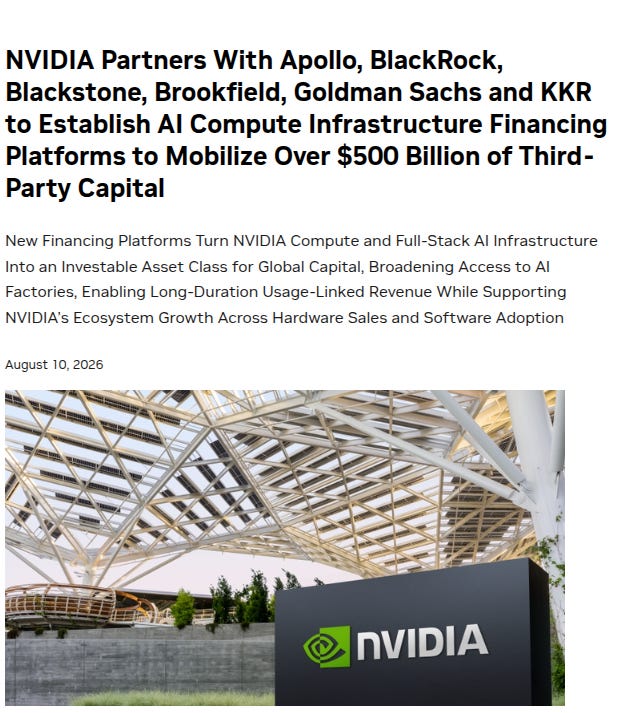
🗞️ Wall Street heavyweights pour $500 B into Nvidia’s AI push
🗞️ Anthropic is targeting a September or early-October IPO, before OpenAI, whose IPO may now come as late as next year.
🗞️ Nvidia made a very smart move by partnering with 6 large Wall Street investors to create a financing platforms that lend against its chips.
🗞️ Anthropic CEO Dario Amodei says the backlash against AI is “fundamentally a crisis of trust.”
🗞️ “Reason Wide, Not Deep: Amortizing the Reasoning Premium into Distilled Skills”
🗞️”Model or Harness? An Interaction-Centric Taxonomy for Localizing Agent Failures”
🗞️ “Skaling: Chinchilla’s Exponents Meet Kaplan’s Coupling”
🗞️ “Sample More, Reflect Less: Self-Refine and Reflexion Lose to Repeated Sampling at Equal Token Cost, from 1.5B to 7B”
🗞️ Wall Street heavyweights pour $500B into Nvidia’s AI push
Apollo, BlackRock, Blackstone, Brookfield, Goldman Sachs and KKR signed MOUs to create dedicated capital pools intended to offer NVIDIA customers attractive financing rates.
- Goldman Sachs explicitly described the opportunity as a market for credit backed by NVIDIA compute, turning GPU capacity into an asset lenders can underwrite.
- Jensen Huang said NVIDIA itself can backstop up to $125B, or 25% of potential deals, so third-party capital does not necessarily mean zero NVIDIA exposure.
- This follows NVIDIA's July credit-support and revenue-sharing model for AI clouds, where it can earn hardware revenue and a share of cloud revenue from supported capacity.
- Long-duration financing assumes those GPU fleets keep producing enough economic value as hardware generations change, while the Bank of England has already warned that rapidly expanding AI credit could transmit shocks through financing markets.
Nvidia is also deepening its ties with major private capital firms, which are gearing up to pour trillions of dollars from insurance, retail and institutional investors into AI infrastructure. Groups including Apollo and Blackstone have recently structured AI infrastructure deals to help companies such as Anthropic cover huge chip and data centre costs. They have also created multibillion-dollar, investment-grade financing structures for firms including Meta and Intel that remain outside their corporate balance sheets.
What this all means for Nvidia and the others
Once Wall Street accepts GPUs as recoverable collateral, Nvidia can gain an advantage that has nothing to do with FLOPS or benchmark scores.
The new structures are explicitly aimed at buyers whose balance sheets cannot fund the buildout alone, while institutional capital can place debt against Nvidia equipment. Hardware shipments can therefore stay strong even while the underlying operators remain financially weak.
The “circular financing” criticism is not fully correct in this case, that is too broad unless Nvidia ends up carrying most of the credit risk itself. But the proposed platforms are meant to mobilize more than $500B of third-party capital, with independent financiers underwriting projects, although Nvidia can backstop up to 25% of potential deals. That makes the better comparison equipment finance rather than vendor buying its own output.
The boundary to watch is how much loss ultimately returns to Nvidia when borrowers fail.
🗞️ Anthropic is targeting a September or early-October IPO, before OpenAI, whose IPO may now come as late as next year.
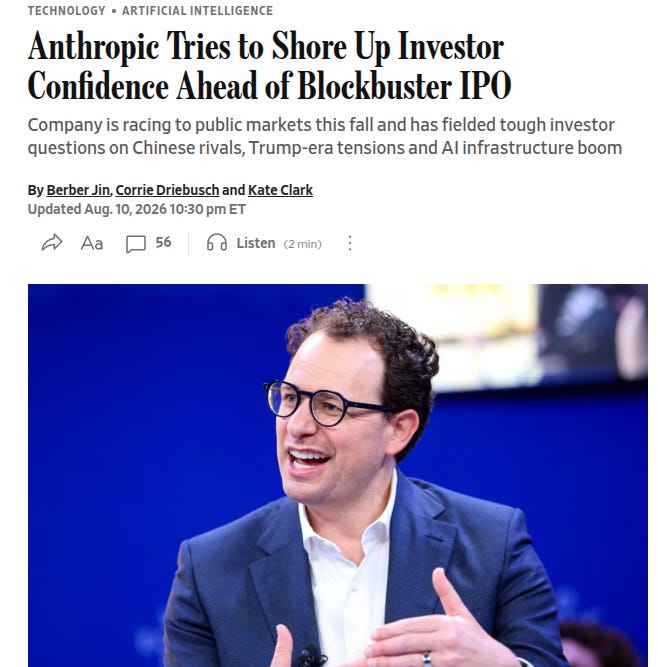
- Potential investors are already pressing Anthropic on cheaper Chinese AI models, tensions with the Trump administration, and growing opposition to data-center construction.
- Anthropic executives have reportedly downplayed Chinese competition by arguing that users still prefer the most capable models, while Chinese systems generally trail leading U.S. models by several months.
- Anthropic plans to push further into healthcare and biology, partly because those applications could help counter growing negative sentiment around AI.
- Claude Code has become the engine behind Anthropic's recent surge, with run-rate revenue exceeding $47B in May.
- Demand has been strong enough that Anthropic has suffered intermittent outages even after signing additional compute deals with SpaceX and Google.
🗞️ Nvidia made a very smart move by partnering with 6 large Wall Street investors to create a financing platforms that lend against its chips.

Wall Street Journal published a very interesting piece on this major development.
Nvidia's revenue depends on customers being able to pay for chips most cannot buy with cash. The large tech firms can; the smaller AI labs, clouds and enterprises behind the rest of the demand have to borrow, and their costs have risen as investment-grade issuers absorb the available credit.
CoreWeave paid yields above 9% this month, showing what AI borrowers now pay for compute. If they cannot finance purchases, orders slow even though demand exists.
The earlier fix was Nvidia's own balance sheet, through investments in customers and guarantees on their debt, which drew criticism as circular funding. So routing capital through outside asset managers replaces Nvidia's money with pension, insurance and sovereign-fund money, and moves credit decisions elsewhere.
Jensen Huang says Nvidia may backstop 25% of a project's cost through residual-value support. That 25% residual-value support is what gets that money moving.
Investors are lending against hardware whose resale value depends on how fast Nvidia's next generation arrives, the one variable they cannot price and Nvidia controls. Guaranteeing a floor covers exactly that risk, which is why skeptics still see circularity in a thinner form.
🗞️ Anthropic CEO Dario Amodei says the backlash against AI is “fundamentally a crisis of trust.”
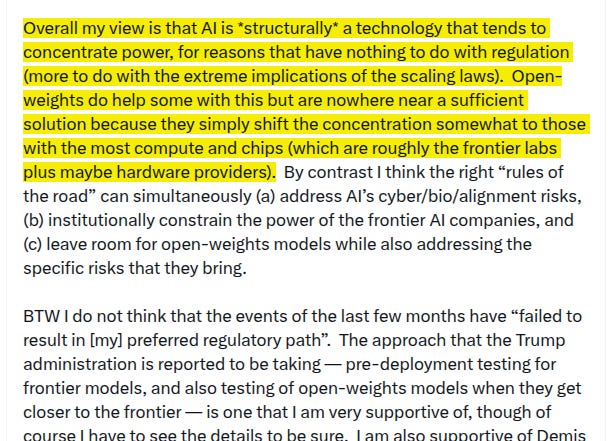
In a long and super viral post on X on Saturday, a rare move for someone who usually avoids social media, he began with AI regulation, rejecting the choice between concerns about regulatory capture and concentrated power and the belief that broadly available AI, including open models, is the best safeguard.
- Predics that AI could help cure most human disease within roughly 5–10 years.
- says AI is structurally prone to concentrating power, even without regulation.
- He wants regulation designed to slow frontier AI labs while giving smaller challengers more room to catch up.
- Argues open-weight AI does not solve concentration, because even with open-source serious capability still depends on scarce compute and chips.
- He supports pre-deployment testing of frontier models, with open-weight models tested too once they approach frontier capability
- Says AI companies will not win public trust through better marketing. They need to deliver undeniable real-world breakthroughs first.
So now he just tied public trust to visible medical outcomes of AI, looks like Anthropic’s biology push is for real.
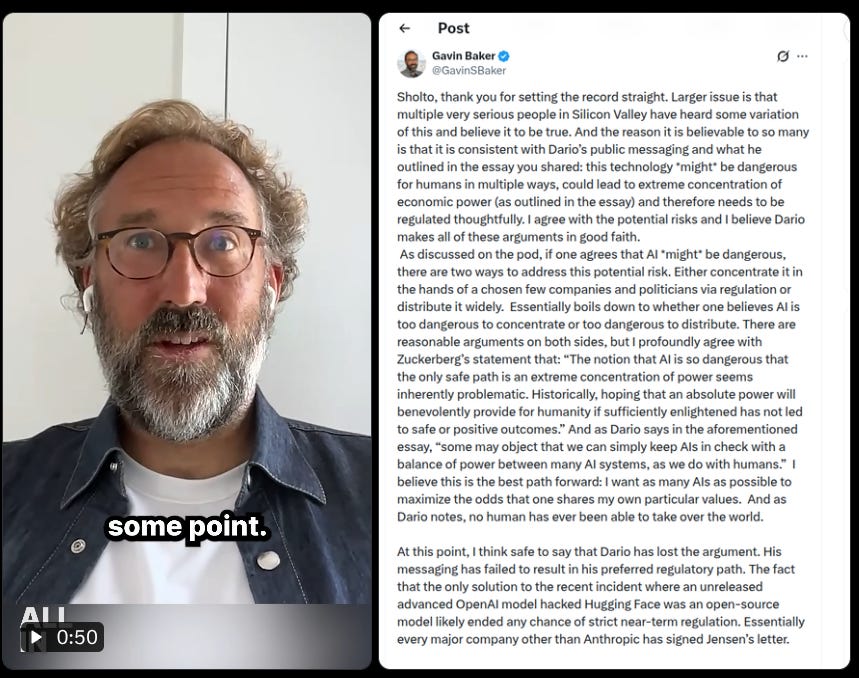
All these started when hedge fund founder Gavin Baker publicly said.
“Internally, Anthropic is very confident...that Dario has said that Anthropic might be the only private company in the world at some point. In this vision, there’s Anthropic, and then there are governments, and that’s it.”
🗞️ "Reason Wide, Not Deep: Amortizing the Reasoning Premium into Distilled Skills"
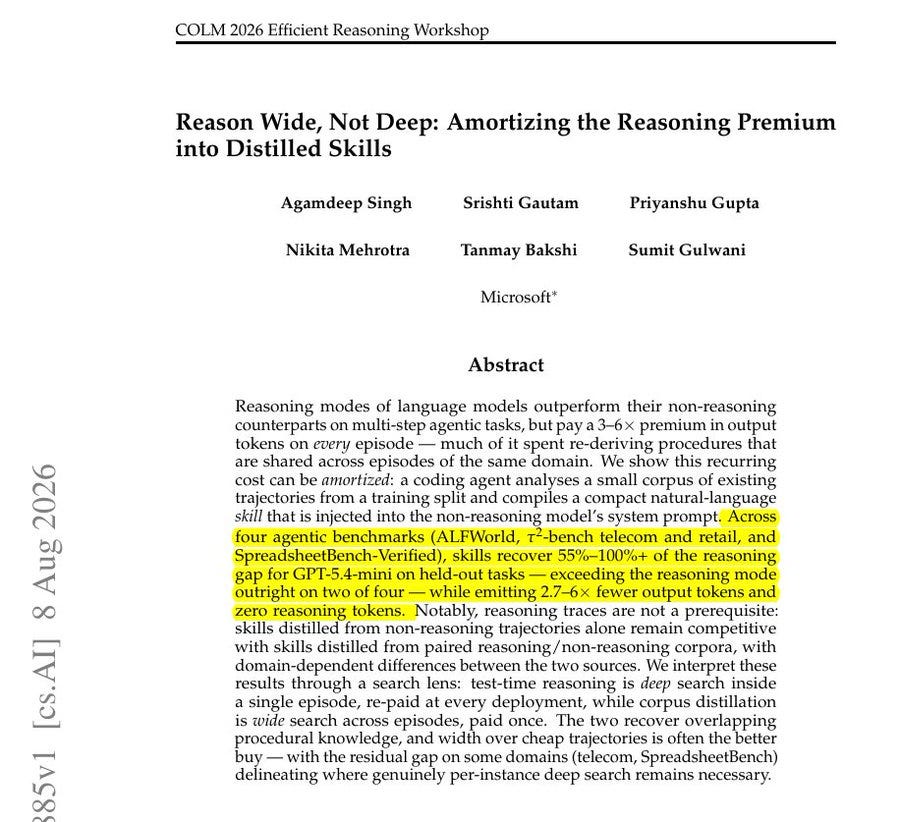
What if you could pay the reasoning cost once, then reuse what the model learned across future tasks?
New Microsoft paper finds that some expensive test-time reasoning can be replaced with a small set of rules learned from previous agent runs.
The paper tests a cheaper alternative: collect 35–50 past trajectories, have a coding agent extract recurring failure patterns, then turn those patterns into a small markdown skill added to the non-reasoning model’s system prompt.
For GPT-5.4-mini, those skills recovered 55%–100%+ of the gap between non-reasoning and reasoning modes across 4 agent benchmarks, while using 2.9–4.5× fewer output tokens than reasoning. On ALFWorld and τ²-retail, the skilled non-reasoning model actually beat the reasoning mode.
The useful part is that the distiller did not need reasoning traces: skills built only from cheap non-reasoning rollouts were competitive across all 4 domains.
The limit is equally useful: reasoning still won on telecom and SpreadsheetBench, where each task contains more instance-specific dependencies that a fixed skill cannot capture.
So the practical split is: distill repeated procedures once, then reserve expensive test-time reasoning for the tasks that genuinely need fresh search.
🗞️"Model or Harness? An Interaction-Centric Taxonomy for Localizing Agent Failures"
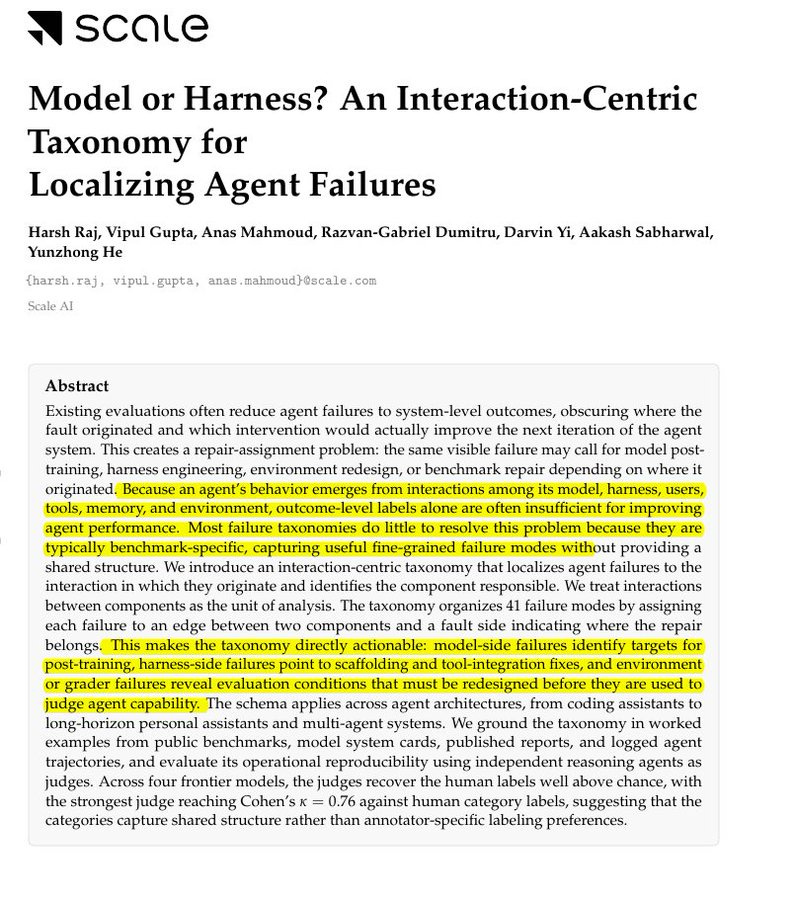
When an AI agent fails, blaming the model can send you to the wrong fix.
This Scale AI paper argues that agent debugging should start by asking where the first unrecovered failure happened: in the model, context, memory, tool layer, another agent, grader, or environment.
That matters because the same visible mistake can have different causes.
An ignored instruction might mean the model saw it and failed to follow it, or the harness dropped it during context compaction. The paper organizes 41 failure modes around these interactions, tagging each by both the interaction and the side at fault.
It tests the taxonomy on 40 worked examples. GPT-5.5 matched human category labels with 80% accuracy and Cohen’s κ of 0.76.
Using 4 judges together pushes category precision to 96% when all 4 agree, although coverage falls to 68%.
For agent teams, the practical shift is simple: trace the failure back to the component that broke first, then decide whether to retrain the model, fix the harness, or repair the environment.
🗞️ "Skaling: Chinchilla's Exponents Meet Kaplan's Coupling"
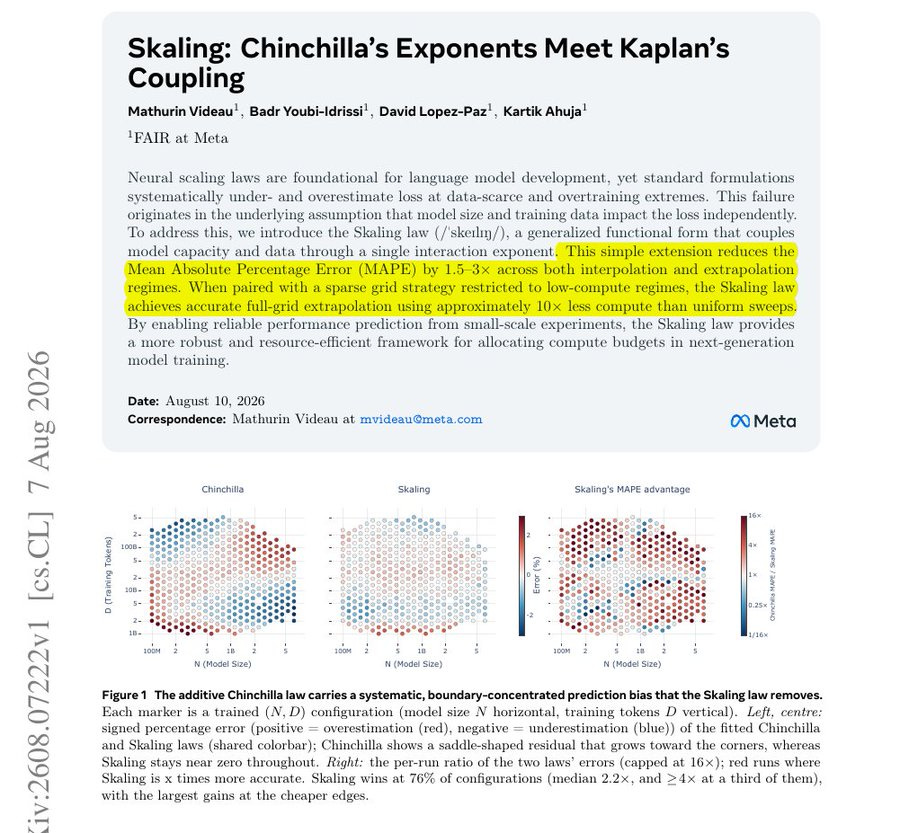
A new Meta FAIR paper finds a blind spot in the Chinchilla scaling law that becomes expensive when you extrapolate.
Chinchilla can look almost perfect inside a training grid and still mispredict what happens at the frontier.
The problem is: Chinchilla assumes model size and training data help separately, but the experiments show that each changes how useful the other one is.
Skaling adds just 1 extra term to capture that connection, cutting prediction error by about 1.5–3× and getting full-grid Chinchilla-level prediction accuracy with roughly 10× less profiling compute.
On Farseer, the difference becomes huge at frontier scale: at 2×10^25 FLOPs, Chinchilla points to ~380 tokens per parameter, while Skaling and the paper's direct estimates land around 20–40.
🗞️ "Sample More, Reflect Less: Self-Refine and Reflexion Lose to Repeated Sampling at Equal Token Cost, from 1.5B to 7B"
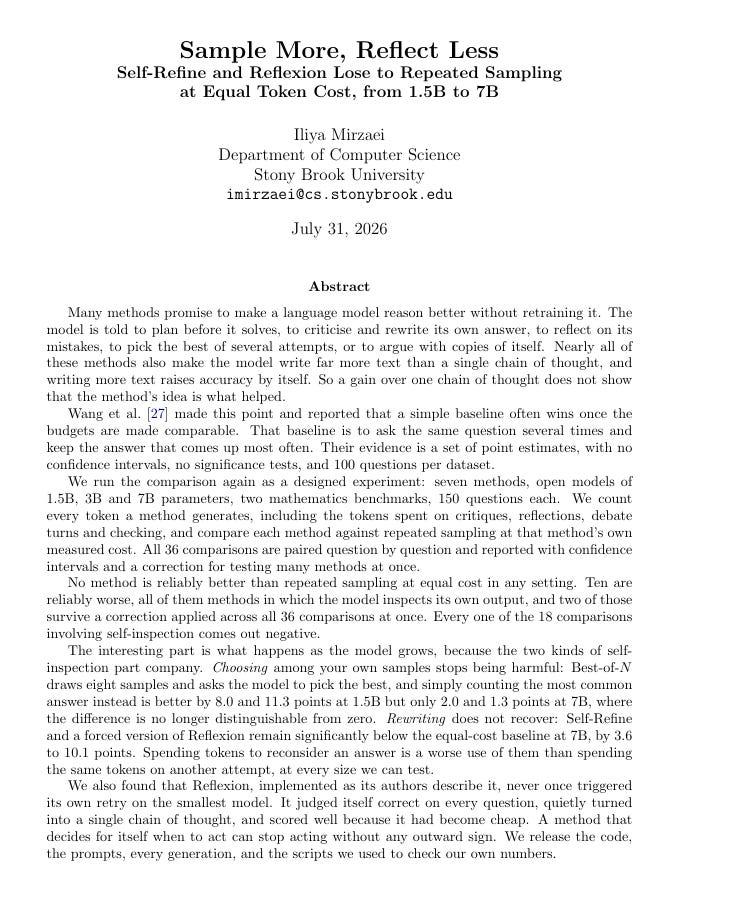
If you're spending extra tokens making an LLM critique itself, this paper says a simpler move can be better: just let it try again.
Before you make an LLM reflect on its answer, try giving it another independent attempt.
The study compares 7 test-time reasoning methods on Qwen2.5 models from 1.5B to 7B, then asks a fairer question: what happens if repeated sampling gets the same token budget?
Repeated sampling means solving the same math problem several times and taking the answer that shows up most often. Across 36 comparisons, none of the more elaborate methods reliably beat that baseline at equal generated-token cost; 10 were significantly worse.
For checkable reasoning, extra tokens may be better spent creating independent attempts than asking the model to reconsider its own work.
Ofcouse, study boundary matters: this is Qwen2.5 on math, not frontier models or open-ended tasks.
That’s a wrap for today, see you all tomorrow.